
[Paper Review] Observational Parameters of Blue Large-amplitude Pulsators
This study presents comprehensive photometric and spectroscopic analysis of Blue Large-Amplitude Pulsators (BLAPs), revealing their period–gravity and period–luminosity relationships, identifying a bimodal helium abundance distribution, and confirming their stability over decades. The key contribution is the first derivation of a period–luminosity relation for Z-bump pulsators, enabling future distance measurements and membership verification in stellar systems.
Blue large-amplitude pulsators (BLAPs) are a recently discovered class of short-period pulsating variable stars. In this work, we present new information on these stars based on photometric and spectroscopic data obtained for known and new objects detected by the Optical Gravitational Lensing Experiment (OGLE) survey. BLAPs are evolved objects with pulsation periods in the range of 3-75 minutes, stretching between subdwarf B-type stars and upper main-sequence stars in the Hertzsprung-Russell diagram. In general, BLAPs are single-mode stars pulsating in the fundamental radial mode. Their phase-folded light curves are typically sawtooth-shaped, but many longer-period objects exhibit an additional bump. The long-term OGLE observations show that the period change rates of BLAPs are usually of the order of $10^{-7}$ yr$^{-1}$ and in a quarter of the sample are negative. The spectroscopic data indicate that the BLAPs form a homogeneous group in the period, surface gravity, and effective temperature spaces. However, we observe a split into two groups in terms of helium-to-hydrogen content. The atmospheres of the He-enriched BLAPs are more abundant in metals (about 5 times) than the atmosphere of the Sun. We discover that BLAPs obey a period--gravity relationship and we use the distance to OGLE-BLAP-009 to derive a period--luminosity relation. Most of the stars observed in the OGLE Galactic bulge fields seem to reside in the bulge, while the remaining objects likely are in the foreground Galactic disk.
Motivation & Objective
- To characterize the observational parameters of Blue Large-Amplitude Pulsators (BLAPs) using long-term photometric and spectroscopic data.
- To determine the pulsation mode, period change rates, and light curve morphology of BLAPs across different periods.
- To investigate the atmospheric composition, particularly helium-to-hydrogen ratios, and its correlation with pulsation properties.
- To establish a period–luminosity relation for BLAPs, a critical tool for distance estimation and membership determination in stellar systems.
- To clarify the spatial distribution of BLAPs in the Milky Way, distinguishing between bulge and disk populations.
Proposed method
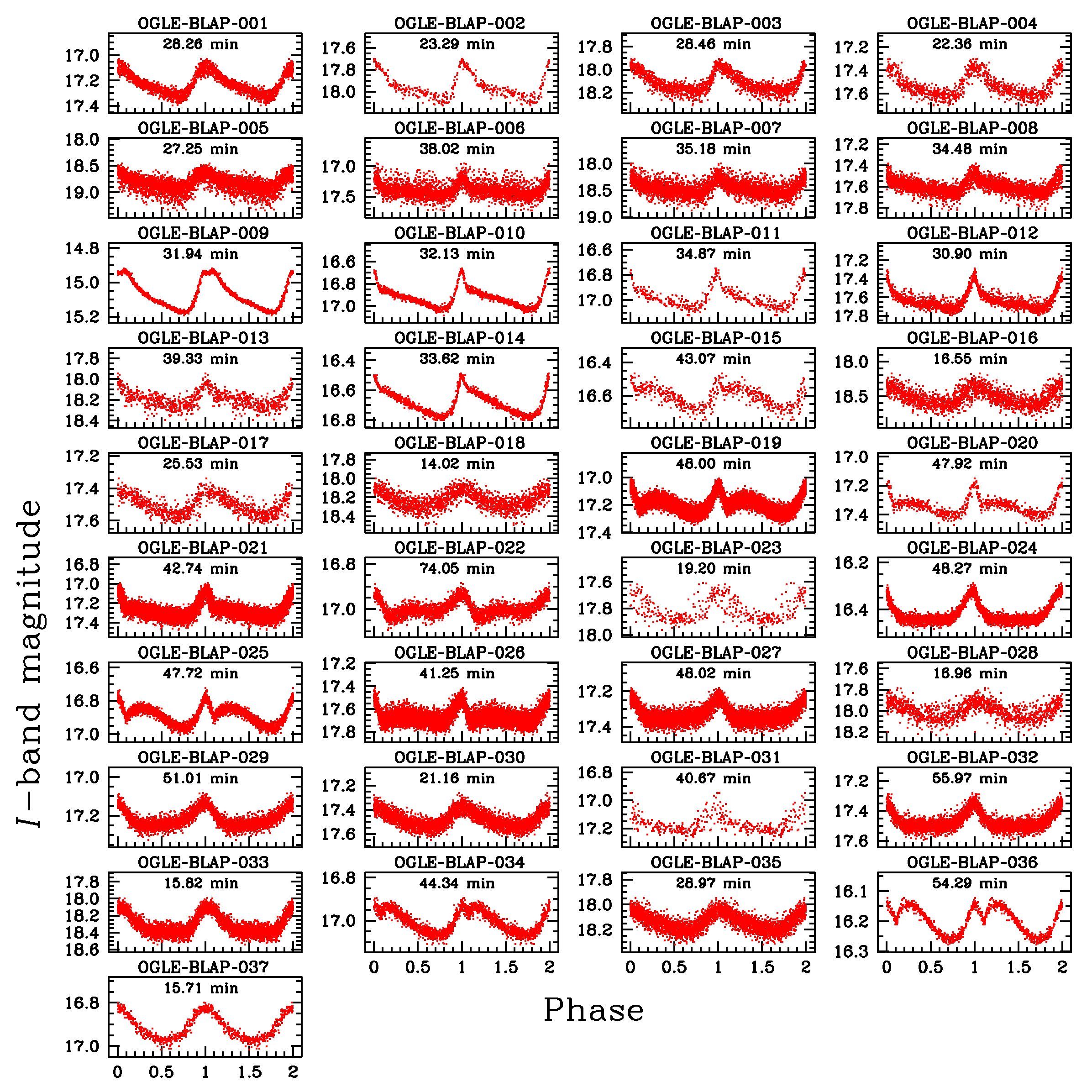
- Utilized long-term photometric data from the 1.3-m Warsaw telescope (OGLE survey) to measure pulsation periods, amplitudes, and period change rates over decades.
- Applied spectroscopic analysis using the 6.5-m Magellan-Baade telescope to determine effective temperatures, surface gravities, and atmospheric abundances (including He/H ratios).
- Constructed phase-folded light curves to classify pulsation morphology, identifying sawtooth, symmetric, and bump-modified shapes based on period.
- Derived a period–gravity relationship by fitting pulsation periods to surface gravity values across the sample.
- Used the distance to OGLE-BLAP-009 (2.2 ± 0.2 kpc) to calibrate the first period–luminosity relation for BLAPs.
- Classified BLAPs into two groups based on helium abundance: He-rich (log(N_He/N_H) ≈ -0.5 dex) and He-poor (log(N_He/N_H) < -2 dex), with period-dependent trends.
Experimental results
Research questions
- RQ1Do BLAPs follow a period–gravity relationship, and can it be used to infer physical parameters such as mass and radius?
- RQ2Is there a period–luminosity relation for BLAPs, and can it be calibrated using known distances?
- RQ3What is the distribution of helium-to-hydrogen abundance in BLAP atmospheres, and how does it correlate with pulsation period and temperature?
- RQ4What are the long-term period change rates of BLAPs, and what do they imply about their evolutionary state?
- RQ5Are BLAPs predominantly located in the Galactic bulge or disk, and how does this inform their origin and evolution?
Key findings
- BLAPs exhibit a linear period–gravity relationship, confirming their status as single-mode radial pulsators with consistent structural parameters.
- The first period–luminosity relation for Z-bump pulsators was derived using the distance to OGLE-BLAP-009 (2.2 ± 0.2 kpc), enabling future distance estimates.
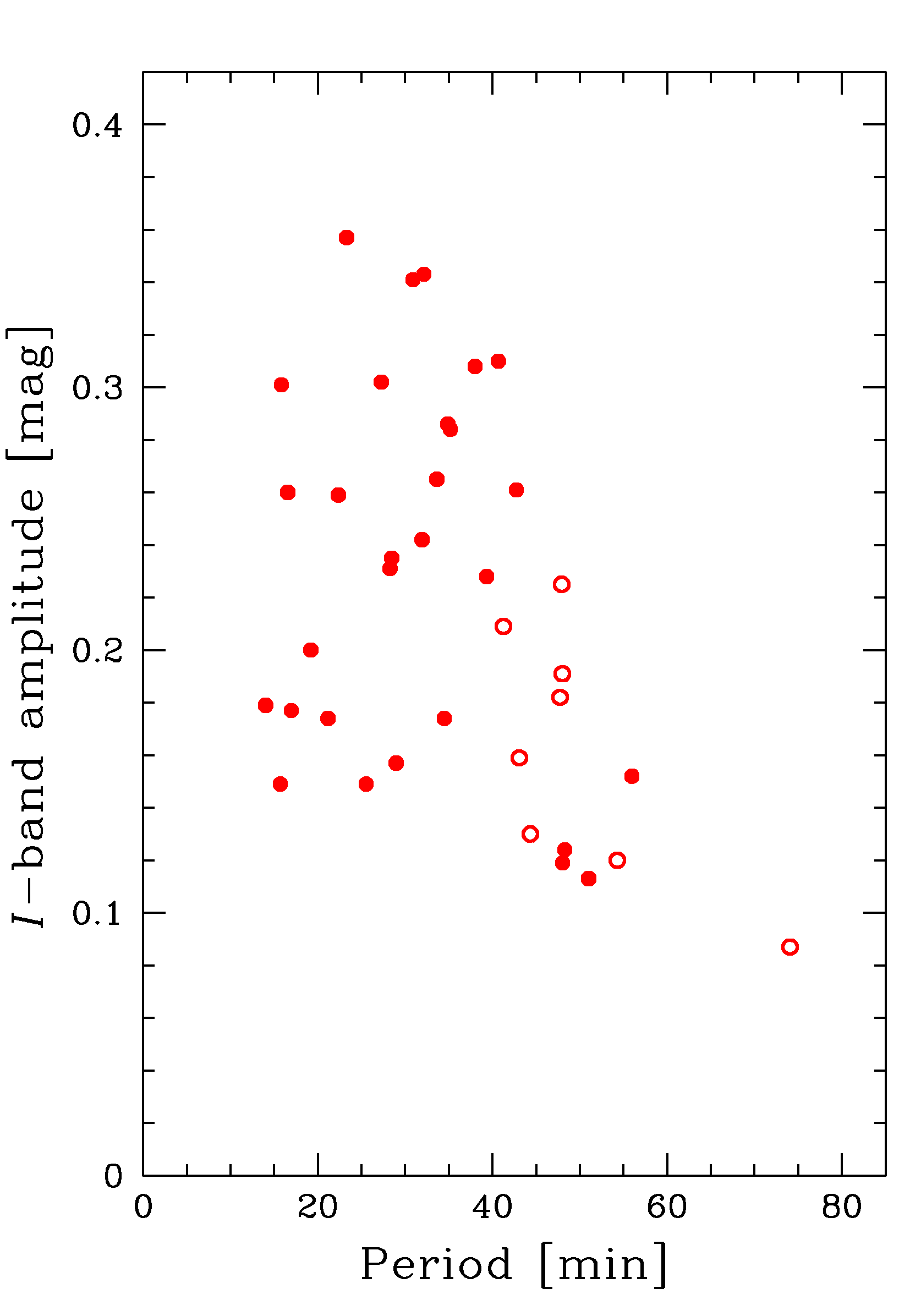
- Period change rates are typically ~10⁻⁷ yr⁻¹, with 25% of the sample showing negative rates; OGLE-BLAP-030 has an anomalously high rate of +4.6 × 10⁻⁶ yr⁻¹ due to triple-mode pulsation.
- BLAPs are divided into two atmospheric groups: He-rich (log(N_He/N_H) ≈ -0.5 dex) with ~5× solar metallicity, and He-poor (log(N_He/N_H) < -2 dex), predominantly found at short periods (P ≤ 15 min) and high temperatures (T_eff > 31,000 K).
- Light curves are stable over decades, with no eclipses detected in 37 stars, ruling out a significant binary fraction.
- Most BLAPs in OGLE Galactic bulge fields are located in the Galactic bulge, while a minority are in the foreground disk, with OGLE-BLAP-009 at 2.2 ± 0.2 kpc and the closest known BLAP (HD 133729) at 463 ± 7 pc.
Read this paper
Open the full text in the Nubint reader and ask about any passage as you read.
Read this paper on NubintThis review was generated by AI from the original paper. Please check the paper before citing it.