
[Paper Review] On-chip quantum interference between independent lithium niobate-on-insulator photon-pair sources
This paper demonstrates on-chip quantum interference between two independent photon-pair sources based on periodically poled lithium niobate-on-insulator (LNOI) waveguides. By integrating a programmable Mach-Zehnder interferometer with high-brightness SPDC sources, the authors achieve 96.8(3.6)% visibility quantum interference, enabling scalable, chip-integrated quantum photonic circuits with high indistinguishability and brightness.
Generating and interfering non-classical states of light is fundamental to optical quantum information science and technology. Quantum photonic integrated circuits provide one pathway towards scalability by combining nonlinear sources of non-classical light and programmable circuits in centimeter-scale devices. The key requirements for quantum applications include efficient generation of indistinguishable photon-pairs and high-visibility programmable quantum interference. Here, we demonstrate a lithium niobate-on-insulator (LNOI) integrated photonic circuit that generates a two-photon path-entangled state, and a programmable interferometer for quantum interference. We generate entangled photons with $\sim2.3 imes10^8$ pairs/s/mW brightness and perform quantum interference experiments on the chip with $96.8\pm3.6\%$ visibility. LNOI is an emerging photonics technology that has revolutionized high-speed modulators and efficient frequency conversion. Our results provide a path towards large-scale integrated quantum photonics including efficient photon-pair generation and programmable circuits for applications such as boson sampling and quantum communications.
Motivation & Objective
- To enable scalable, chip-integrated quantum photonic circuits by combining high-brightness photon-pair generation with programmable quantum interference.
- To overcome limitations of silicon and silicon nitride platforms by leveraging the strong nonlinear and electro-optic properties of lithium niobate-on-insulator (LNOI).
- To achieve high-visibility quantum interference between independently generated photons using on-chip interferometry, a key requirement for quantum advantage in boson sampling and quantum communications.
- To demonstrate that LNOI technology can support both efficient photon-pair generation and high-fidelity quantum interference in a single integrated platform.
Proposed method
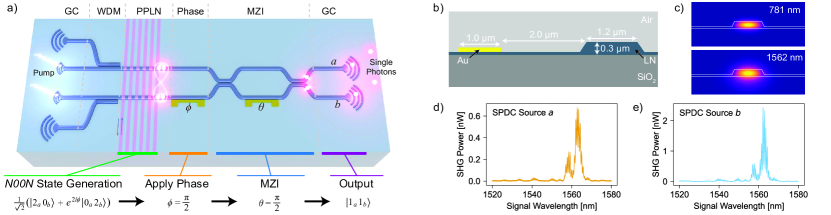
- The chip integrates two identical periodically poled LNOI waveguides for spontaneous parametric down-conversion (SPDC), generating a path-entangled N00N state.
- A Mach-Zehnder interferometer (MZI) with thermo-optic phase shifters enables tunable quantum interference between the two output modes.
- Photon-pair generation is driven by a pump laser at 781 nm, producing correlated pairs at 1562 nm via type-II phase-matching.
- On-chip brightness is measured as ~2.3×10⁸ pairs/s/mW, significantly exceeding typical bulk SPDC sources.
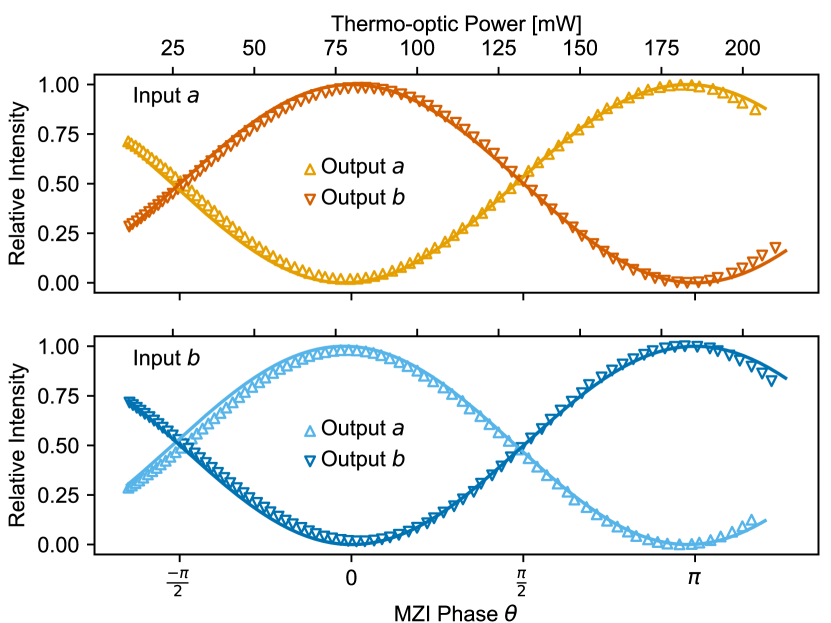
- Quantum interference visibility is quantified via a controlled phase sweep of the N00N state and MZI, with output states measured using single-photon detectors.
- Off-chip Hong-Ou-Mandel (HOM) experiments verify photon indistinguishability, measuring a visibility of 83.2±0.1% with a dip width of 71.9(0.5) fs.
Experimental results
Research questions
- RQ1Can independent, on-chip photon-pair sources based on LNOI achieve high-visibility quantum interference?
- RQ2What is the on-chip brightness of SPDC sources in periodically poled LNOI waveguides?
- RQ3Can a single LNOI chip integrate both high-efficiency photon-pair generation and a programmable interferometer for quantum interference?
- RQ4How does the visibility of on-chip quantum interference compare to off-chip HOM measurements of photon indistinguishability?
- RQ5To what extent can LNOI technology enable scalable, integrated quantum photonic circuits for near-term quantum advantage?
Key findings
- The chip achieves 96.8(3.6)% visibility in on-chip quantum interference between independently generated photons, demonstrating high indistinguishability.
- On-chip photon-pair brightness reaches ~2.3×10⁸ pairs/s/mW, exceeding typical free-space SPDC sources, including those based on ppKTP.
- The Hong-Ou-Mandel experiment confirms photon indistinguishability with a visibility of 83.2±0.1%, limited by fiber beamsplitter bandwidth.
- The spectral bandwidth of the photons after fiber coupling is estimated at ~50 nm, consistent with the 71.9(0.5) fs HOM dip width.
- The observed visibility is reduced compared to on-chip interference, attributed to limited bandwidth and misalignment in off-chip components.
- The integration of SPDC sources and a programmable interferometer on a single LNOI chip enables a scalable platform for quantum information tasks like boson sampling and quantum metrology.
Better researchstarts right now
From reading papers to final review, dramatically reduce your research time.
No credit card · Free plan available
This review was created by AI and reviewed by human editors.