
[Paper Review] On constraining Cosmology and the Halo Mass Function with Weak Gravitational Lensing
This study investigates the impact of allowing the halo mass function (HMF) to vary in weak gravitational lensing analyses, showing that a modified HMF can resolve the S₈ tension between Planck and DES-y3/KiDS-1000 data. By freeing HMF parameters alongside cosmological ones, the model reduces power in the matter power spectrum by ~25% at k ~ 1 h/Mpc, bringing Planck cosmology into agreement with lensing data without requiring new physics.
The discrepancy between the weak lensing (WL) and the {\it Planck} measurements of $S_8$ has been a subject of several studies. These studies tend to show that a suppression of the amplitude of the mass power spectrum $P(k)$ at high $k$ could resolve it. The WL signal at small-scale is sensitive to various effects, such as baryonic effects and intrinsic alignment. The accuracy of $P(k)$ depends on the modelling precision of these effects. A common approach for calculating $P(k)$ relies on a halo model. Amongst the various components necessary for the construction of $P(k)$, the halo mass function (HMF) is an important one. Traditionally, the HMF has been assumed to follow a fixed model. Recent literature shows that baryonic physics, amongst several other factors, could affect the HMF. In this study, we investigate the impact of allowing the HMF to vary. This provides a way of testing the validity of the halo model-HMF calibration using data. We find that the {\it Planck} cosmology is not compatible with the vanilla HMF for both the DES-y3 and the KiDS-1000 data. When the cosmology and the HMF parameters are allowed to vary, the {\it Planck} cosmology is no longer in tension. The modified HMF predicts a matter power spectrum with a $\sim 25\%$ power loss at $k\sim 1~{ m h/Mpc}$, in agreement with the recent studies. We show that Stage IV surveys will be able to measure the HMF parameters with a few percent accuracy.
Motivation & Objective
- To investigate whether freeing the halo mass function (HMF) parameters can resolve the S₈ tension between weak lensing surveys (DES-y3, KiDS-1000) and Planck CMB measurements.
- To assess whether the standard Sheth-Tormen HMF model is consistent with current weak lensing data when cosmological parameters are simultaneously varied.
- To evaluate the potential of future Stage IV surveys to constrain HMF parameters with few percent accuracy.
- To explore whether discrepancies in P(k) modelling—particularly from baryonic effects and intrinsic alignment—may stem from inaccuracies in HMF calibration rather than systematics.
- To test whether the HMF can absorb unmodelled non-linear effects, thereby reducing reliance on ad hoc modifications to the matter power spectrum.
Proposed method
- The authors modify the HMcode software to allow joint inference of cosmological parameters and HMF parameters (p, q) in the Sheth-Tormen HMF model.
- They use the same analysis pipelines from DES-y3 and KiDS-1000 collaborations to ensure consistency with existing data products and methods.
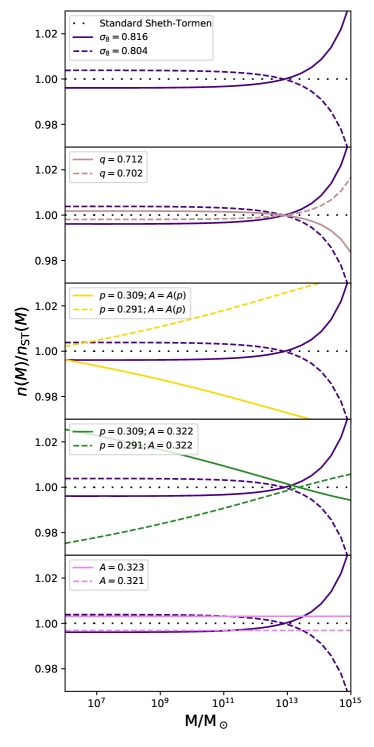
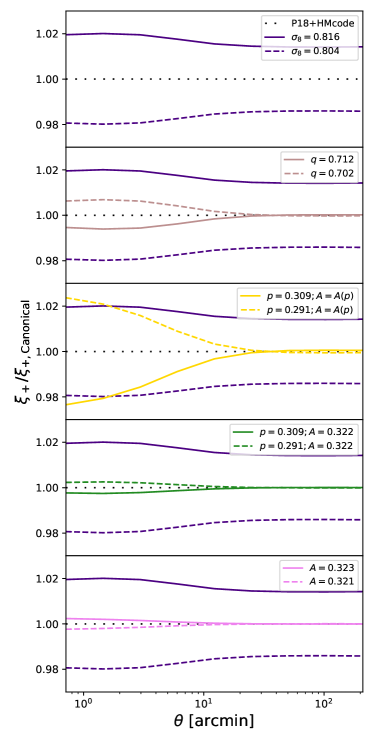
- The matter power spectrum P(k) is computed within the halo model framework, with HMF as a free component, and projected into shear correlation functions ξ₊ and ξ₋.
- Posterior distributions are sampled using MultiNest, with constraints derived from weak lensing shear power spectra and angular clustering.
- The analysis compares fixed-HMF (Sheth-Tormen) vs. free-HMF scenarios, testing compatibility with Planck18, DES-y3, and KiDS-1000 cosmologies.
- Sensitivity to baryonic effects and intrinsic alignment is implicitly absorbed through the HMF parameter space, avoiding direct modelling of these effects.
Experimental results
Research questions
- RQ1Can allowing the halo mass function to vary resolve the S₈ tension between Planck and weak lensing surveys like DES-y3 and KiDS-1000?
- RQ2Is the standard Sheth-Tormen HMF model consistent with current weak lensing data when cosmological parameters are also free to vary?
- RQ3To what extent can the HMF absorb unmodelled non-linear effects such as baryonic feedback and intrinsic alignment?
- RQ4What level of precision can future Stage IV weak lensing surveys achieve in constraining HMF parameters?
- RQ5Does the observed S₈ discrepancy stem from inaccuracies in HMF calibration rather than new physics or systematics?
Key findings
- The vanilla Sheth-Tormen HMF is incompatible with Planck18 cosmology when fitted to DES-y3 and KiDS-1000 data, indicating a model mismatch.
- When both cosmological parameters and HMF parameters (p, q) are allowed to vary, the S₈ tension with Planck18 is resolved, and the posterior S₈ value aligns with Planck18.
- The modified HMF suppresses the matter power spectrum by approximately 25% at k ~ 1 h/Mpc, consistent with other studies attempting to resolve S₈ tension via P(k) modifications.
- The HMF parameters (p, q) inferred from data strongly exclude the standard Sheth-Tormen values (p=0.3, q=0.707), suggesting a potential deficiency in current HMF calibration.
- Stage IV weak lensing surveys are expected to measure HMF parameters with a few percent accuracy, enabling robust tests of HMF models.
- The result suggests that unmodelled non-linear effects may be absorbed by the HMF, implying that current simulations may be missing components affecting halo formation and distribution.
Better researchstarts right now
From reading papers to final review, dramatically reduce your research time.
No credit card · Free plan available
This review was created by AI and reviewed by human editors.