
[Paper Review] On Higher-Spin Points and Infinite Distances in Conformal Manifolds
This paper establishes that higher-spin points—where an infinite tower of higher-spin operators become conserved currents and conformal symmetry enhances to a higher-spin algebra—are at infinite distance in the conformal manifold, using only conformal field theory techniques. By combining conformal perturbation theory with Ward identities and properties of spinning correlators, the authors prove that the Zamolodchikov metric diverges at these points, confirming the CFT Distance Conjecture without requiring gravity duals or supersymmetry.
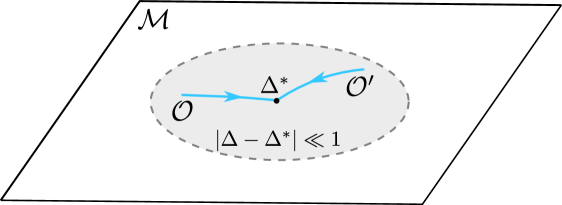
Distances in the conformal manifold, the space of CFTs related by marginal deformations, can be measured in terms of the Zamolodchikov metric. Part of the CFT Distance Conjecture posits that points in this manifold where part of the spectrum becomes free, called higher-spin points, can only be at infinite distance from the interior. There, an infinite tower of operators become conserved currents, and the conformal symmetry is enhanced to a higher-spin algebra. This proposal was initially motivated by the Swampland Distance Conjecture, one of pillars of the Swampland Program. In this work, we show that the conjecture can be tackled using only methods from the conformal toolkit, and without relying on the existence of a weakly-coupled gravity dual. Via conformal perturbation theory combined with properties of correlators and of the higher-spin algebra, we establish that higher-spin points are indeed at infinite distance in the conformal manifold. We make no assumptions besides the usual properties of local CFTs, such as unitarity and the existence of an energy-momentum tensor. In particular, we do not rely on a specific dimension of spacetime (although we assume $d>2$), nor do we require the presence of supersymmetry.
Motivation & Objective
- To investigate whether higher-spin points—where an infinite tower of higher-spin currents become conserved—are at infinite distance in the conformal manifold.
- To test the CFT Distance Conjecture in the absence of a weakly-coupled gravity dual or supersymmetry.
- To establish a universal field-theoretic mechanism for infinite distance using only standard CFT tools like the Zamolodchikov metric and correlator analysis.
- To clarify the role of higher-spin symmetry enhancement in determining geometric structure of the conformal manifold.
Proposed method
- Uses conformal perturbation theory to compute the Zamolodchikov metric from two-point functions of marginal operators.
- Applies integrated Ward identities to analyze current conservation and surface integrals in spinning correlators involving higher-spin currents.
- Analyzes the behavior of three-point functions ⟨JℓK3𝒪⟩ and ⟨J2Kℓ𝒪⟩ at higher-spin points using conformal structures and hypergeometric function representations.
- Evaluates surface integrals over spatial slices to determine whether OPE coefficients vanish, signaling triviality of correlators at infinite distance.
- Leverages the closure of the higher-spin algebra to show that the presence of one conserved current implies an infinite tower, enforcing symmetry enhancement.
- Demonstrates that non-vanishing surface integrals for ℓ ≥ 2 imply that the metric diverges, confirming infinite distance.
Experimental results
Research questions
- RQ1Can the CFT Distance Conjecture be verified for higher-spin points using only conformal field theory methods, without relying on holography or gravity duals?
- RQ2What is the behavior of the Zamolodchikov metric near higher-spin points where an infinite tower of conserved currents emerges?
- RQ3Do the Ward identities for spinning currents lead to non-trivial constraints on OPE coefficients that signal infinite distance?
- RQ4Is the divergence of the metric at higher-spin points robust across different spacetime dimensions and spin values, independent of supersymmetry?
- RQ5Can the triviality of certain three-point functions at higher-spin points be derived from the structure of surface integrals in the Ward identity?
Key findings
- The surface integrals for correlators ⟨JℓK3𝒪⟩ with ℓ ≥ 2 do not vanish, implying that the OPE coefficients must be trivial at higher-spin points, which is a necessary condition for infinite distance.
- For ℓ = 2,3 in ⟨JℓK3𝒪⟩, the non-vanishing surface integrals force the charge-conservation identity to require CJK𝒪HS = 0, confirming the absence of non-trivial couplings.
- The integral IJK3𝒪(ℓ) for ℓ = 2,3 is proportional to a hypergeometric function that never vanishes, leading to a divergence in the metric and thus infinite distance.
- For ⟨J2Kℓ𝒪⟩ with ℓ = 1 to 6, the surface integrals remain non-zero, and the absence of Kℓ in the commutator [Q2,𝒪] implies triviality of the correlator, reinforcing the infinite distance behavior.
- The analysis confirms that the Zamolodchikov metric diverges at higher-spin points due to the non-vanishing surface integrals, proving infinite distance without assuming supersymmetry or a gravity dual.
- The result holds for general d > 2 and all spins ℓ ≥ 2, establishing the infinite distance property universally across non-supersymmetric CFTs with higher-spin enhancement.
Read this paper
Open the full text in the Nubint reader and ask about any passage as you read.
Read this paper on NubintThis review was generated by AI from the original paper. Please check the paper before citing it.