
[Paper Review] On Large Visual Language Models for Medical Imaging Analysis: An Empirical Study
The paper empirically evaluates zero-shot and few-shot visual language models on medical imaging classification tasks (brain MRI, ALL-IDB2 microscopic images, chest X-ray COVID) and compares them to CNN baselines, highlighting zero-shot/few-shot capabilities and prompting strategies.
Recently, large language models (LLMs) have taken the spotlight in natural language processing. Further, integrating LLMs with vision enables the users to explore emergent abilities with multimodal data. Visual language models (VLMs), such as LLaVA, Flamingo, or CLIP, have demonstrated impressive performance on various visio-linguistic tasks. Consequently, there are enormous applications of large models that could be potentially used in the biomedical imaging field. Along that direction, there is a lack of related work to show the ability of large models to diagnose the diseases. In this work, we study the zero-shot and few-shot robustness of VLMs on the medical imaging analysis tasks. Our comprehensive experiments demonstrate the effectiveness of VLMs in analyzing biomedical images such as brain MRIs, microscopic images of blood cells, and chest X-rays.
Motivation & Objective
- Assess the zero-shot and few-shot robustness of large visual language models (VLMs) on medical imaging classification tasks.
- Compare VLMs with CNN baselines on three datasets (BTD, ALL-IDB2, CX-Ray).
- Analyze prompting strategies and their impact on VLM performance in biomedical imaging.
Proposed method
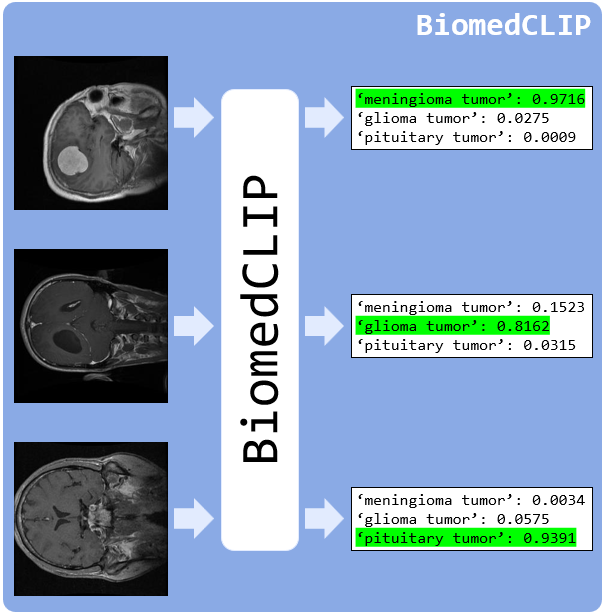
- Evaluate five VLMs (BiomedCLIP, OpenCLIP, OpenFlamingo, LLaVA, ChatGPT-4) and two CNN baselines (CNN, ResNet-18) without fine-tuning.
- Use zero-shot prompting for most VLMs and few-shot prompting for OpenFlamingo with demonstration images.
- Report test accuracy on each dataset and compute averages across datasets.
- Describe dataset-specific prompts to improve CLIP-based models (e.g., rich descriptive prompts per dataset).
- Discuss prompting strategies (single-step vs multi-step, demonstration selection) and their effect on performance.
Experimental results
Research questions
- RQ1How do zero-shot VLMs perform on medical-imaging classification tasks without task-specific fine-tuning?
- RQ2Does few-shot prompting improve VLM classification accuracy on medical images, and under what conditions?
- RQ3How do VLMs compare to CNN-based models on brain MRI, ALL-IDB2, and CX-Ray datasets?
- RQ4What prompting strategies yield the best accuracy for CLIP-based models in this domain?
- RQ5What limitations and safety considerations arise when applying VLMs to medical imaging?
Key findings
- CNN-based models still achieve the best performance across datasets, reflecting benefit from supervised training.
- BiomedCLIP often provides the strongest averaged performance among VLMs across the three datasets (BTD, ALL-IDB2, CX-Ray).
- OpenFlamingo, LLaVA, and ChatGPT-4 demonstrate notable zero-shot performance, with few-shot prompting providing gains for some datasets.
- Zero-shot CLIP-based models (BiomedCLIP, OpenCLIP) show substantial variability across datasets, highlighting dataset-specific prompt design importance.
- Prompt engineering and demonstration selection (few-shot prompts) can improve VLM accuracy on medical imaging tasks.
- Overall, VLMs offer value as pre-trained, non-finetuned tools and as chat assistants for pre-diagnosis, but do not yet surpass dedicated CNNs on benchmark tasks.

Read this paper
Open the full text in the Nubint reader and ask about any passage as you read.
Read this paper on NubintThis review was generated by AI from the original paper. Please check the paper before citing it.