
[Paper Review] On the Skew-Symmetric Binary Sequences and the Merit Factor Problem
This paper proposes a lightweight stochastic algorithm that reduces memory complexity from O(n²) to O(n) for optimizing skew-symmetric binary sequences by exploiting mathematical properties of the flip operation. It achieves merit factors above 5 for sequences up to length 10⁵+1, with runtime scaling quadratically with sequence length.
The merit factor problem is of practical importance to manifold domains, such as digital communications engineering, radars, system modulation, system testing, information theory, physics, chemistry. However, the merit factor problem is referenced as one of the most difficult optimization problems and it was further conjectured that stochastic search procedures will not yield merit factors higher than 5 for long binary sequences (sequences with lengths greater than 200). Some useful mathematical properties related to the flip operation of the skew-symmetric binary sequences are presented in this work. By exploiting those properties, the memory complexity of state-of-the-art stochastic merit factor optimization algorithms could be reduced from $O(n^2)$ to $O(n)$. As a proof of concept, a lightweight stochastic algorithm was constructed, which can optimize pseudo-randomly generated skew-symmetric binary sequences with long lengths (up to ${10}^5+1$) to skew-symmetric binary sequences with a merit factor greater than 5. An approximation of the required time is also provided. The numerical experiments suggest that the algorithm is universal and could be applied to skew-symmetric binary sequences with arbitrary lengths.
Motivation & Objective
- Address the computational infeasibility of high-memory stochastic algorithms for optimizing skew-symmetric binary sequences.
- Reduce the memory complexity of the flip operation from O(n²) to O(n) using mathematical insights into skew-symmetric structure.
- Develop a lightweight stochastic algorithm capable of finding skew-symmetric binary sequences with merit factor >5 for long lengths (up to 10⁵+1).
- Provide empirical and analytical approximations for the time required to achieve high merit factors across varying sequence lengths.
Proposed method
- Leverage mathematical properties of skew-symmetric binary sequences to derive an O(n) alternative to the traditional tau table (τ(S)) used in merit factor computation.
- Design a stochastic optimization algorithm that uses local (L) and global (G) improvement heuristics to guide search steps.
- Implement a 'Quake' function that flips Q random bits in the sequence to escape local minima, with Q dynamically scaled based on sequence length.
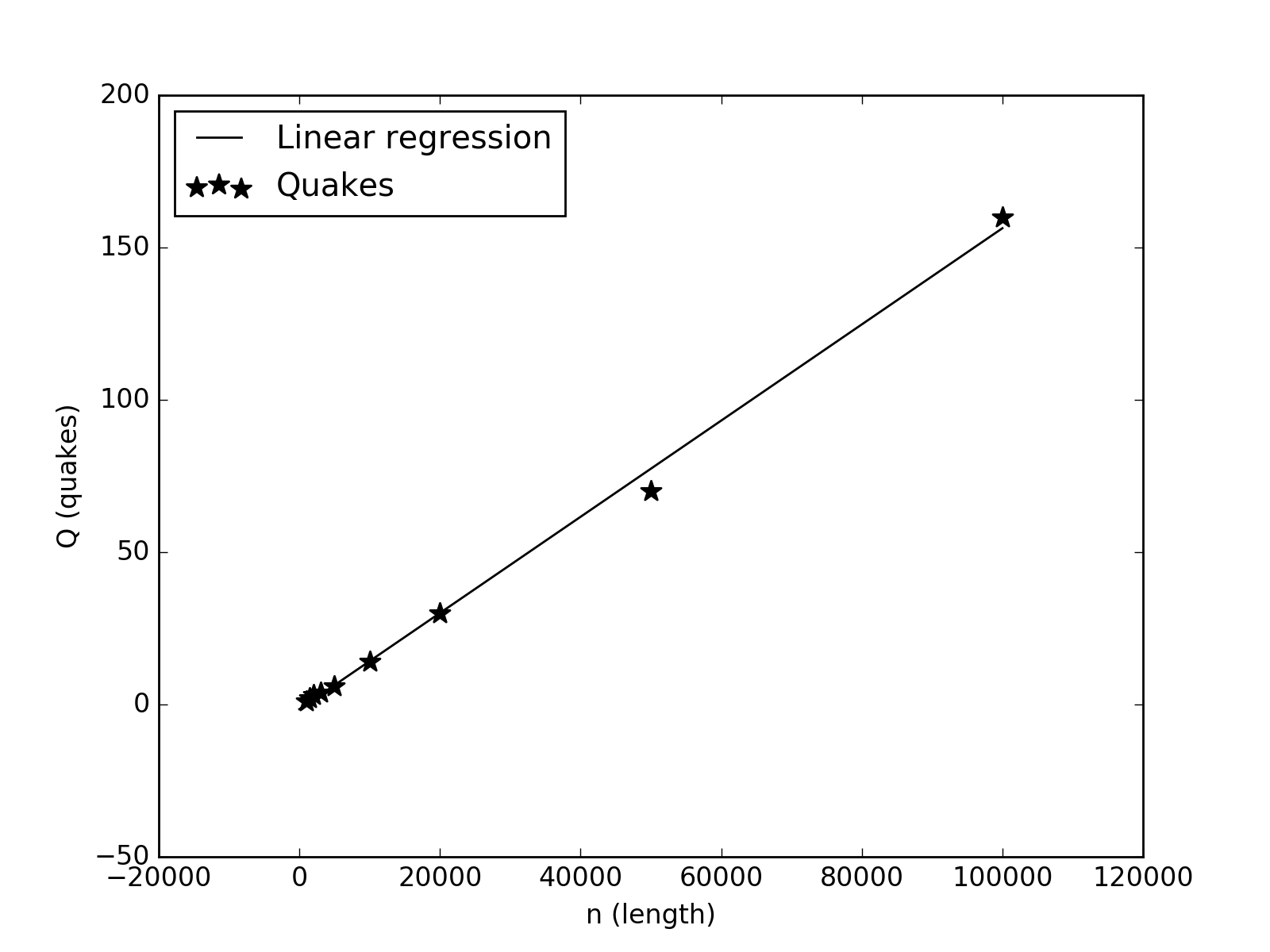
- Use linear regression on experimental (n, Q) pairs to model the required number of quakes as Q ≈ 0.001578787n − 1.546093.
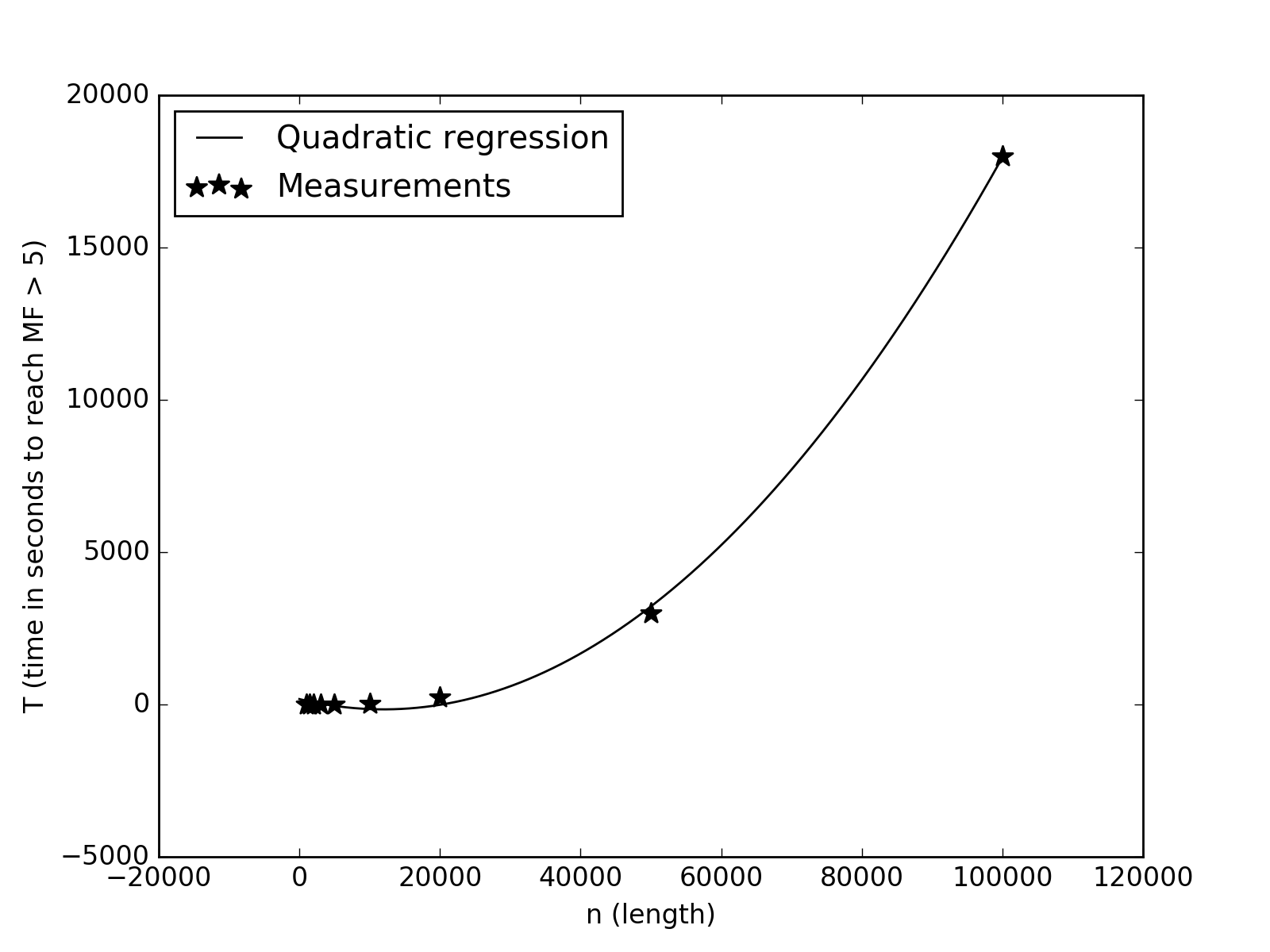
- Apply quadratic regression to (n, T) measurements to estimate runtime T ≈ 177.2867 − 0.0562043n + 0.000002340029n² seconds.
- Validate the algorithm across sequence lengths from 999 to 100,001, using C++ on a 12-thread system with consistent performance across runs.
Experimental results
Research questions
- RQ1Can the memory complexity of stochastic merit factor optimization for skew-symmetric binary sequences be reduced from O(n²) to O(n) using structural properties?
- RQ2What is the minimal number of random bit flips (Q) required to achieve a merit factor >5 for long skew-symmetric sequences?
- RQ3How does the required runtime scale with increasing sequence length n for achieving merit factors >5?
- RQ4Can a universal, lightweight stochastic algorithm consistently produce high-merit-factor skew-symmetric sequences across arbitrary odd lengths up to 10⁵+1?
- RQ5Is there a predictable relationship between sequence length and the number of Quake operations needed to reach high merit factors?
Key findings
- The proposed algorithm reduces memory complexity of the flip operation from O(n²) to O(n) by replacing the tau table with a mathematically derived O(n) alternative.
- For sequences of length 10,001, a merit factor >5 was achieved in approximately 1 minute using Q = 14 quakes.
- At length 20,001, the algorithm required about 4 minutes to reach a merit factor >5, with Q = 30.
- For length 50,001, the runtime was approximately 40 minutes, using Q = 70 quakes.
- For length 100,001, the algorithm reached merit factors >5 in about 5 hours, using Q = 160 quakes.
- The required number of quakes Q grows linearly with n, with the fitted model Q ≈ 0.001578787n − 1.546093.
Better researchstarts right now
From reading papers to final review, dramatically reduce your research time.
No credit card · Free plan available
This review was created by AI and reviewed by human editors.