
[Paper Review] Open-Endedness is Essential for Artificial Superhuman Intelligence
This paper argues that open-endedness—defined as the continuous generation of novel, learnable, and human-relevant artifacts—is essential for achieving artificial superhuman intelligence (ASI). By formalizing open-endedness through observer-based novelty and learnability, the authors propose that foundation models, when combined with open-ended learning frameworks, can enable autonomous, self-improving AI systems capable of sustained innovation, with critical implications for safety and scalability in future AI development.
In recent years there has been a tremendous surge in the general capabilities of AI systems, mainly fuelled by training foundation models on internetscale data. Nevertheless, the creation of openended, ever self-improving AI remains elusive. In this position paper, we argue that the ingredients are now in place to achieve openendedness in AI systems with respect to a human observer. Furthermore, we claim that such open-endedness is an essential property of any artificial superhuman intelligence (ASI). We begin by providing a concrete formal definition of open-endedness through the lens of novelty and learnability. We then illustrate a path towards ASI via open-ended systems built on top of foundation models, capable of making novel, humanrelevant discoveries. We conclude by examining the safety implications of generally-capable openended AI. We expect that open-ended foundation models will prove to be an increasingly fertile and safety-critical area of research in the near future.
Motivation & Objective
- To establish a formal, observer-dependent definition of open-endedness based on novelty and learnability, enabling precise research and development in open-ended AI.
- To argue that open-endedness is a necessary property for artificial superhuman intelligence (ASI), as it enables continuous, creative, and self-improving discovery beyond human limits.
- To demonstrate that foundation models and open-ended systems are orthogonal but synergistic, with foundation models providing generalization and search guidance, while open-ended systems drive innovation.
- To identify the safety and alignment challenges of open-ended AI, emphasizing the need for human-relevant and interpretable knowledge discovery.
- To provide a foundation for future research by clarifying the distinction between open-endedness, continual RL, AIGAs, and curiosity-based exploration.
Proposed method
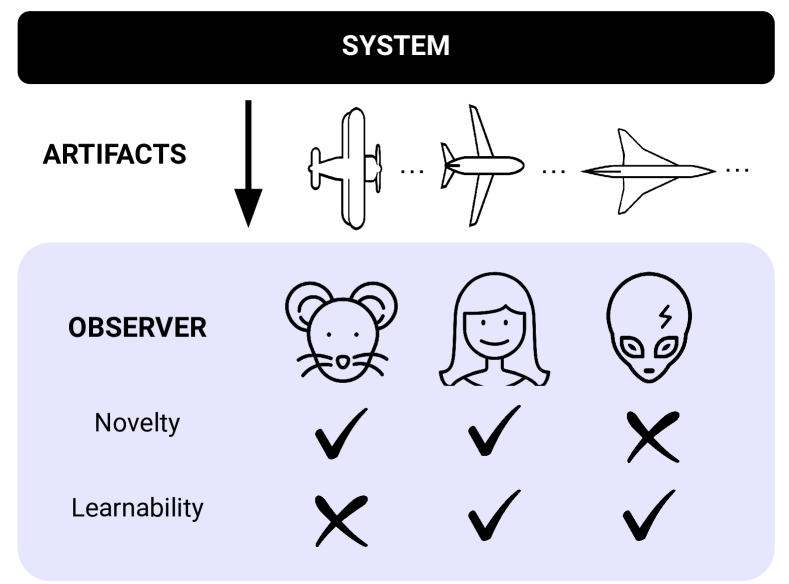
- Defining open-endedness via an observer's history-conditional model: artifacts are novel if they are unpredictable given past observations, and learnable if the observer can reduce epistemic uncertainty over time.
- Formalizing novelty as the divergence between the observer's predictive model and actual artifacts, ensuring that surprises are meaningful and not random noise.
- Introducing learnability as the observer's ability to progressively model and understand new artifacts, preventing stochastic traps common in curiosity-driven RL.
- Proposing that foundation models serve as general-purpose mutation and evaluation operators, enabling efficient exploration of diverse, human-relevant knowledge spaces.
- Using the observer's learning process as a proxy for epistemic progress, ensuring that novelty is not just random but systematically informative.
- Distinguishing open-endedness from related concepts like continual RL and AIGAs by emphasizing sustained novelty accumulation over time, not just ongoing learning or meta-learning.
Experimental results
Research questions
- RQ1What formal definition of open-endedness enables precise research and development in artificial general and superhuman intelligence?
- RQ2How can foundation models be integrated with open-ended learning to produce human-relevant, novel discoveries at scale?
- RQ3What distinguishes open-ended systems from continual reinforcement learning or AI-generating algorithms in terms of long-term innovation capacity?
- RQ4How can open-endedness be measured and optimized in practice, avoiding stochastic traps and ensuring meaningful progress?
- RQ5What are the safety implications of open-ended AI systems that autonomously generate increasingly complex, human-relevant knowledge?
Key findings
- The paper formalizes open-endedness as the continuous production of artifacts that are both novel (unpredictable by an observer's history-conditional model) and learnable (reducing epistemic uncertainty over time).
- Foundation models are shown to be essential enablers of open-endedness by providing generalization, human-relevant priors, and efficient search over diverse knowledge spaces.
- Existing open-ended systems, such as those achieving superhuman play in Go or discovering new mathematical results, demonstrate the feasibility of open-ended discovery when combined with foundation models.
- The proposed definition avoids stochastic traps by focusing on expected novelty and learnability, distinguishing it from traditional curiosity-based RL that can be misled by random noise.
- The authors argue that open-endedness is not merely a feature of AI but a necessary condition for artificial superhuman intelligence, as it enables sustained, self-improving innovation.
- The integration of open-endedness with foundation models creates a new, fertile research frontier with high safety-critical importance for future AI development.

Read this paper
Open the full text in the Nubint reader and ask about any passage as you read.
Read this paper on NubintThis review was generated by AI from the original paper. Please check the paper before citing it.