
[Paper Review] OpenShape: Scaling Up 3D Shape Representation Towards Open-World Understanding
OpenShape learns scalable, multi-modal embeddings for 3D shapes aligned with language and 2D images, enabling strong zero-shot open-world 3D recognition and cross-modal tasks.
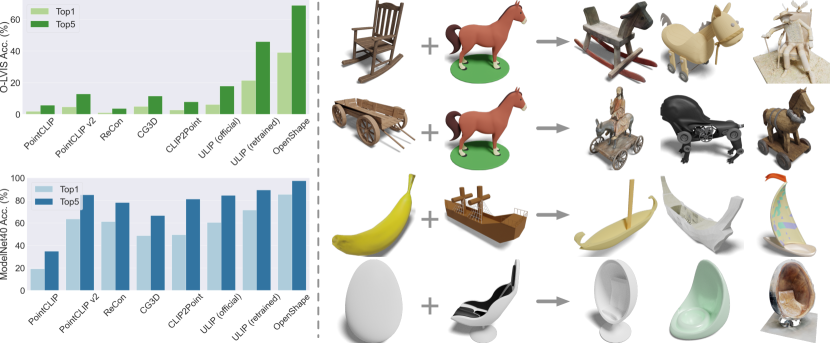
We introduce OpenShape, a method for learning multi-modal joint representations of text, image, and point clouds. We adopt the commonly used multi-modal contrastive learning framework for representation alignment, but with a specific focus on scaling up 3D representations to enable open-world 3D shape understanding. To achieve this, we scale up training data by ensembling multiple 3D datasets and propose several strategies to automatically filter and enrich noisy text descriptions. We also explore and compare strategies for scaling 3D backbone networks and introduce a novel hard negative mining module for more efficient training. We evaluate OpenShape on zero-shot 3D classification benchmarks and demonstrate its superior capabilities for open-world recognition. Specifically, OpenShape achieves a zero-shot accuracy of 46.8% on the 1,156-category Objaverse-LVIS benchmark, compared to less than 10% for existing methods. OpenShape also achieves an accuracy of 85.3% on ModelNet40, outperforming previous zero-shot baseline methods by 20% and performing on par with some fully-supervised methods. Furthermore, we show that our learned embeddings encode a wide range of visual and semantic concepts (e.g., subcategories, color, shape, style) and facilitate fine-grained text-3D and image-3D interactions. Due to their alignment with CLIP embeddings, our learned shape representations can also be integrated with off-the-shelf CLIP-based models for various applications, such as point cloud captioning and point cloud-conditioned image generation.
Motivation & Objective
- Motivate open-world 3D shape understanding beyond small curated datasets.
- Scale up 3D data and enrich noisy text descriptions to improve semantic alignment with CLIP spaces.
- Investigate scaling of 3D backbones and introduce hard negative mining to handle data imbalance.
- Demonstrate strong zero-shot 3D classification and cross-modal capabilities with CLIP-aligned embeddings.
Proposed method
- Ensemble four large public 3D datasets to 876k shapes for training.
- Use multi-modal contrastive learning to align 3D shape embeddings with CLIP language and image spaces while freezing CLIP encoders.
- Filter and enrich text descriptions via GPT-4 filtering, BLIP/Azure captions, and image-retrieved captions to improve 3D–text alignment.
- Scale up 3D backbones (e.g., PointBERT, SparseConv) and compare their performance with respect to training data size.
- Introduce offline hard negative mining to create challenging batch compositions and improve discriminative learning.
- Leverage a common embedding space to enable cross-modal tasks and integration with CLIP-based models.
Experimental results
Research questions
- RQ1Can large-scale, multi-modal pretraining of 3D shapes achieve open-world understanding and strong zero-shot performance?
- RQ2How do data scale, text quality, backbone scaling, and hard negative mining influence zero-shot 3D recognition?
- RQ3What is the impact of aligning 3D embeddings with CLIP language and image spaces on cross-modal tasks?
- RQ4How do OpenShape embeddings enable retrieval and generation tasks across modalities?
- RQ5How close can zero-shot 3D recognition approach or match fully supervised baselines on standard benchmarks?
Key findings
- OpenShape achieves 46.8% zero-shot accuracy on Objaverse-LVIS (1,156 categories), surpassing prior methods by a large margin.
- On ModelNet40, OpenShape reaches 85.3% zero-shot accuracy, outperforming prior zero-shot baselines by at least 20%.
- OpenShape demonstrates strong few-shot and cross-modal retrieval capabilities, including retrieving shapes from images or texts and enabling shape-conditioned generation.
- Em aligning 3D embeddings with CLIP spaces enables integration with CLIP-based models for tasks like point cloud captioning and point cloud-conditioned image generation.
- Backbone scaling and text enrichment strategies significantly improve performance, with hard negative mining helping address data imbalance.

Read this paper
Open the full text in the Nubint reader and ask about any passage as you read.
Read this paper on NubintThis review was generated by AI from the original paper. Please check the paper before citing it.