
[Paper Review] Optical Cluster Cosmology with SDSS redMaPPer clusters and HSC-Y3 lensing measurements
This paper presents a blind, joint cosmological analysis of galaxy clusters using the SDSS redMaPPer catalog and HSC-Y3 weak lensing data, employing a full-forward modeling approach that accounts for anisotropic boosts from projection effects and baryonic feedback. The analysis yields a robust constraint of $ S_8 = 0.816^{+0.041}_{-0.039} $, consistent with CMB and large-scale structure results, demonstrating unbiased cosmological constraints without informative priors.
We present cosmology results obtained from a blind joint analysis of the abundance, projected clustering, and weak lensing of galaxy clusters measured from the Sloan Digital Sky Survey (SDSS) redMaPPer cluster catalog and the Hyper-Suprime Cam (HSC) Year3 shape catalog. We present a full-forward model for the cluster observables, which includes empirical modeling for the anisotropic boosts on the lensing and clustering signals of optical clusters. We validate our analysis via mock cluster catalogs which include observational systematics, such as the projection effect and the effect of baryonic feedback, and find that our analysis can robustly constrain cosmological parameters in an unbiased manner without any informative priors on our model parameters. The joint analysis of our observables in the context of the flat $Λ$CDM model results in cosmological constraints for $S_8\equiv σ_8 \sqrt{Ω_{ m m} / 0.3}=0.816^{+0.041}_{-0.039}$. Our result is consistent with the $S_8$ inference from other cosmic microwave background- and large scale structure-based cosmology analyses, including the result from the \emph{Planck} 2018 primary CMB analysis.
Motivation & Objective
- To perform a blind, joint analysis of cluster abundance, projected clustering, and weak lensing to constrain cosmological parameters using optical clusters.
- To model and correct for anisotropic boosts in lensing and clustering signals caused by line-of-sight projection effects and filamentary structure.
- To validate the analysis pipeline using realistic mock catalogs that include observational systematics such as projection effects and baryonic feedback.
- To achieve unbiased cosmological constraints without informative priors on model parameters.
- To provide a self-calibrating framework for optical cluster cosmology using abundance and lensing data.
Proposed method
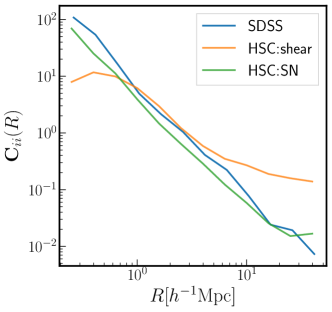
- A full-forward modeling approach is used to simulate cluster observables, including richness, projected clustering, and weak lensing signals.
- Empirical modeling of anisotropic boosts in lensing and clustering is incorporated to account for line-of-sight projection effects and filament alignment.
- Mocks are generated with realistic systematics, including projection effects and baryonic feedback, to test the robustness of the analysis.
- The analysis is performed in a blind manner, with cosmological constraints derived without informative priors on model parameters.
- The flat $\Lambda$CDM model is used as the fiducial cosmology, with $S_8 = \sigma_8 \sqrt{\Omega_{\rm m}/0.3}$ as the primary cosmological constraint.
- Posterior sampling is performed using Markov Chain Monte Carlo methods to derive constraints on $S_8$ and the mass-observable relation.
Experimental results
Research questions
- RQ1Can a blind joint analysis of cluster abundance, clustering, and weak lensing yield unbiased cosmological constraints without informative priors?
- RQ2How do projection effects and filamentary structure induce anisotropic boosts in lensing and clustering signals of optical clusters?
- RQ3To what extent do baryonic feedback and observational systematics affect cosmological inference in optical cluster surveys?
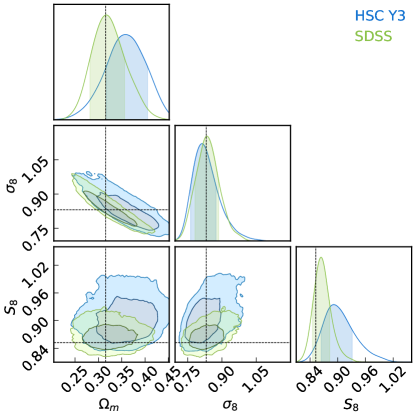
- RQ4Is the $S_8$ constraint from this optical cluster analysis consistent with those from CMB and large-scale structure probes?
- RQ5Can a full-forward modeling approach robustly account for systematics and yield reliable cosmological constraints in a self-calibrating framework?
Key findings
- The joint analysis yields a cosmological constraint of $ S_8 = 0.816^{+0.041}_{-0.039} $, consistent with Planck 2018 and other large-scale structure results.
- The analysis is robust to systematics such as projection effects and baryonic feedback, as validated by mock catalogs.
- The method successfully models anisotropic boosts in lensing and clustering signals due to line-of-sight structure, improving accuracy.
- The blind analysis framework produces unbiased constraints without requiring informative priors on model parameters.
- The results support the viability of optical cluster cosmology as a self-calibrating probe of cosmology when systematics are properly modeled.
- The study demonstrates that photometric cluster surveys can yield competitive cosmological constraints when combined with weak lensing and forward modeling.
Read this paper
Open the full text in the Nubint reader and ask about any passage as you read.
Read this paper on NubintThis review was generated by AI from the original paper. Please check the paper before citing it.