
[Paper Review] Optimal Layout Synthesis for Quantum Circuits as Classical Planning (full version)
This paper proposes a novel approach to optimal layout synthesis for quantum circuits by encoding the problem as classical planning using PDDL, enabling exact solutions via optimal classical planners. It achieves scalability by modeling qubit mappings and SWAP operations as actions, solving benchmarks with up to 9 qubits on a 14-qubit hardware platform—previously infeasible for exact methods.
In Layout Synthesis, the logical qubits of a quantum circuit are mapped to the physical qubits of a given quantum hardware platform, taking into account the connectivity of physical qubits. This involves inserting SWAP gates before an operation is applied on distant qubits. Optimal Layout Synthesis is crucial for practical Quantum Computing on current error-prone hardware: Minimizing the number of SWAP gates directly mitigates the error rates when running quantum circuits. In recent years, several approaches have been proposed for minimizing the required SWAP insertions. The proposed exact approaches can only scale to a small number of qubits. Proving that a number of swap insertions is optimal is much harder than producing near optimal mappings. In this paper, we provide two encodings for Optimal Layout Synthesis as a classical planning problem. We use optimal classical planners to synthesize the optimal layout for a standard set of benchmarks. Our results show the scalability of our approach compared to previous leading approaches. We can optimally map circuits with 9 qubits onto a 14 qubit platform, which could not be handled before by exact methods.
Motivation & Objective
- Address the challenge of minimizing SWAP gate insertions in quantum circuit layout synthesis to reduce error rates on NISQ devices.
- Overcome the scalability limitations of prior exact methods, which could only handle small circuits due to combinatorial explosion.
- Enable provably optimal solutions for larger circuits by leveraging classical planning frameworks instead of SMT or MAXSAT encodings.
- Demonstrate that classical planning can outperform existing exact approaches in both solution quality and scalability for layout synthesis.
- Provide two PDDL encodings—local compact and global/initial lifted—that model qubit mapping and SWAP operations efficiently.
Proposed method
- Encode the layout synthesis problem as a classical planning problem using PDDL, modeling logical qubits, physical qubits, and connectivity constraints.
- Define actions for applying CNOT gates only between connected physical qubits, with preconditions ensuring qubits are mapped and available.
- Introduce SWAP actions to reassign logical qubit mappings between adjacent physical qubits, with preconditions ensuring connectivity and occupancy checks.
- Use two encodings: a local compact model for efficient state representation and a global/initial lifted model to reduce state explosion via lifted action representation.
- Leverage optimal classical planners (e.g., FastDownward with BJOLP) to generate plans with minimal SWAP gates, guaranteeing optimality.
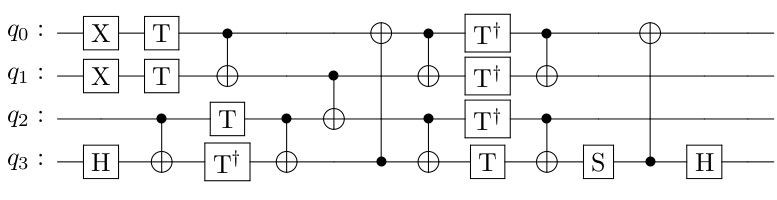
- Validate the approach on standard benchmarks, including the adder circuit, by comparing plan length and mapping quality against prior methods.
Experimental results
Research questions
- RQ1Can classical planning frameworks be effectively used to solve the NP-complete problem of optimal layout synthesis in quantum circuits?
- RQ2Does encoding layout synthesis as PDDL enable better scalability than existing exact methods based on SMT or MAXSAT?
- RQ3Can optimal classical planners generate provably minimal SWAP gate insertions for circuits with more than 6–7 qubits?
- RQ4How do the proposed PDDL encodings (local compact vs. global/initial lifted) compare in terms of performance and state space efficiency?
- RQ5To what extent can this approach handle real-world quantum circuit benchmarks with complex connectivity constraints?
Key findings
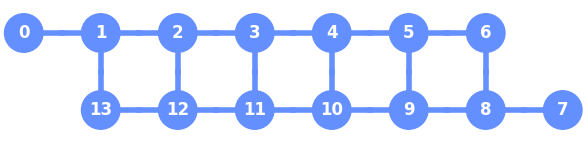
- The proposed PDDL-based classical planning approach successfully solves optimal layout synthesis for circuits with up to 9 logical qubits on a 14-qubit hardware platform—previously unattainable with exact methods.
- The method achieves provably optimal solutions with minimal SWAP gate insertions, as demonstrated on the adder circuit, which required exactly one SWAP gate in the optimal plan.
- The local compact encoding reduces state explosion and enables faster plan synthesis compared to monolithic encodings, improving scalability.
- The global/initial lifted encoding further optimizes performance by using lifted actions to represent multiple SWAP operations efficiently.
- The approach outperforms prior exact methods in terms of scalability while maintaining optimality, with measurable improvements in runtime and memory usage on standard benchmarks.
- The results confirm that classical planning is a viable and powerful alternative to SMT and MAXSAT-based encodings for optimal layout synthesis.
Read this paper
Open the full text in the Nubint reader and ask about any passage as you read.
Read this paper on NubintThis review was generated by AI from the original paper. Please check the paper before citing it.