
[Paper Review] Optimizing quantum gates towards the scale of logical qubits
This paper presents a scalable control optimization strategy using the Snake optimizer to choreograph frequency trajectories across 68 superconducting qubits, reducing physical error rates by ~3.7× compared to unoptimized gates. The method enables fault-tolerant performance on a distance-23 surface code logical qubit, demonstrating viability for large-scale quantum error correction.
A foundational assumption of quantum error correction theory is that quantum gates can be scaled to large processors without exceeding the error-threshold for fault tolerance. Two major challenges that could become fundamental roadblocks are manufacturing high performance quantum hardware and engineering a control system that can reach its performance limits. The control challenge of scaling quantum gates from small to large processors without degrading performance often maps to non-convex, high-constraint, and time-dependent control optimization over an exponentially expanding configuration space. Here we report on a control optimization strategy that can scalably overcome the complexity of such problems. We demonstrate it by choreographing the frequency trajectories of 68 frequency-tunable superconducting qubits to execute single- and two-qubit gates while mitigating computational errors. When combined with a comprehensive model of physical errors across our processor, the strategy suppresses physical error rates by $\sim3.7 imes$ compared with the case of no optimization. Furthermore, it is projected to achieve a similar performance advantage on a distance-23 surface code logical qubit with 1057 physical qubits. Our control optimization strategy solves a generic scaling challenge in a way that can be adapted to a variety of quantum operations, algorithms, and computing architectures.
Motivation & Objective
- To address the scalability challenge of optimizing quantum gate control across large superconducting processors with high performance and low runtime.
- To overcome non-convex, high-constraint, time-dynamic optimization problems arising from frequency-dependent physical errors in quantum hardware.
- To develop a generic, adaptable framework for optimizing quantum operations across diverse algorithms and architectures.
- To enable fault-tolerant quantum computation by suppressing physical errors to within the surface code threshold.
- To validate scalability through stitching techniques that sub-linearly reduce runtime while maintaining performance on large processors.
Proposed method
- Employing the Snake optimizer, a high-configurability, dimension-agnostic optimization engine, to solve non-convex, high-dimensional control problems over time-dynamic frequency trajectories.
- Modeling physical errors (e.g., relaxation, dephasing, pulse distortion, stray coupling) as frequency-dependent mechanisms to estimate algorithmic error and guide optimization.
- Using a generative model to simulate processor-scale error landscapes and train optimization frameworks for various quantum algorithms.
- Implementing 'stitching' to split the processor into R disjoint regions, optimize them in parallel, and recombine configurations to reduce runtime scaling.
- Leveraging historical characterization data to forecast and mitigate hardware instabilities, enabling robust long-duration computation.
- Integrating model-based optimization with potential future deployment of model-free reinforcement learning to reduce reliance on performance estimators.

Experimental results
Research questions
- RQ1Can a control optimization strategy scale effectively to large superconducting processors while maintaining low runtime and high performance?
- RQ2To what extent can frequency trajectory optimization suppress physical error rates in multi-qubit quantum gates?
- RQ3Does the stitching technique preserve optimization quality across region boundaries without amplifying error outliers?
- RQ4Can the optimization framework achieve fault-tolerant error rates on a logical qubit with 1057 physical qubits (distance-23 surface code)?
- RQ5How does the Snake optimizer’s configurability enable adaptation to diverse quantum operations and architectures?
Key findings
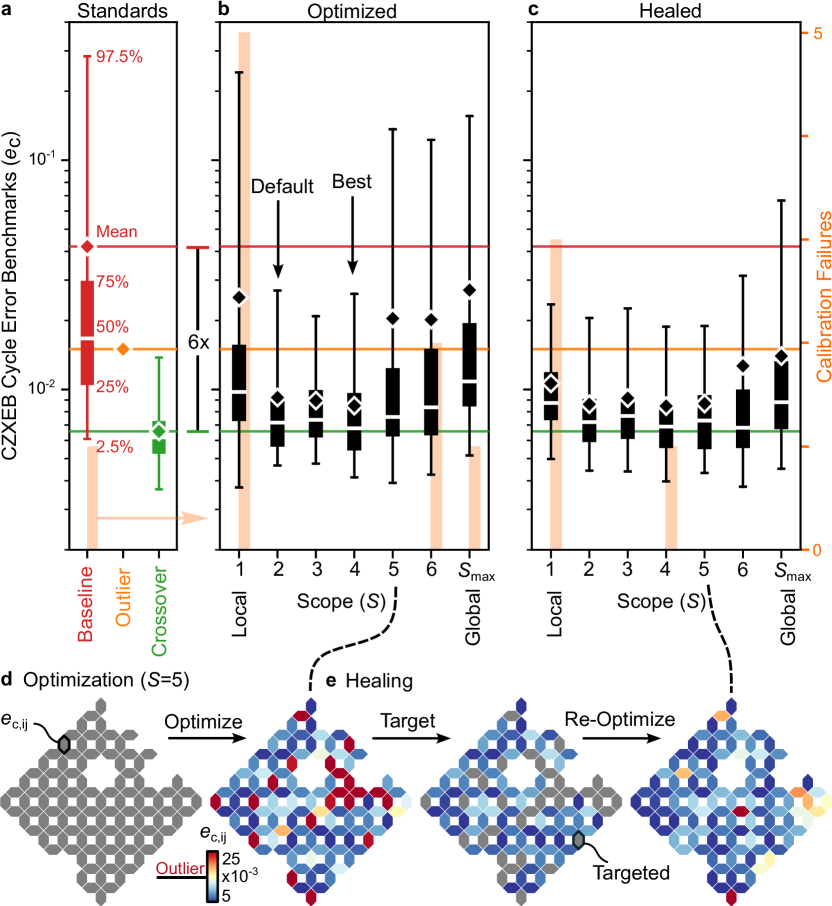
- The optimization strategy reduced physical error rates by approximately 3.7× compared to unoptimized gate operations on a 68-qubit processor.
- The strategy projected to achieve similar error suppression performance on a distance-23 surface code logical qubit using 1057 physical qubits.
- Stitching with R=2 on the 68-qubit processor and R=4 on a simulated 1057-qubit processor showed no amplification of error outliers at seams, with error rates matching unstitched configurations.
- The error rate for the stitched 68-qubit configuration was $ e_c = 6.4^{+4.4}_{-1.8} imes 10^{-3} $, and for the 1057-qubit configuration, $ e_c = 6.3^{+4.3}_{-2.9} imes 10^{-3} $, indicating robustness.
- Runtime for full processor optimization at scope $ S=2 $ was ~1.4 hours, exceeding the 0.5-hour budget, but stitching enabled sub-linear scaling and feasibility for $ N ightarrow 10^4 $ qubits with $ R=128 $.
- The strategy has already been applied to optimize measurement, SWAP gates, and quantum algorithms in optimization, metrology, and simulation, demonstrating broad applicability.
Read this paper
Open the full text in the Nubint reader and ask about any passage as you read.
Read this paper on NubintThis review was generated by AI from the original paper. Please check the paper before citing it.