
[Paper Review] Optomechanics of optically-levitated particles: A tutorial and perspective
A comprehensive survey and tutorial on levitated optomechanics, detailing trapping principles, regimes, detection, and future experimental/theoretical directions for junior researchers.
Optomechanics, the study of the mechanical interaction of light with matter, has proven to be a fruitful area of research that has yielded many notable achievements, including the direct detection of gravitational waves in kilometer-scale optical interferometers. Light has been used to cool and demonstrate quantum control over the mechanical degrees of freedom of individual ions and atoms, and more recently has facilitated the observation of quantum ``mechanics'' in objects of larger mass, even at the kg-scale. Optical levitation, where an object can be suspended by radiation pressure and largely decoupled from its environment, has recently established itself as a rich field of study, with many notable results relevant for precision measurement, quantum information science, and foundational tests of quantum mechanics and fundamental physics. This article provides a survey of several current activities in field along with a tutorial describing associated key concepts and methods, both from an experimental and theoretical approach. It is intended as a resource for junior researchers who are new to this growing field as well as beginning graduate students. The tutorial is concluded with a perspective on both promising emerging experimental platforms and anticipated future theoretical developments.
Motivation & Objective
- Provide an accessible overview of levitated optomechanics for new researchers and students.
- Summarize core concepts of optical trapping, forces, and dynamics across regimes (Rayleigh, Mie-Lorentz, geometric).
- Highlight experimental configurations, particle sources/materials, and detection methods.
- Discuss quantum regime possibilities, hybrid systems, thermodynamics, sensing applications, and future directions.
Proposed method
- Describe physical regimes based on the size parameter x = 2πR/λ0 and identify dominant forces (gradient, scattering) in each regime.
- Present the Maxwell stress tensor framework for calculating forces and torques on trapped particles and discuss applicable approximations (Rayleigh, Mie-Lorentz).
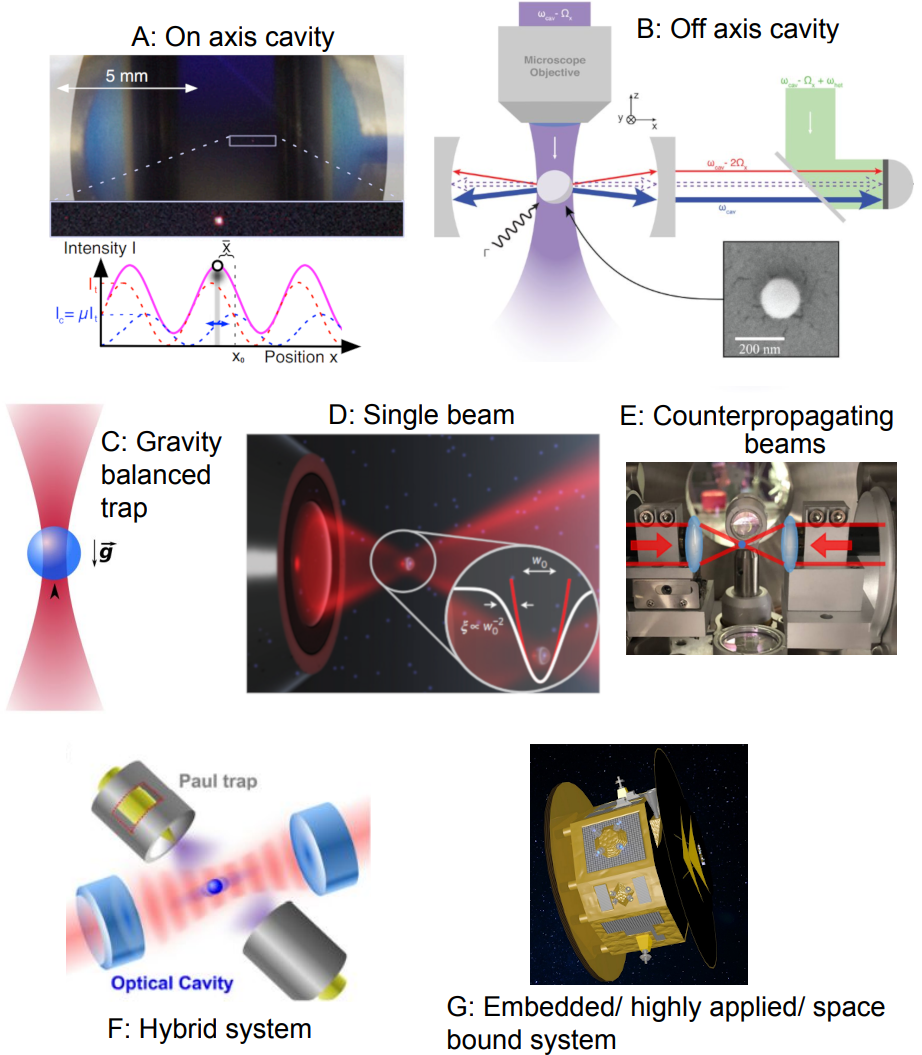
- Outline trapping configurations (single/multi-beam tweezers, cavities, coherent scattering, etc.) and particle loading methods (PZT launchers, LIAD, electrosprays).
- Explain optomechanical coupling models, including cavity-based and active feedback approaches, with key Hamiltonians and cooling concepts.
- Summarize thermodynamics, detection, and fundamental physics motivations, emphasizing current capabilities and limitations.
Experimental results
Research questions
- RQ1What are the dominant optical forces and regimes governing levitated nanoparticles under different size scales?
- RQ2How do trapping configurations and materials influence optomechanical coupling and detection?
- RQ3What are the viable pathways to reach and explore the quantum regime in levitated systems (ground-state cooling, squeezing, entanglement)?
- RQ4What future experimental platforms and theoretical developments are most promising for precision sensing and fundamental physics tests?
Key findings
- The paper provides a structured tutorial on optical trapping principles, force regimes, and the 3D harmonic behavior of trapped particles in vacuum.
- It describes cavity-based and coherent-scattering optomechanics and discusses their respective advantages and limitations.
- It outlines active feedback as an alternative route to control and cooling without cavities, with a dynamical equation for motion under feedback.
- It covers a broad set of applications and future directions, including thermodynamics, sensing, high-mass interferometry, and tests of quantum foundations.
- It highlights the importance of material choice, heating management, and loading methods for achieving stable levitated systems at low pressures.
Read this paper
Open the full text in the Nubint reader and ask about any passage as you read.
Read this paper on NubintThis review was generated by AI from the original paper. Please check the paper before citing it.