
[Paper Review] OPUS: An Integrated Assessment Model for Satellites and Orbital Debris
OPUS is an integrated assessment model that couples astrodynamics simulations with theoretical economic models of satellite operators to evaluate policy interventions for orbital debris mitigation. By modeling both orbital congestion and behavioral responses to economic incentives—such as launch costs and disposal regulations—it demonstrates that policy instruments like orbital-use fees can improve sustainability and economic welfare, offering a versatile tool for assessing space traffic management strategies.
An increasingly salient public policy challenge is how to manage the growing number of satellites in orbit, including large constellations. Many policy initiatives have been proposed that attempt to address the problem from different angles, but there is a paucity of analytical tools to help policymakers evaluate the efficacy of these different proposals and any potential counterproductive outcomes. To help address this problem, this paper summarizes work done to develop an experimental integrated assessment model -- Orbital Debris Propagators Unified with Economic Systems (OPUS) -- that combines both astrodynamics of the orbital population and economic behavior of space actors. For a given set of parameters, the model first utilizes a given astrodynamic propagator to assess the state of objects in orbit. It then uses a set of user-defined economic and policy parameters -- e.g. launch prices, disposal regulations -- to model how actors will respond to the economic incentives created by a given scenario. For the purposes of testing, the MIT Orbital Capacity Tool (MOCAT) version 4S was used as the primary astrodynamics propagator to simulate the true expected target collision probability ($p_c$) for a given end-of-life (EOL) disposal plan. To demonstrate propagator-agnosticism, a Gaussian mixture probability hypothesis density (GMPHD) filter was also used to simulate $p_c$. We also explore economic policy instruments to improve both sustainability of and economic welfare from orbit use. In doing so, we demonstrate that this hybrid approach can serve as a useful tool for evaluating policy proposals for managing orbital congestion. We also discuss areas where this work can be made more robust and expanded to include additional policy considerations.
Motivation & Objective
- To address the lack of analytical tools that combine astrodynamics and economic behavior in space policy evaluation.
- To develop a hybrid model capable of simulating how economic incentives influence satellite deployment and debris mitigation.
- To enable policymakers to assess the efficacy of proposals like orbital-use fees, deorbit timelines, and debris removal subsidies.
- To create a propagator-agnostic framework compatible with existing debris analysis tools.
- To support sensitivity analysis on key policy parameters and improve robustness of space sustainability assessments.
Proposed method
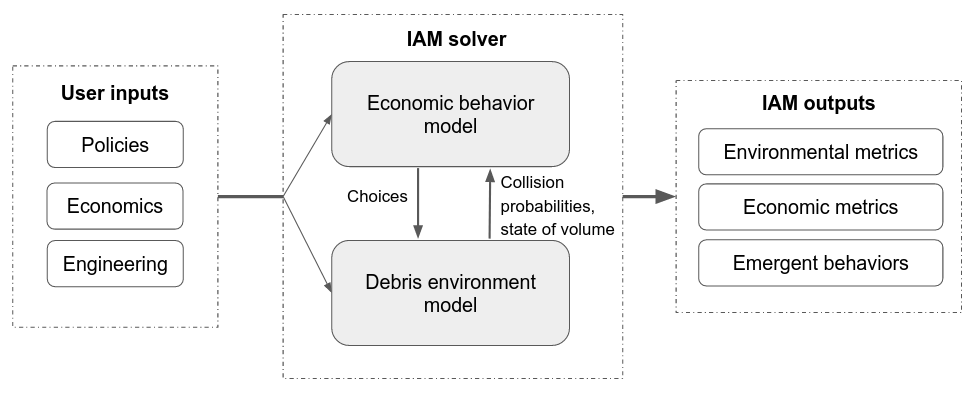
- OPUS uses a two-model architecture: an astrodynamics propagator (e.g., MOCAT-4S or GMPHD filter) to simulate orbital object states and collision probabilities.
- It couples this with a theoretically grounded economic model of launch behavior derived from equilibrium conditions in launcher markets.
- The model endogenizes launch rates based on economic parameters such as launch prices, disposal regulations, and orbital-use fees.
- It supports propagator-agnosticism by decoupling the physics engine from the economic model, enabling compatibility with multiple debris tracking tools.
- Simulation is conducted in MATLAB for propagation, with analytics and visualization in R.
- Policy scenarios are tested by varying economic parameters, including taxes, disposal requirements, and market structures.
Experimental results
Research questions
- RQ1How do economic incentives such as orbital-use fees affect satellite constellation deployment and debris mitigation behavior?
- RQ2What is the impact of varying post-mission disposal timelines on long-term orbital congestion and collision probability?
- RQ3How do different economic policy instruments compare in improving both space sustainability and economic welfare?
- RQ4To what extent can a hybrid physics-economics model improve the evaluation of space traffic management policies?
- RQ5How do large constellations and non-commercial actors influence the effectiveness of policy interventions in orbital congestion?
Key findings
- OPUS demonstrates that orbital-use fees can effectively reduce debris accumulation and improve long-term orbital sustainability.
- The model shows that stricter disposal regulations, such as reducing the 25-year post-mission disposal standard, can significantly lower collision probabilities.
- Economic incentives such as deorbit performance bonds or targeted subsidies can alter satellite design and end-of-life behavior in ways that reduce long-term debris risk.
- The model’s propagator-agnostic design enables consistent results across different astrodynamics tools, enhancing its robustness and compatibility.
- Sensitivity analysis reveals that launch cost reductions can increase congestion unless paired with effective economic or regulatory controls.
- OPUS can simulate complex policy scenarios, including anti-satellite tests and changes in commercial demand, providing insight into unintended consequences.
Better researchstarts right now
From reading papers to final review, dramatically reduce your research time.
No credit card · Free plan available
This review was created by AI and reviewed by human editors.