
[논문 리뷰] Personalization of Stress Mobile Sensing using Self-Supervised Learning
이 논문은 환자별로 레이블이 거의 없는 데이터를 사용하여 웨어러블 전도성 활성도(EDA) 신호에서 스트레스 예측을 개인화하기 위한 자기지도 학습(SSL) 방법을 제안한다. 비라벨 생체신호 시퀀스를 대상으로 1D 컨볼루션 신경망(CNN)을 사전 훈련시켜 개인별로 특화된 시간 동적 패턴을 학습함으로써, 감독 학습 기반 보다 30퍼센트 미만의 레이블 데이터로도 높은 정확도의 스트레스 예측이 가능해지며, 개인 맞춤형 디지털 헬스 시스템의 레이블링 부담을 크게 줄였다.
Stress is widely recognized as a major contributor to a variety of health issues. Stress prediction using biosignal data recorded by wearables is a key area of study in mobile sensing research because real-time stress prediction can enable digital interventions to immediately react at the onset of stress, helping to avoid many psychological and physiological symptoms such as heart rhythm irregularities. Electrodermal activity (EDA) is often used to measure stress. However, major challenges with the prediction of stress using machine learning include the subjectivity and sparseness of the labels, a large feature space, relatively few labels, and a complex nonlinear and subjective relationship between the features and outcomes. To tackle these issues, we examine the use of model personalization: training a separate stress prediction model for each user. To allow the neural network to learn the temporal dynamics of each individual's baseline biosignal patterns, thus enabling personalization with very few labels, we pre-train a 1-dimensional convolutional neural network (CNN) using self-supervised learning (SSL). We evaluate our method using the Wearable Stress and Affect prediction (WESAD) dataset. We fine-tune the pre-trained networks to the stress prediction task and compare against equivalent models without any self-supervised pre-training. We discover that embeddings learned using our pre-training method outperform supervised baselines with significantly fewer labeled data points: the models trained with SSL require less than 30% of the labels to reach equivalent performance without personalized SSL. This personalized learning method can enable precision health systems which are tailored to each subject and require few annotations by the end user, thus allowing for the mobile sensing of increasingly complex, heterogeneous, and subjective outcomes such as stress.
연구 동기 및 목표
- 웨어러블 생체신호 센싱에서 희소하고 주관적이며 비용이 많이 드는 인간 레이블 스트레스 데이터 문제를 해결하기 위해.
- 최소한의 사용자 레이블링 데이터로도 고성능의 개인별 스트레스 예측 모델을 가능하게 하기 위해.
- 비라벨 장기 생체신호 데이터를 대상으로 자기지도 사전 훈련을 통해 개인 맞춤 기초 동적 패턴을 학습하기 위해.
- 실시간 개인 맞춤 디지털 간섭 조치의 구현 가능성을 높이기 위해.
- 정서 컴퓨팅 분야에서 딥 러닝 모델 훈련을 위한 대규모 라벨 데이터셋에 대한 의존도를 줄이기 위해.
제안 방법
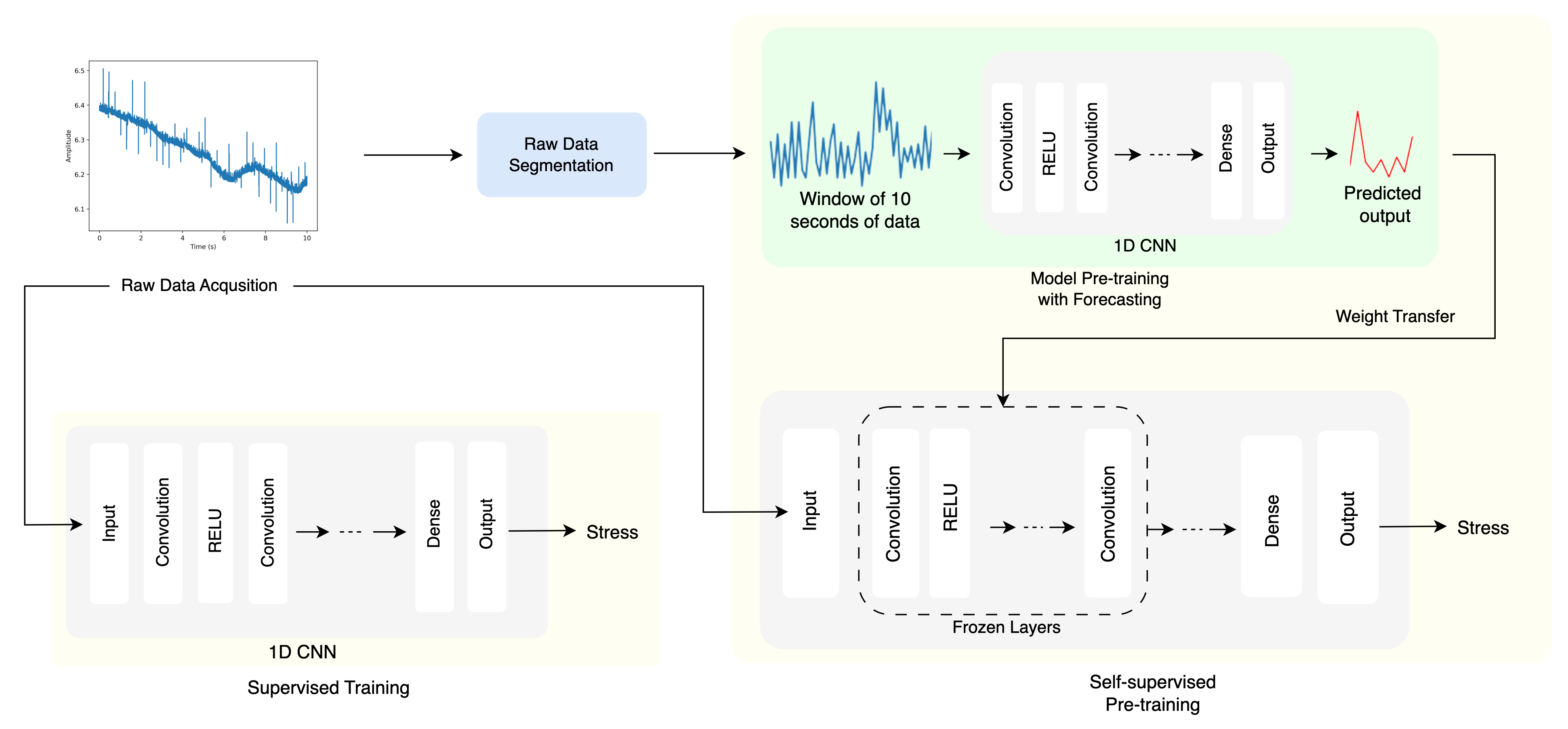
- 동일한 시퀀스의 양면을 최대한 유사하게 만들고, 다른 시퀀스는 다를 수 있도록 하는 SimCLR 스타일의 대비 손실를 사용하여, 비라벨 EDA 시퀀스를 대상으로 1D 컨volutional 신경망(CNN)을 사전 훈련하여 개인별 시간 패턴을 포착한다.
- 하류의 스트레스 예측 미세조정을 위해 사전 훈련된 인코더를 특징 추출기로 사용한다.
- WESAD 데이터셋에서 사용자별 스트레스 레이블의 소량을 사용하여 SSL로 학습된 모델을 미세조정한다.
- SSL 사전 훈련 없이 감독 학습 기반 베이스라인과 성능을 비교하며, 레이블 수를 다양하게 변화시켜 평가한다.
- 시간적 코어빙 증강 기법을 적용한 인스턴스 수준의 대비 학습을 통해 원시 EDA 신호에서 표현 학습을 향상시킨다.
- SimCLR 스타일의 대비 손실를 사용하여 동일한 시퀀스의 양면(긍정적 쌍) 간의 일치를 극대화하고, 다른 시퀀스(부정적 쌍) 간의 거리를 최소화한다.
실험 결과
연구 질문
- RQ1자기지도 사전 훈련을 통해 EDA 신호에서 개인 맞춤 스트레스 예측을 위한 레이블 예측 수를 줄일 수 있는가?
- RQ2제한된 레이블 데이터에서 SSL 기반 개인 맞춤화는 감독 학습 대비 성능에서 어떻게 비교되는가?
- RQ3SSL이 비라벨 생체신호 시퀀스에서 개인별 생리적 동적 패턴을 어느 정도 학습할 수 있는가?
- RQ4사전 훈련된 모델이 개인 간 일반화가 가능하며, 최소한의 레이블링으로 임상적으로 유의미한 성능을 달성할 수 있는가?
- RQ5SSL을 통해 주관적인 결과(예: 스트레스)를 실생활 저자료 환경에서 개인 맞춤 모바일 센싱이 가능한가?
주요 결과
- SSL 기반 개인 맞춤화 방법은 감독 학습 기반 베이스라인과 동일한 성능을 달성하면서도 레이블 데이터의 30퍼센트 미만을 사용하였다.
- SSL을 통한 사전 훈련은 특히 저자료 환경에서 모델 수렴과 일반화 성능을 크게 향상시켰다.
- 이 방법은 개인 맞춤 스트레스 예측의 레이블링 부담을 줄여 실시간 디지털 간섭 조치의 구현 가능성을 높였다.
- 사전 훈련된 임bedding은 개인별 EDA 신호의 시간 동적 패턴을 잘 포착하여, 더 적은 레이블로도 더 나은 미세조정 성능을 보였다.
- 최소한의 감독 학습 조건에서도 비개인화 및 비SSL 미세조정 모델보다 여러 평가 지표에서 뛰어난 성능을 보였다.
- 결과적으로 SSL는 풍부한 비라벨 생체신호 데이터를 효과적으로 활용하여, 최소한의 인간 레이블링으로도 고정밀도의 개인 맞춤 스트레스 모니터링을 가능하게 할 수 있음을 시사한다.

더 나은 연구,지금 바로 시작하세요
논문 읽기부터 검토까지, 연구 시간을 획기적으로 줄여보세요.
카드 등록 없음 · 무료 플랜 제공
이 리뷰는 AI가 만들고, 인간 에디터가 검토했습니다.