
[Paper Review] Position Paper: Agent AI Towards a Holistic Intelligence
This position paper defines Agent AI as embodied, multimodal systems that integrate large foundation models into cohesive, interactive agents and outlines a framework for Agent Foundation Models, learning, memory, action, and cognition toward holistic intelligence.
Recent advancements in large foundation models have remarkably enhanced our understanding of sensory information in open-world environments. In leveraging the power of foundation models, it is crucial for AI research to pivot away from excessive reductionism and toward an emphasis on systems that function as cohesive wholes. Specifically, we emphasize developing Agent AI -- an embodied system that integrates large foundation models into agent actions. The emerging field of Agent AI spans a wide range of existing embodied and agent-based multimodal interactions, including robotics, gaming, and healthcare systems, etc. In this paper, we propose a novel large action model to achieve embodied intelligent behavior, the Agent Foundation Model. On top of this idea, we discuss how agent AI exhibits remarkable capabilities across a variety of domains and tasks, challenging our understanding of learning and cognition. Furthermore, we discuss the potential of Agent AI from an interdisciplinary perspective, underscoring AI cognition and consciousness within scientific discourse. We believe that those discussions serve as a basis for future research directions and encourage broader societal engagement.
Motivation & Objective
- Motivate a shift from reductionist AI toward integrated, embodied agents that operate as cohesive systems.
- Introduce the Agent Foundation Model as a core building block for embodied intelligence.
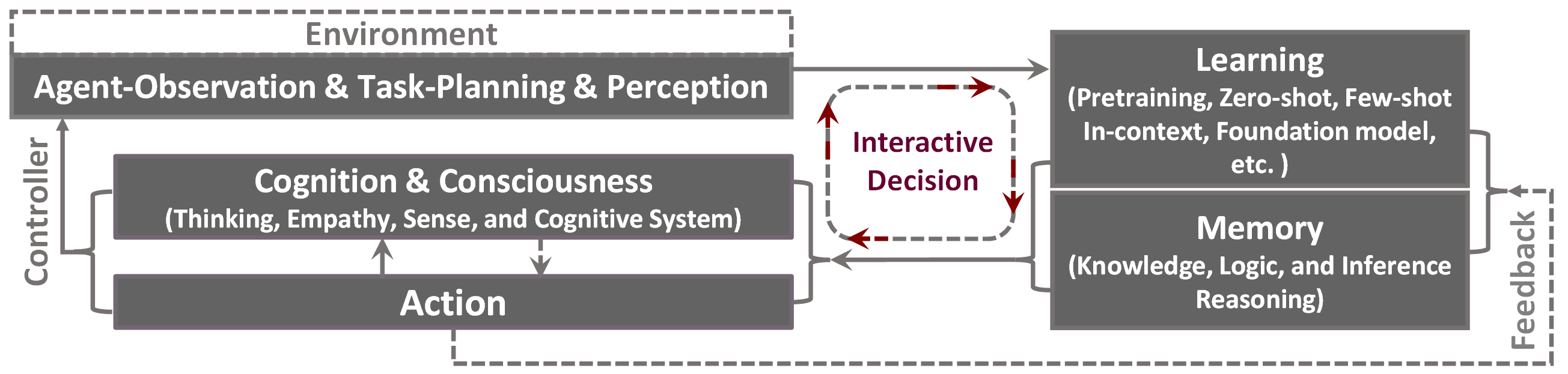
- Outline the five-module architecture (environment perception, learning, memory, action, cognition) enabling holistic agent behavior.
- Discuss methodological approaches for training, memory, action prediction, and cross-modal integration in Agent AI.
- Highlight ethical, societal, and interdisciplinary considerations for advancing Agent AI toward AGI-like capabilities.
Proposed method
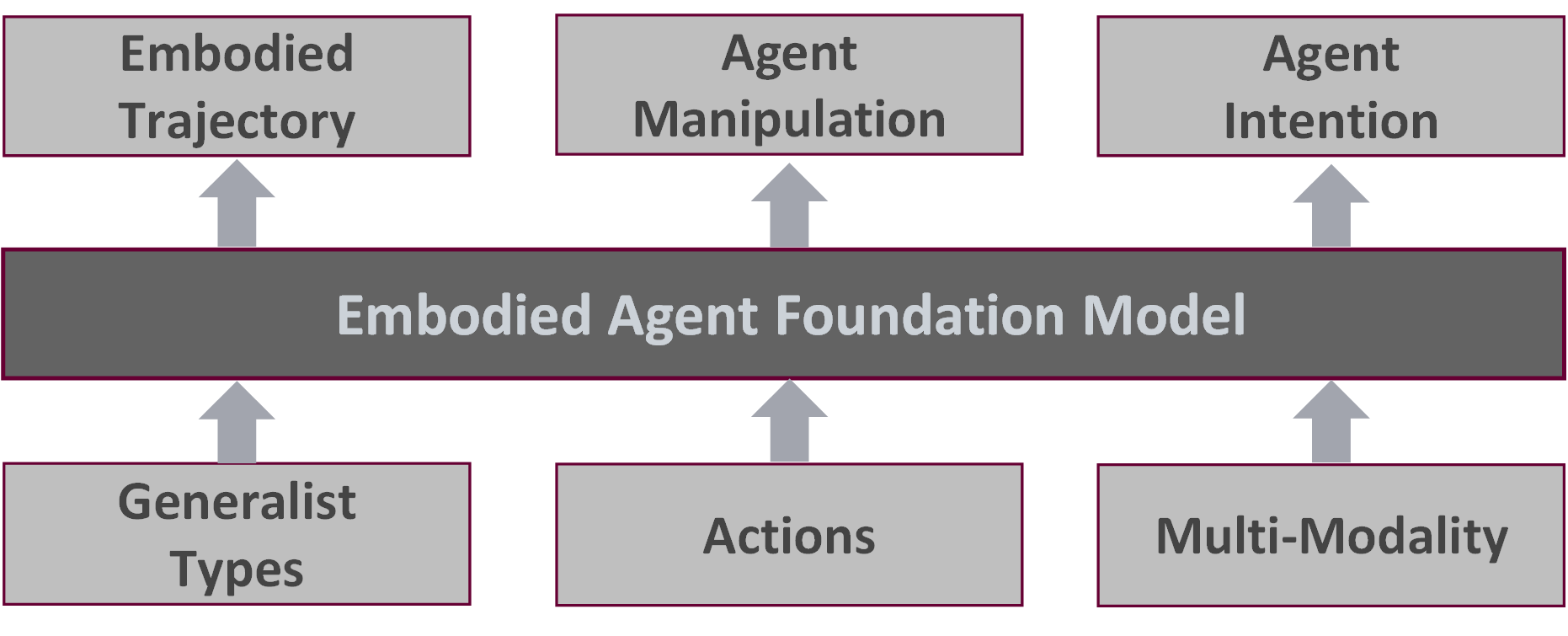
- Propose the Agent Foundation Model framework that unifies language, vision, memory, and action for embodied agents.
- Describe how the Agent Transformer processes multimodal inputs and predicts low-level actions, high-level intentions, and instructions.
- Explain learning strategies including reinforcement learning (RL), imitation learning (IL), and RL from human feedback (RLHF) for agent policy refinement.
- Discuss optimization in spatial and temporal dimensions for multi-agent coordination and task scheduling.
- Present self-improvement pathways for transformers through human feedback and environment interactions.
- Outline data-driven self-improvement approaches leveraging multimodal data and generated training data.
Experimental results
Research questions
- RQ1How can an agent-grounded, multimodal foundation model be trained to predict both fine-grained actions and high-level intentions across domains?
- RQ2What architecture and training strategies enable cohesive cognition, memory, perception, and action to achieve holistic intelligence in embodied agents?
- RQ3What ethical and societal considerations arise when pursuing Agent AI toward AGI-like capabilities?
- RQ4How can agent–environment–human interactions be optimized to improve robustness and generalization across robotics, gaming, and healthcare?
Key findings
- The paper articulates a cohesive five-module architecture for Agent AI: Environment and Perception, Learning, Memory, Action, and Cognition.
- It introduces the Agent Foundation Model and Agent Transformer as multimodal encoders capable of predicting low-level actions, agent types, and high-level instructions using past interactions as context.
- RL, IL, and RLHF are presented as essential learning paradigms to train agents in diverse environments, including robotics, gaming, and healthcare.
- Optimization is discussed in spatial and temporal terms, including multi-agent coordination, task scheduling, and convention discovery to improve coordination with humans and other agents.
- Self-improvement pathways for transformers are proposed through continual environmental interaction and human feedback, enabling progressively better policy and behavior.
- The categorization framework groups Agent AI into manipulation and intention actions across physical and virtual environments, plus non-embodied multimodal agents, to map existing research and define future directions.
Read this paper
Open the full text in the Nubint reader and ask about any passage as you read.
Read this paper on NubintThis review was generated by AI from the original paper. Please check the paper before citing it.