
[Paper Review] Pre-optimizing variational quantum eigensolvers with tensor networks
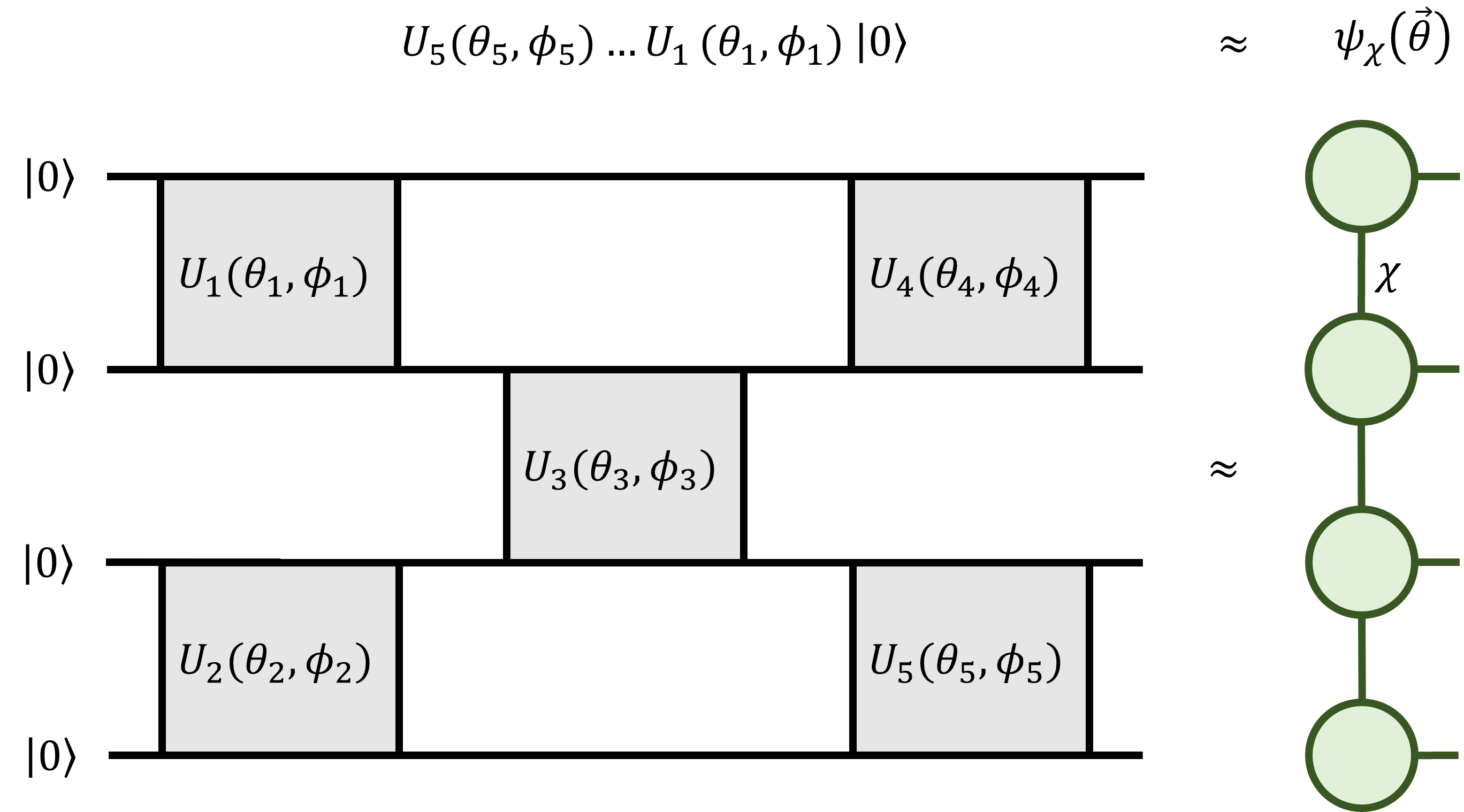
The paper introduces VTNE, a classical pre-optimization of VQE where the parameterized quantum circuit is approximated as a matrix product state to find good initial parameters, then used to initialize VQE on quantum hardware for 1D and 2D Fermi-Hubbard models.
The variational quantum eigensolver (VQE) is a promising algorithm for demonstrating quantum advantage in the noisy intermediate-scale quantum (NISQ) era. However, optimizing VQE from random initial starting parameters is challenging due to a variety of issues including barren plateaus, optimization in the presence of noise, and slow convergence. While simulating quantum circuits classically is generically difficult, classical computing methods have been developed extensively, and powerful tools now exist to approximately simulate quantum circuits. This opens up various strategies that limit the amount of optimization that needs to be performed on quantum hardware. Here we present and benchmark an approach where we find good starting parameters for parameterized quantum circuits by classically simulating VQE by approximating the parameterized quantum circuit (PQC) as a matrix product state (MPS) with a limited bond dimension. Calling this approach the variational tensor network eigensolver (VTNE), we apply it to the 1D and 2D Fermi-Hubbard model with system sizes that use up to 32 qubits. We find that in 1D, VTNE can find parameters for PQC whose energy error is within 0.5% relative to the ground state. In 2D, the parameters that VTNE finds have significantly lower energy than their starting configurations, and we show that starting VQE from these parameters requires non-trivially fewer operations to come down to a given energy. The higher the bond dimension we use in VTNE, the less work needs to be done in VQE. By generating classically optimized parameters as the initialization for the quantum circuit one can alleviate many of the challenges that plague VQE on quantum computers.
Motivation & Objective
- Address challenges in VQE optimization on NISQ devices (barren plateaus, noise, slow convergence).
- Propose VTNE to pre-optimize PQCs classically using tensor networks.
- Demonstrate the approach on 1D and 2D Fermi-Hubbard models up to 32 qubits.
- Quantify how MPS bond dimension affects classical pre-optimization and quantum-resource savings.
Proposed method
- Represent the parameterized quantum circuit (PQC) as a matrix product state (MPS) with fixed bond dimension chi via TEBD contraction.
- Use a matrix product operator (MPO) for the Hamiltonian to compute the approximate energy E_chi(theta) = <psi_chi(theta)|H|psi_chi(theta)>.
- Compute an approximate gradient by a pathway that uses two circuit evaluations to update L and R MPS factors (Eq. 7-11) and truncate to bond dimension chi during recursion.
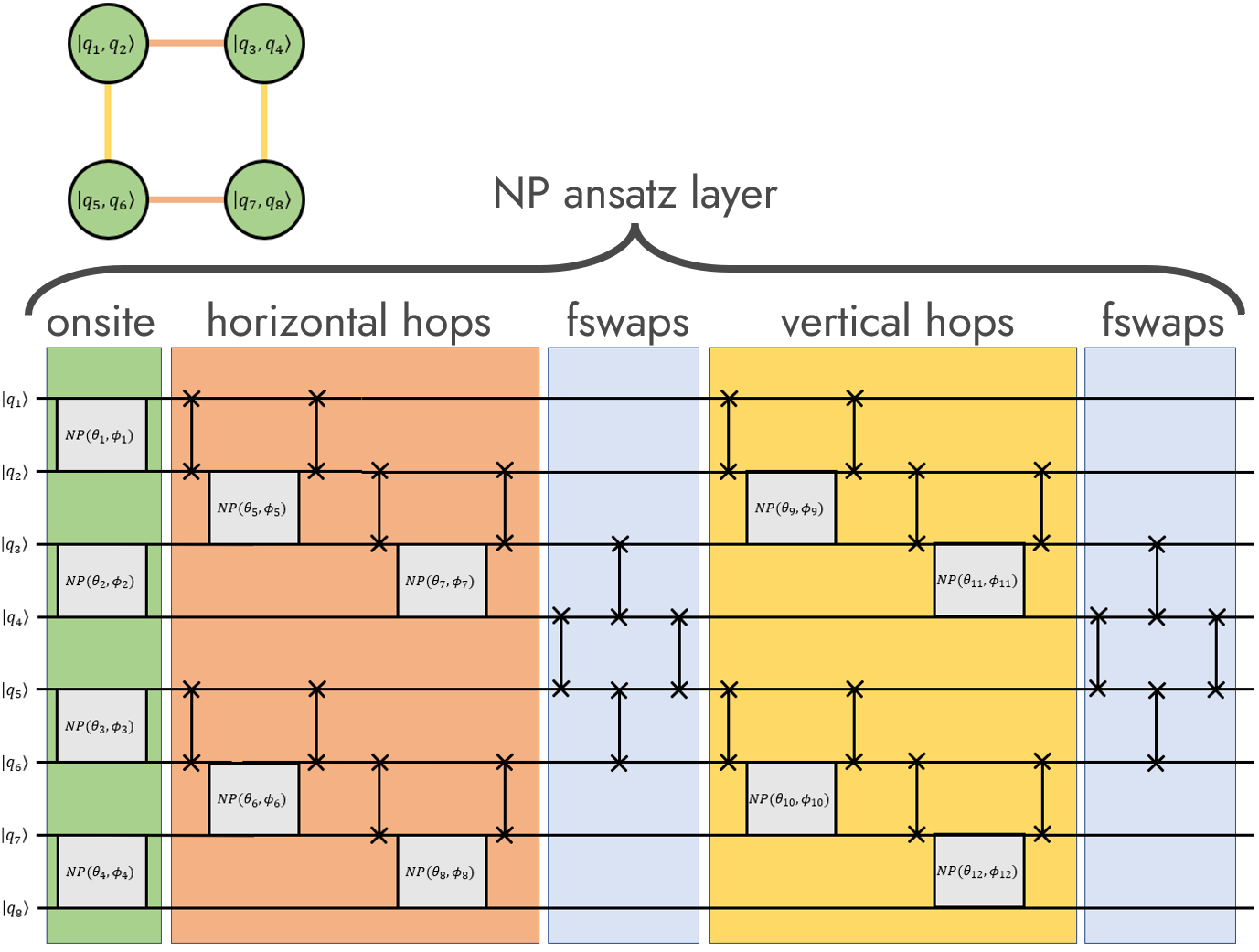
- Initialize the interacting (U=2) optimization from non-interacting (U=0) optimized parameters to aid convergence.
- Implement with ITensor to perform tensor network calculations.
- Compare PTNE-preoptimized parameters against random initializations in VQE with Adam optimization.
Experimental results
Research questions
- RQ1Can classical VTNE pre-optimization yield high-quality initial parameters for VQE on quantum hardware?
- RQ2How does the MPS bond dimension chi affect the accuracy of VTNE-precomputed parameters and the subsequent VQE energy?
- RQ3Do VTNE-initialized VQE runs require fewer quantum-resource (gate) operations to reach a target energy compared to random initializations?
- RQ4How does the performance of VTNE differ between 1D and 2D Fermi-Hubbard models?
- RQ5What is the relationship between VTNE results and established classical benchmarks (e.g., DMRG) for these systems?
Key findings
- In 1D, VTNE can yield energy errors within 0.5% relative to the ground state for suitable parameters.
- In 2D, VTNE-derived parameters have significantly lower energy than random starts, and pre-optimization reduces subsequent VQE effort.
- Increasing the MPS bond dimension chi reduces the energy error and the number of gradient evaluations needed in VQE.
- For 1D systems up to 32 qubits, chi_b = 16 achieves relative energy error ≲3%.
- VQE starting from classically optimized VTNE parameters requires notably fewer gradient evaluations than starting from random parameters (e.g., saves ~400-1000 steps in presented cases).
- Using a larger MPS bond dimension for contraction during VQE (chi_a > chi_b) yields energies comparable to or better than those with chi_b, indicating potential gains when run on hardware.
Read this paper
Open the full text in the Nubint reader and ask about any passage as you read.
Read this paper on NubintThis review was generated by AI from the original paper. Please check the paper before citing it.