
[Paper Review] Predicting a Protein's Stability under a Million Mutations
Introduces Mutate Everything, a parallel decoding method that predicts ΔΔG for all single and higher-order mutations in one forward pass, enabling scalable stability assessment across proteins.
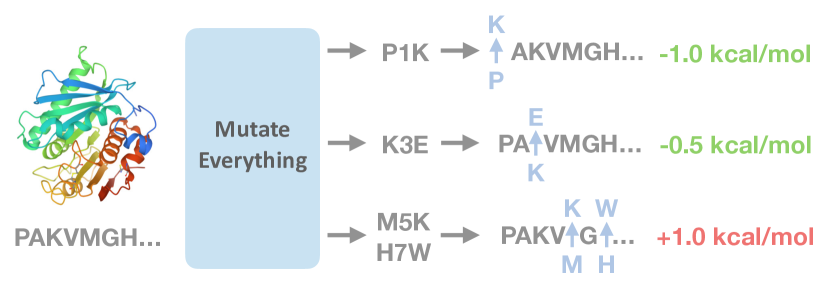
Stabilizing proteins is a foundational step in protein engineering. However, the evolutionary pressure of all extant proteins makes identifying the scarce number of mutations that will improve thermodynamic stability challenging. Deep learning has recently emerged as a powerful tool for identifying promising mutations. Existing approaches, however, are computationally expensive, as the number of model inferences scales with the number of mutations queried. Our main contribution is a simple, parallel decoding algorithm. Our Mutate Everything is capable of predicting the effect of all single and double mutations in one forward pass. It is even versatile enough to predict higher-order mutations with minimal computational overhead. We build Mutate Everything on top of ESM2 and AlphaFold, neither of which were trained to predict thermodynamic stability. We trained on the Mega-Scale cDNA proteolysis dataset and achieved state-of-the-art performance on single and higher-order mutations on S669, ProTherm, and ProteinGym datasets. Code is available at https://github.com/jozhang97/MutateEverything
Motivation & Objective
- Motivate rapid identification of stabilizing mutations to aid protein engineering under epistasis.
- Develop a scalable decoder that computes ΔΔG for all single and higher-order mutations in one forward pass.
- Demonstrate state-of-the-art performance on benchmark stability datasets (ProTherm, S669, ProteinGym).
- Show practical scalability to enumerate mutations across proteins and compare favorably with existing methods.
Proposed method
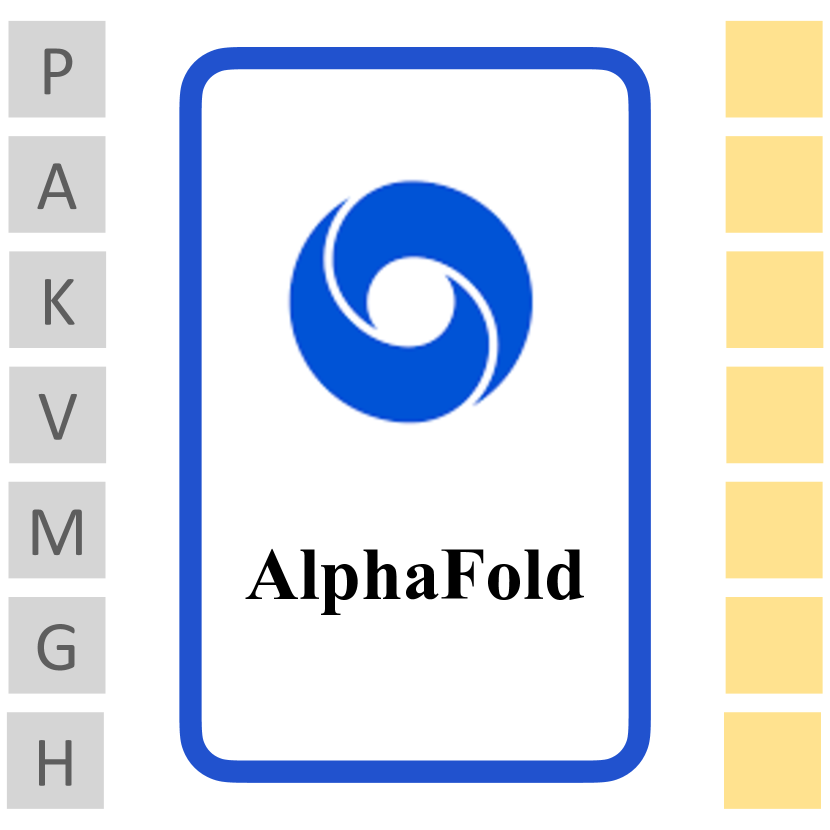
- Use a pre-trained backbone (AlphaFold, fine-tuned; can also use ESM2) to extract per-position features for the sequence.
- For each position and possible amino acid, compute a latent mutation representation z(μ)=f^t(x_p)+h^t.
- Decode single mutations with a lightweight head g^1 to predict ΔΔG from z(μ).
- For higher-order mutations M={μ_k}, aggregate their single-mutation representations (sum) and decode with a lightweight head g to predict ΔΔG.
- Precompute all z(μ) for the L×20 possible mutations; for any mutation set, index, sum relevant z(μ), and decode in parallel.
- Train with a Huber loss on single and double mutants, learning residuals for higher-order interactions as needed.
Experimental results
Research questions
- RQ1Can a unified, parallel decoder accurately predict ΔΔG for both single and higher-order mutations?
- RQ2How does the Mutate Everything framework perform on established stability benchmarks (ProTherm, S669, ProteinGym) compared to state-of-the-art methods?
- RQ3Does enumerating all mutations in one forward pass enable tractable stability analysis across large proteins or the whole proteome?
- RQ4To what extent can fine-tuning backbones like AlphaFold/ESM2 improve stability prediction without structural coordinates?
- RQ5How does the model handle epistatic effects in higher-order mutation sets?
Key findings
- Achieves state-of-the-art Spearman correlations on ProTherm PTMul (0.53) and S669 (0.56) and outperforms on ProteinGym stability benchmarks (0.52–0.53 r_s) and AUC/ MCC metrics.
- Ranks stabilizing double mutations ahead of destabilizing ones with nDCG 0.43 vs 0.25 and DetPr 0.16 vs 0.10 on cDNA2.
- Runs all single and double mutations in one forward pass in seconds on a single GPU (0.6s with ESM2, 12.1s with AlphaFold backbone).
- Outperforms additive baselines by modeling epistasis rather than simple summation of single mutations.
- Demonstrates generalization to ProteinGym and ProteinGym-Stability, with ensembling providing gains over Tranception-based methods.
Better researchstarts right now
From reading papers to final review, dramatically reduce your research time.
No credit card · Free plan available
This review was created by AI and reviewed by human editors.