
[Paper Review] Predicting Tuberculosis from Real-World Cough Audio Recordings and Metadata
This study develops and evaluates machine learning models that predict tuberculosis (TB) using cough audio recordings and clinical metadata collected via a mobile app in low-resource regions. It achieves an AUC of 0.81±0.05 when combining cough sounds with demographic and clinical data, demonstrating that mobile-based audio and symptom analysis can improve TB case-finding efficiency.
Tuberculosis (TB) is an infectious disease caused by the bacterium Mycobacterium tuberculosis and primarily affects the lungs, as well as other body parts. TB is spread through the air when an infected person coughs, sneezes, or talks. Medical doctors diagnose TB in patients via clinical examinations and specialized tests. However, coughing is a common symptom of respiratory diseases such as TB. Literature suggests that cough sounds coming from different respiratory diseases can be distinguished by both medical doctors and computer algorithms. Therefore, cough recordings associated with patients with and without TB seems to be a reasonable avenue of investigation. In this work, we utilize a very large dataset of TB and non-TB cough audio recordings obtained from the south-east of Africa, India, and the south-east of Asia using a fully automated phone-based application (Hyfe), without manual annotation. We fit statistical classifiers based on spectral and time domain features with and without clinical metadata. A stratified grouped cross-validation approach shows that an average Area Under Curve (AUC) of approximately 0.70 $\pm$ 0.05 both for a cough-level and a participant-level classification can be achieved using cough sounds alone. The addition of demographic and clinical factors increases performance, resulting in an average AUC of approximately 0.81 $\pm$ 0.05. Our results suggest mobile phone-based applications that integrate clinical symptoms and cough sound analysis could help community health workers and, most importantly, health service programs to improve TB case-finding efforts while reducing costs, which could substantially improve public health.
Motivation & Objective
- To develop machine learning models that predict TB status using cough audio recordings and clinical metadata from real-world, community-based settings.
- To evaluate the performance of conventional machine learning and deep learning models in distinguishing TB from non-TB coughs using automated, phone-based data collection.
- To assess whether integrating clinical and demographic metadata improves TB prediction accuracy beyond cough audio alone.
- To provide a publicly available, large-scale dataset and benchmark for future research in AI-driven TB screening.
- To support public health efforts by enabling low-cost, non-invasive digital tools for community-based TB case finding.
Proposed method
- Collected a large dataset of cough audio recordings and clinical metadata from 7 countries using a fully automated, phone-based application (Hyfe) without manual annotation.
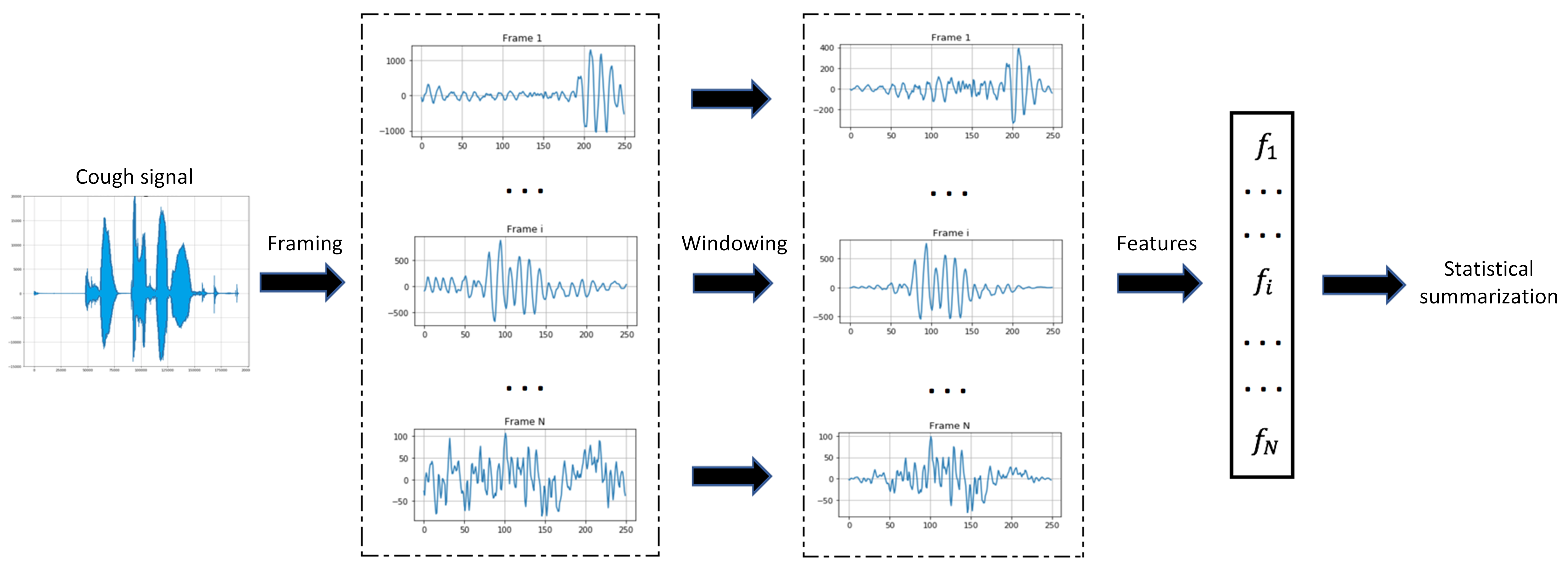
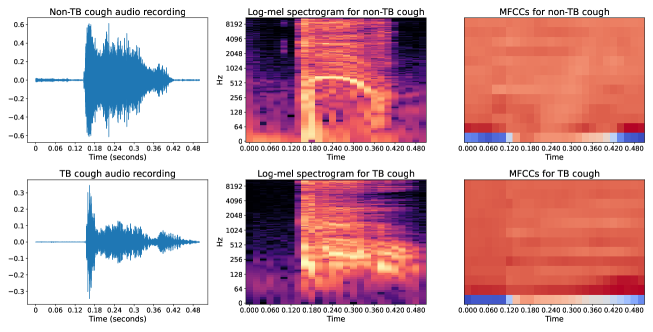
- Extracted low-level acoustic features (LLDs) including spectral, temporal, and spectrotemporal features such as MFCCs, spectral centroid, zero-crossing rate, and log-mel spectrograms.
- Trained conventional machine learning models (e.g., logistic regression, SVM, random forests, AdaBoost, MLP) on both audio-only and audio-plus-metadata inputs.
- Applied deep learning via 2D convolutional neural networks (2D-CNNs) on spectrogram representations of cough sounds to learn hierarchical patterns.
- Used stratified grouped cross-validation to account for participant-level data structure and avoid data leakage.
- Combined individual cough predictions using weighted averaging to improve participant-level classification performance.
Experimental results
Research questions
- RQ1Can cough audio recordings alone reliably predict TB status in real-world, community-based populations?
- RQ2How does the inclusion of clinical and demographic metadata affect the performance of TB prediction models using cough sounds?
- RQ3Which machine learning models—conventional or deep learning—perform best in classifying TB from cough audio and metadata?
- RQ4Does aggregating predictions across multiple coughs per individual improve overall diagnostic accuracy?
- RQ5Can mobile-based audio and symptom analysis serve as a scalable, low-cost tool for TB case-finding in high-burden, low-resource settings?
Key findings
- In the cough-only experiment, the best-performing model (2D-CNN) achieved a mean AUC of approximately 0.70±0.05 on a cough-level classification task.
- Participant-level classification using aggregated cough probabilities improved performance, with all models achieving higher AUC than cough-level predictions.
- In the Cough+Metadata experiment, all models except MLPs achieved a mean AUC above 0.80, with the ensemble model AdaBoost reaching 0.82±0.05 on a cough-level basis.
- The addition of clinical and demographic metadata increased the average AUC from ~0.70 (cough-only) to ~0.81 (cough+metadata), indicating significant performance gains.
- Logistic regression and AdaBoost outperformed more complex models like Random Forests and MLPs, suggesting simpler models may be more effective for this task.
- Weighted averaging of cough-level predictions improved participant-level classification, indicating that ensemble strategies can enhance system robustness.
Better researchstarts right now
From reading papers to final review, dramatically reduce your research time.
No credit card · Free plan available
This review was created by AI and reviewed by human editors.