
[Paper Review] Probing Permanent Dipoles in CdSe Nanoplatelets with Transient Electric Birefringence
This study uses transient electric birefringence (TEB) to detect a large ground-state electric dipole moment (>245 D) in 5-monolayer-thick zinc-blende CdSe nanoplatelets (NPLs), oriented along their length. Upon face-to-face stacking induced by oleic acid, the in-plane dipole components cancel while normal components add, yielding a net 80 D dipole parallel to the normal, explaining their strong stacking propensity and poor colloidal stability despite the non-polar $τ$3m symmetry of bulk CdSe.
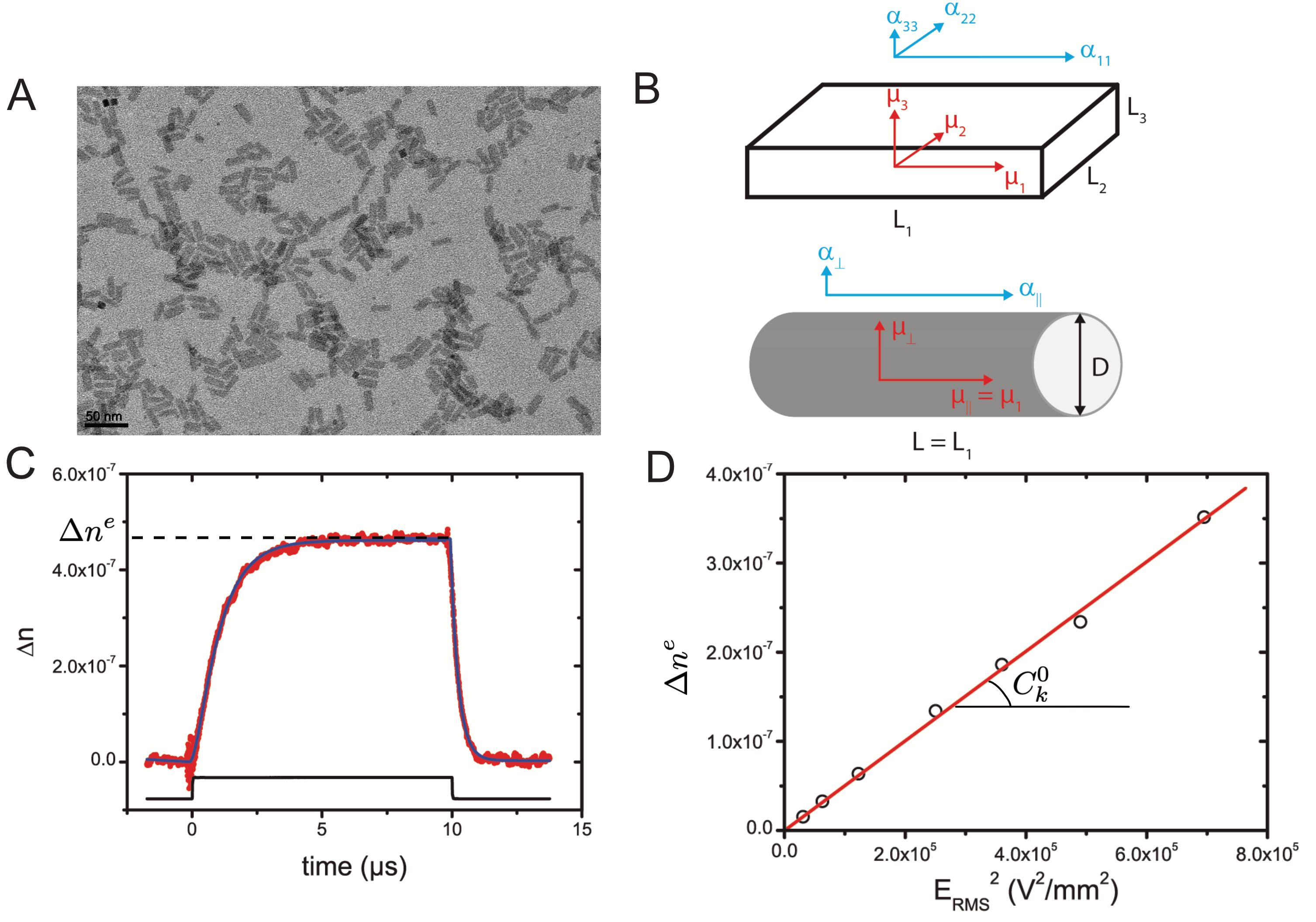
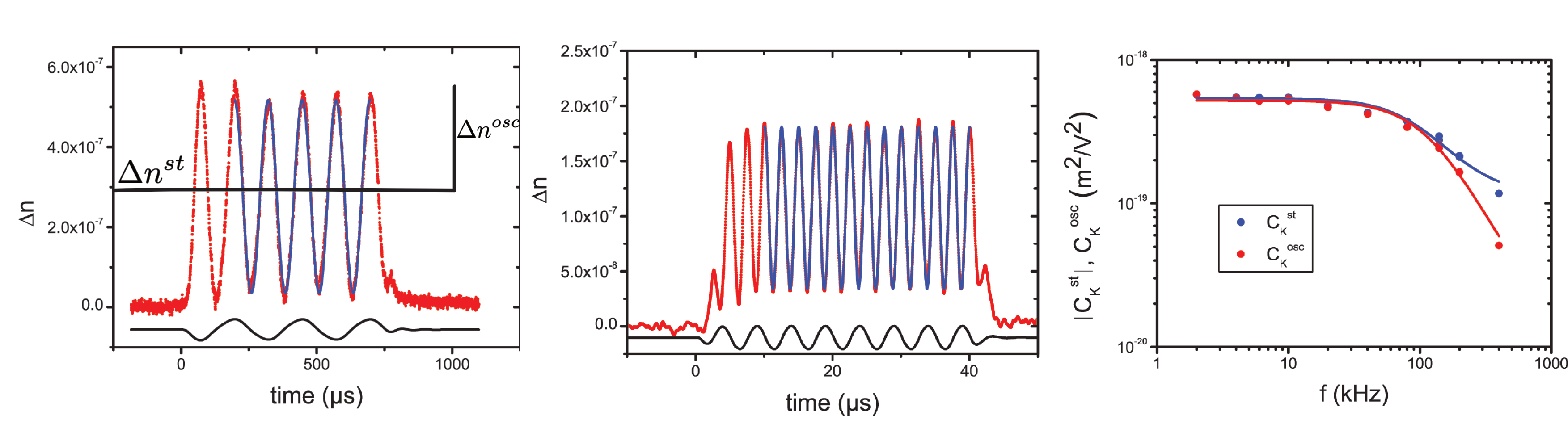
Zinc-blende CdSe semiconducting nanoplatelets (NPL) show outstanding quantum confinement properties thanks to their small, atomically-controlled, thickness. For example, they display extremely sharp absorption peaks that make them very interesting objects for optoelectronic applications. However, the presence of a ground-state electric dipole for these nanoparticles has not yet been investigated. We therefore used transient electric birefringence (TEB) to probe the electric dipole of 5-monolayer thick zinc-blende CdSe NPL with a parallelepipedic shape. We studied a dilute dispersion of isolated NPL coated with branched ligands and we measured, as a function of time, the birefringence induced by DC and AC field pulses. The electro-optic behavior proves the presence of a large dipolar moment (> 245 D) oriented along the length of the platelets. We then induced the slow face-to-face stacking of the NPL by adding oleic acid. In these stacks, the in-plane dipole components of consecutive NPL cancel whereas their normal components add. Moreover, interestingly, the excess polarizability tensor of the NPL stacks gives rise to an electro-optic contribution opposite to that of the electric dipole. By monitoring the TEB signal of the slowly-growing stacks over up to a year, we extracted the evolution of their average length with time and we showed that their electro-optic response can be explained by the presence of a 80 D dipolar component parallel to their normal. In spite of the $\\bar{4}$3m space group of bulk ZB CdSe, these NPL thus bear an important ground-state dipole whose magnitude per unit volume is twice that found for wurtzite CdSe nanorods. We discuss the possible origin of this electric dipole, its consequences for the optical properties of these nanoparticles, and how it could explain their strong stacking propensity that severely hampers their colloidal stability.
Motivation & Objective
- To investigate the presence of a ground-state electric dipole in zinc-blende CdSe nanoplatelets (NPLs), which are otherwise expected to be non-polar due to their cubic symmetry.
- To understand the origin and magnitude of any dipole moment in these NPLs, particularly given their exceptional optical properties and strong tendency to stack.
- To probe how dipole alignment evolves during slow face-to-face stacking of NPLs, and how this affects their electro-optic response.
- To correlate the time-resolved TEB signal with the growth kinetics of NPL stacks over a period of up to one year.
- To explain the observed colloidal instability of CdSe NPLs in terms of their intrinsic dipole moment and stacking behavior.
Proposed method
- Transient electric birefringence (TEB) was employed to measure the time-resolved optical anisotropy induced by applied DC and AC electric field pulses.
- A custom-built, high-sensitivity TEB setup with a digital oscilloscope and PMT was used, optimized with a Senarmont compensator for weak signals and a Berek compensator for strong signals.
- The field-inversion 'double-field' trick was applied to isolate the induced birefringence from background signals, enabling measurement of internal fields up to 2 kV/mm.
- Capillaries sealed with electrodes allowed long-term, in-situ monitoring of TEB over 15 months without sample degradation or solvent evaporation.
- Rotational diffusion and response time were controlled via load resistor (R_L ≤ 1 kΩ) and deconvolution techniques to achieve sub-50 ns time resolution for isolated NPLs.
- Stacking kinetics were monitored by measuring TEB at intervals from 0 to 415 days after oleic acid addition, with path length fixed at 1 mm to minimize light scattering and absorption.
Experimental results
Research questions
- RQ1Does the zinc-blende CdSe nanoplatelet possess a permanent ground-state electric dipole despite its $τ$3m symmetry?
- RQ2What is the magnitude and orientation of the dipole moment in isolated 5-monolayer CdSe NPLs?
- RQ3How does the dipole moment evolve during slow face-to-face stacking of NPLs, and what is the net electro-optic response of the resulting stacks?
- RQ4Why do CdSe NPLs exhibit strong stacking propensity despite their non-polar bulk structure?
- RQ5Can the time-resolved TEB signal be used to extract the average length evolution of NPL stacks over extended timescales?
Key findings
- A permanent electric dipole moment of >245 D was detected in isolated 5-monolayer CdSe nanoplatelets, oriented along their length, indicating a significant asymmetry in charge distribution.
- The dipole moment per unit volume in these NPLs is twice that of wurtzite CdSe nanorods, despite the absence of a polar crystal structure in bulk zinc-blende CdSe.
- Upon face-to-face stacking induced by oleic acid, in-plane dipole components cancel while normal components add, resulting in a net 80 D dipole parallel to the normal direction.
- The electro-optic response of the stacks is dominated by a 80 D dipole component, with an additional contribution from excess polarizability tensor that opposes the dipole effect.
- The TEB signal evolution over 15 months allowed extraction of the average stack length as a function of time, confirming slow, continuous growth.
- The observed dipole and stacking behavior explain the severe colloidal instability of CdSe NPLs, which hinders their practical applications.
Read this paper
Open the full text in the Nubint reader and ask about any passage as you read.
Read this paper on NubintThis review was generated by AI from the original paper. Please check the paper before citing it.