
[Paper Review] Problematic Advertising and its Disparate Exposure on Facebook
This study investigates problematic advertising on Facebook by analyzing a 3-month longitudinal panel of 132 users, identifying four key categories of problematic ads—deceptive, prohibited by Facebook, clickbait, and sensitive topics—and finding that older users and racial minorities are disproportionately exposed. The study attributes 22% of problematic ad exposure to platform-level personalization algorithms, indicating algorithmic bias in ad delivery.
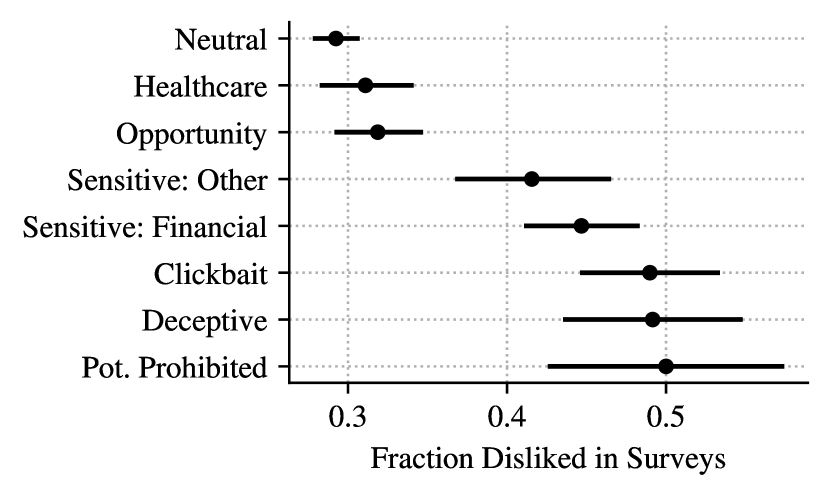
Targeted advertising remains an important part of the free web browsing experience, where advertisers' targeting and personalization algorithms together find the most relevant audience for millions of ads every day. However, given the wide use of advertising, this also enables using ads as a vehicle for problematic content, such as scams or clickbait. Recent work that explores people's sentiments toward online ads, and the impacts of these ads on people's online experiences, has found evidence that online ads can indeed be problematic. Further, there is the potential for personalization to aid the delivery of such ads, even when the advertiser targets with low specificity. In this paper, we study Facebook -- one of the internet's largest ad platforms -- and investigate key gaps in our understanding of problematic online advertising: (a) What categories of ads do people find problematic? (b) Are there disparities in the distribution of problematic ads to viewers? and if so, (c) Who is responsible -- advertisers or advertising platforms? To answer these questions, we empirically measure a diverse sample of user experiences with Facebook ads via a 3-month longitudinal panel. We categorize over 32,000 ads collected from this panel ($n=132$); and survey participants' sentiments toward their own ads to identify four categories of problematic ads. Statistically modeling the distribution of problematic ads across demographics, we find that older people and minority groups are especially likely to be shown such ads. Further, given that 22% of problematic ads had no specific targeting from advertisers, we infer that ad delivery algorithms (advertising platforms themselves) played a significant role in the biased distribution of these ads.
Motivation & Objective
- To identify the specific categories of Facebook ads that users perceive as problematic.
- To examine whether there are demographic disparities in the exposure to problematic ads on Facebook.
- To determine whether advertisers or advertising platforms (via personalization algorithms) are primarily responsible for skewed ad exposure.
Proposed method
- Recruited a diverse panel of 132 paid participants to longitudinally track their Facebook ad experiences over three months.
- Instrumented participants’ desktop browsers to log all Facebook ads and extract detailed targeting information provided by Facebook.
- Developed a codebook of ad categories based on computational, social science research, and platform policies, covering 8 types including clickbait, sensitive topics, and opportunity ads.
- Used human raters to classify over 32,000 collected ads into the defined categories using the codebook.
- Conducted regular surveys to assess participants’ sentiment toward the ads they received, identifying which categories were perceived as problematic.
- Applied statistical modeling to analyze demographic disparities in problematic ad exposure and disentangle the roles of advertiser targeting versus platform personalization.
Experimental results
Research questions
- RQ1What categories of ads do users perceive as problematic on Facebook?
- RQ2Are there demographic disparities in the distribution of problematic ads across users?
- RQ3To what extent are advertisers versus advertising platform personalization algorithms responsible for observed disparities in problematic ad exposure?
Key findings
- Participants most frequently found deceptive ads, Facebook-prohibited content, clickbait, and sensitive-topic ads (e.g., financial, gambling, weight loss) to be problematic.
- Older users were significantly more likely to be exposed to deceptive and clickbait ads compared to younger users.
- Black participants were disproportionately shown clickbait ads, indicating a racial disparity in exposure.
- Men were more likely to encounter financial ads—classified as sensitive due to regulatory and policy restrictions—despite their mixed nature of potential harm and benefit.
- 22% of problematic ads had no specific targeting from advertisers, indicating that platform-level personalization algorithms played a major role in their biased distribution.
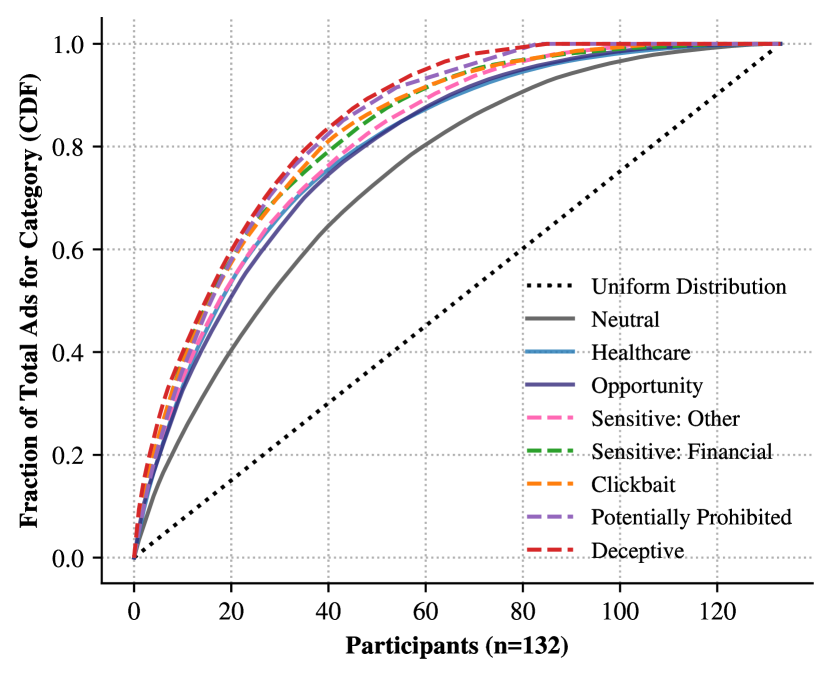
- The distribution of problematic ads was skewed, with a subset of users receiving over three times the median exposure to such content.
Better researchstarts right now
From reading papers to final review, dramatically reduce your research time.
No credit card · Free plan available
This review was created by AI and reviewed by human editors.