
[Paper Review] Progress in Direct Measurements of the Hubble Constant
A review of two decades of direct local measurements of H0, focusing on Cepheids, TRGB, and JAGB, with JWST results and systematic uncertainties, to resolve the H0 tension.
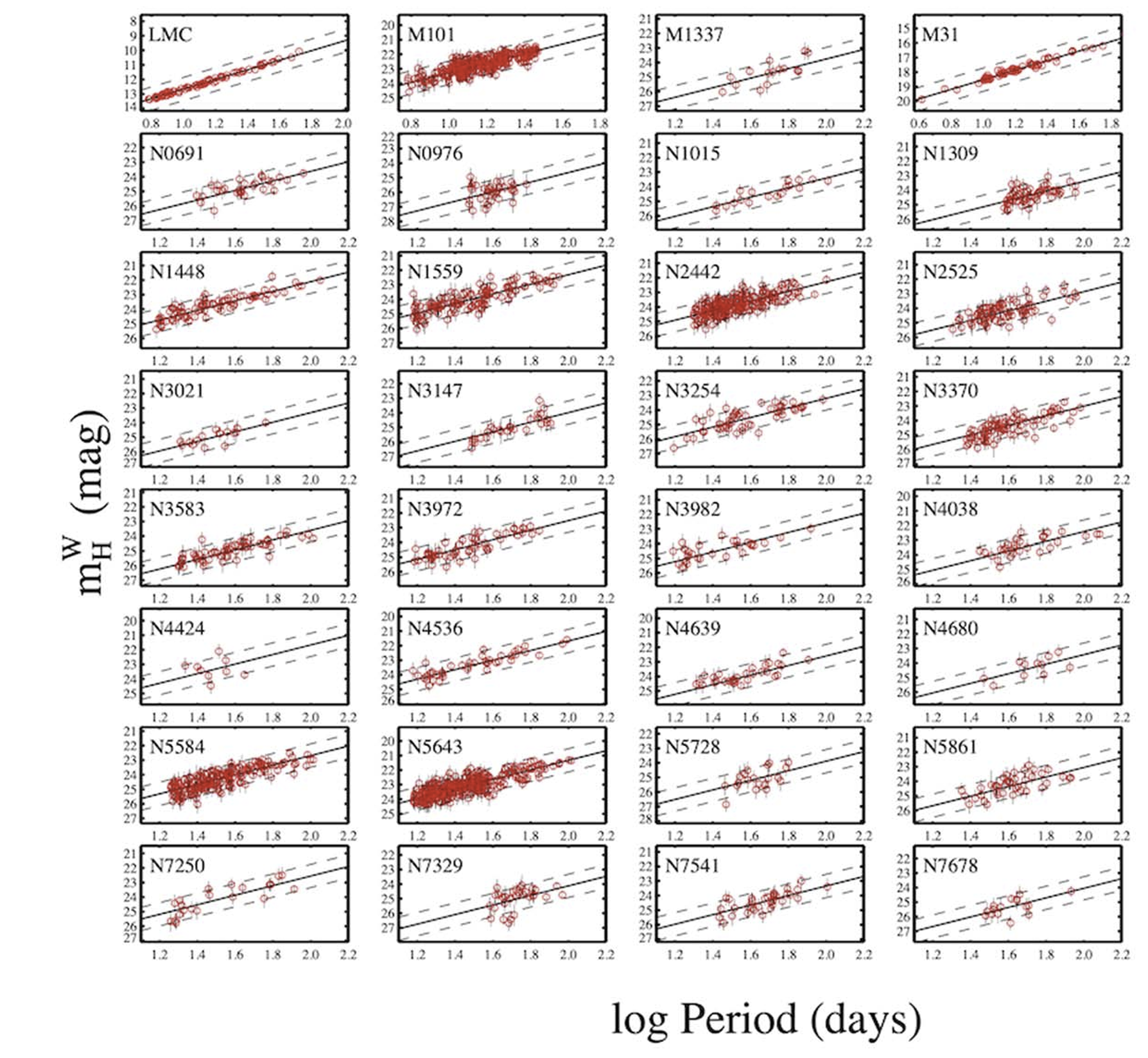
One of the most exciting and pressing issues in cosmology today is the discrepancy between some measurements of the local Hubble constant and other values of the expansion rate inferred from the cosmic microwave background (CMB) radiation. Resolving these differences holds the potential for the discovery of new physics beyond the standard model of cosmology: Lambda Cold Dark Matter (LCDM), a successful model that has been in place for more than 20 years. Given both the fundamental significance of this outstanding discrepancy, and the many-decades-long effort to increase the accuracy of the extragalactic distance scale, it is critical to demonstrate that the local measurements are convincingly free from residual systematic errors. We review the progress over the past quarter century in measurements of the local value of the Hubble constant, and discuss remaining challenges. Particularly exciting are new data from the James Webb Space Telescope (JWST). JWST is delivering high-resolution near-infrared imaging data to both test for and to address directly several of the systematic uncertainties that have historically limited the accuracy of the extragalactic distance scale. We present an overview of our new JWST program to observe Cepheids, TRGB and JAGB stars. For the first galaxy in our program, NGC 7250, the high-resolution JWST images demonstrate that many of the Cepheids observed with the Hubble Space Telescope (HST) are significantly crowded by nearby neighbors. Avoiding the more significantly crowded variables, the scatter in the JWST near-infrared (NIR) Cepheid period-luminosity relation is decreased by a factor of two compared to those from HST, illustrating the power of JWST for improvements to local measurements of Ho. Ultimately, these data will either confirm the standard model, or provide robust evidence for the inclusion of additional new physics.
Motivation & Objective
- Assess the historical and current state of local H0 measurements and their precision.
- Identify and evaluate dominant systematics affecting Cepheid- and TRGB-based distances.
- Summarize the emergence of JWST data and its impact on reducing crowding and dust-related uncertainties.
- Discuss alternative distance indicators (JAGB) and independent anchors to the distance scale.
- Outline prospects and remaining challenges for achieving percent-level accuracy in H0.
Proposed method
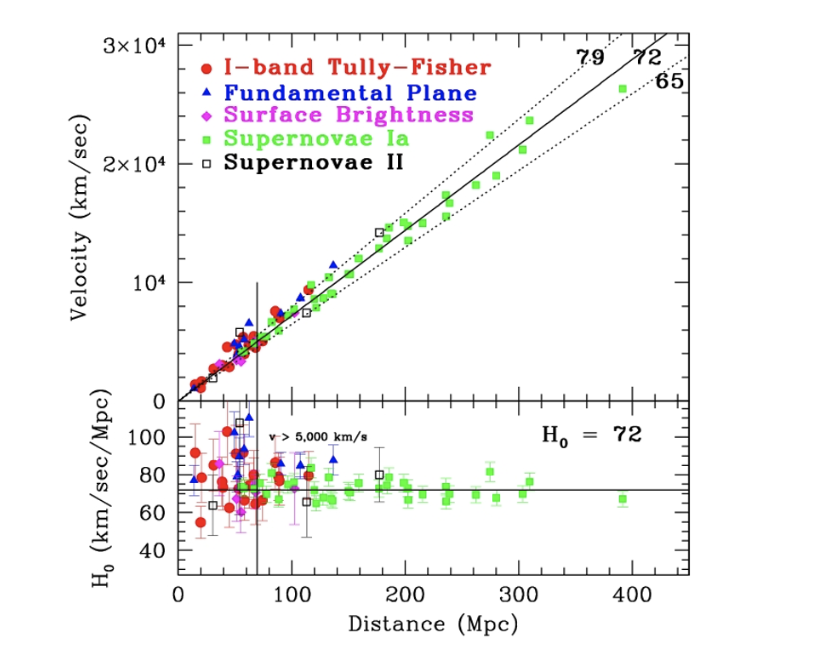
- Review the Hubble Key Project and its 10% total uncertainty goal.
- Discuss Cepheid and TRGB distance scales as the two highest-precision local methods.
- Evaluate anchors to the distance scale (LMC, MW parallaxes, NGC 4258) and their impact on H0.
- Summarize SHoES, CCHP, CSP, and Pantheon+ efforts for SN Ia calibration and H0.
- Present JWST capabilities and first results (e.g., NGC 7250) to address crowding and reddening.
Experimental results
Research questions
- RQ1What is the current status of direct local measurements of H0 and their precision?
- RQ2What are the dominant systematic uncertainties in Cepheid and TRGB distance scales, and how have they been mitigated?
- RQ3How do independent calibrations (anchors) influence the derived H0 and its uncertainty?
- RQ4To what extent can JWST data reduce known systematics and constrain H0 further?
- RQ5Do alternative distance indicators (e.g., JAGB) agree with Cepheid/TRGB scales and what is their impact on H0?
Key findings
- Cepheid-based calibrations yield H0 around 73 km s-1 Mpc-1, while TRGB-based calibrations trend slightly lower (~70 km s-1 Mpc-1).
- JWST near-infrared imaging reduces Cepheid crowding, halving the scatter in the Cepheid PL relation compared to HST in the first JWST results.
- TRGB calibrations with independent anchors (NGC 4258, LMC, SMC) show consistency with maser and halo TRGB measurements, supporting robust distance scales.
- Anchors (LMC distance modulus, MW parallaxes, NGC 4258 masers) dominate the current systematic budget and thus the global H0 precision.
- CCHP and SHoES programs emphasize infrared Cepheids, reddening corrections, and parallax baselines to push toward sub-2% systematic uncertainties.
- JAGB is emerging as a competitive standard candle with small metallicity and reddening sensitivities, offering independent cross-checks.
Read this paper
Open the full text in the Nubint reader and ask about any passage as you read.
Read this paper on NubintThis review was generated by AI from the original paper. Please check the paper before citing it.