
[Paper Review] Proposal for many-body quantum chaos detection
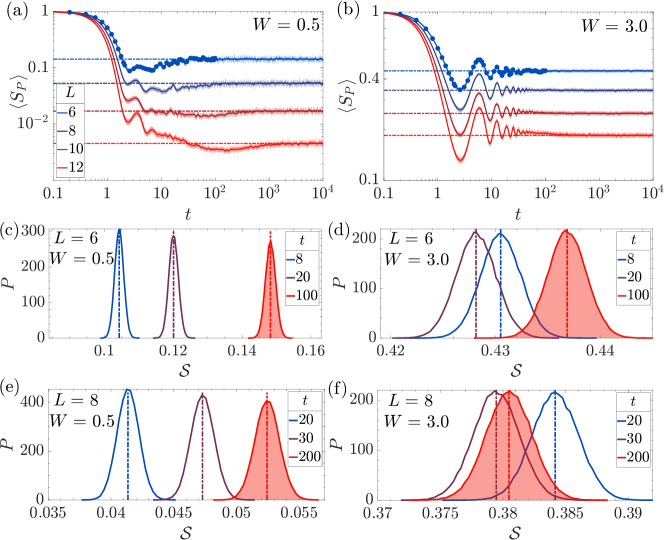
This paper proposes detecting many-body quantum chaos via the dynamical signature of spectral correlations—specifically the slope-dip-ramp-plateau structure (correlation hole)—in experimentally accessible observables: the survival probability and spin autocorrelation function. Using small spin-1/2 models (6-site Heisenberg and long-range Ising chains), it demonstrates that the correlation hole emerges within experimentally feasible timescales and gate depths, making detection feasible on current quantum simulators and quantum computers.
In this work, the term ``quantum chaos'' refers to spectral correlations similar to those found in the random matrix theory. Quantum chaos can be diagnosed through the analysis of level statistics using e.g.~the spectral form factor, which detects both short- and long-range level correlations. The spectral form factor corresponds to the Fourier transform of the two-point spectral correlation function and exhibits a typical slope-dip-ramp-plateau structure (aka correlation hole) when the system is chaotic. We discuss how this structure could be detected through the quench dynamics of two physical quantities accessible to experimental many-body quantum systems: the survival probability and the spin autocorrelation function. The survival probability is equivalent to the spectral form factor with an additional filter. When the system is small, the dip of the correlation hole reaches sufficiently large values at times which are short enough to be detected with current experimental platforms. As the system is pushed away from chaos, the correlation hole disappears, signaling integrability or localization. We also provide a relatively shallow circuit with which the correlation hole could be detected with commercially available quantum computers.
Motivation & Objective
- To identify experimentally accessible dynamical observables that manifest the spectral correlations characteristic of quantum chaos in many-body systems.
- To demonstrate that the slope-dip-ramp-plateau structure (correlation hole) in the spectral form factor can be probed through time evolution of physical observables in realistic quantum platforms.
- To evaluate the feasibility of detecting quantum chaos in current experimental setups, particularly with few-body systems and shallow quantum circuits.
- To assess the role of noise and finite-size effects in enhancing detectability of the correlation hole in small systems.
- To provide a roadmap for experimental detection of many-body quantum chaos using existing quantum simulators and quantum computers.
Proposed method
- The survival probability and spin autocorrelation function are computed as time-evolved observables under chaotic many-body spin-1/2 Hamiltonians, specifically the 1D disordered Heisenberg model and the 1D long-range Ising model in a transverse field.
- The spectral form factor, which encodes level statistics and exhibits the characteristic slope-dip-ramp-plateau structure, is linked to the dynamics of these observables via their Fourier transforms.
- Numerical simulations are performed on small systems (e.g., 6-site chains) to ensure the Heisenberg time is short enough for full evolution within current coherence times.
- Trotterization and hybrid quantum-classical algorithms are proposed as viable methods for time evolution on near-term quantum hardware, balancing circuit depth and precision.
- The analysis includes shot-noise experiments to assess the number of measurements required to infer the presence of the correlation hole.
- Finite-size effects are leveraged to enhance the visibility of the dip and ramp in the survival probability, making detection more feasible in small systems.

Experimental results
Research questions
- RQ1Can the characteristic slope-dip-ramp-plateau structure of the spectral form factor be experimentally detected through the dynamics of the survival probability in many-body quantum systems?
- RQ2Is the correlation hole in the survival probability or spin autocorrelation function observable within the coherence times and gate depth limitations of current quantum simulators and quantum computers?
- RQ3How does the number of qubits and system size affect the visibility and detectability of the correlation hole in small spin chains?
- RQ4Can noise or finite-size effects enhance the detectability of quantum chaos signatures in small systems?
- RQ5What is the minimal number of measurement shots required to reliably infer the presence of the correlation hole in experimental time-series data?
Key findings
- The 6-site disordered Heisenberg chain exhibits a clear correlation hole in the survival probability within a Heisenberg time that is short enough to be accessible on current quantum hardware.
- The dip in the survival probability reaches values large enough to be experimentally detectable at times that are short enough for current platforms, even with limited coherence.
- The spin autocorrelation function also displays the characteristic slope-dip-ramp-plateau structure when the system is chaotic, offering a local real-space probe of spectral correlations.
- For a single excitation in a spin chain, the Heisenberg time scales linearly with system size, making full evolution up to saturation feasible in small systems.
- Measurement protocols requiring only a few time points within the correlation hole can suffice to infer its presence, reducing experimental overhead.
- Noise in the system may reduce the need for ensemble averaging, potentially enhancing the detectability of the correlation hole in realistic experimental settings.
Read this paper
Open the full text in the Nubint reader and ask about any passage as you read.
Read this paper on NubintThis review was generated by AI from the original paper. Please check the paper before citing it.