
[Paper Review] PySAGES: flexible, advanced sampling methods accelerated with GPUs
PySAGES is a GPU-accelerated, Python-based software library that enables advanced sampling methods—such as adaptive biasing forces, metadynamics, and forward flux sampling—in molecular dynamics simulations. It provides a flexible, user-friendly interface for defining collective variables and free energy calculations, achieving high performance through native GPU acceleration and seamless integration with MD backends like OpenMM and hoomd-blue.
Molecular simulations are an important tool for research in physics, chemistry, and biology. The capabilities of simulations can be greatly expanded by providing access to advanced sampling methods and techniques that permit calculation of the relevant underlying free energy landscapes. In this sense, software that can be seamlessly adapted to a broad range of complex systems is essential. Building on past efforts to provide open-source community supported software for advanced sampling, we introduce PySAGES, a Python implementation of the Software Suite for Advanced General Ensemble Simulations (SSAGES) that provides full GPU support for massively parallel applications of enhanced sampling methods such as adaptive biasing forces, harmonic bias, or forward flux sampling in the context of molecular dynamics simulations. By providing an intuitive interface that facilitates the management of a system's configuration, the inclusion of new collective variables, and the implementation of sophisticated free energy-based sampling methods, the PySAGES library serves as a general platform for the development and implementation of emerging simulation techniques. The capabilities, core features, and computational performance of this new tool are demonstrated with clear and concise examples pertaining to different classes of molecular systems. We anticipate that PySAGES will provide the scientific community with a robust and easily accessible platform to accelerate simulations, improve sampling, and enable facile estimation of free energies for a wide range of materials and processes.
Motivation & Objective
- To develop a flexible, open-source software framework for advanced sampling in molecular simulations.
- To accelerate free energy calculations using GPU-accelerated implementations of enhanced sampling techniques.
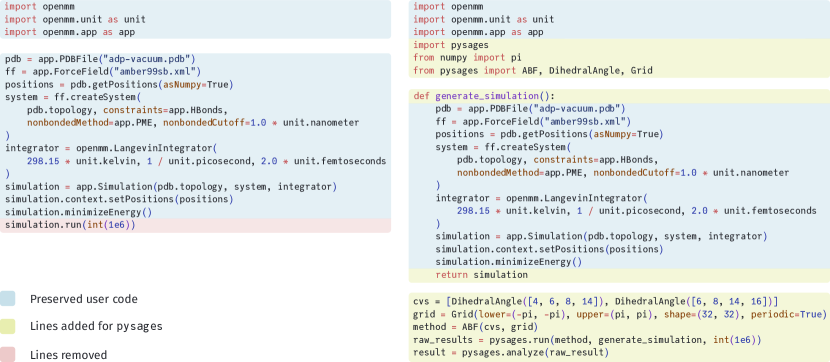
- To provide an intuitive Python interface for defining collective variables and integrating with existing MD backends.
- To support a broad range of complex systems, including biomolecules and soft materials.
- To enable accurate and efficient estimation of free energy landscapes across diverse molecular systems.
Proposed method
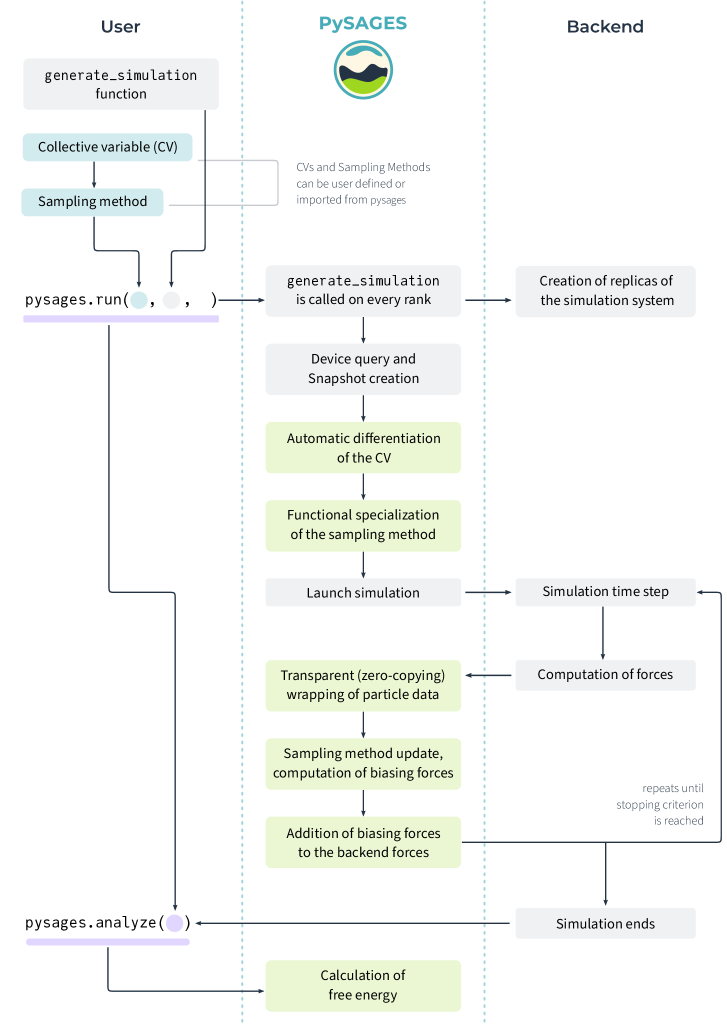
- Implementing a modular Python library built on the SSAGES framework with full GPU support via CUDA and cuDNN.
- Integrating advanced sampling methods including adaptive biasing forces (ABF), well-tempered metadynamics (WTMD), and forward flux sampling (FFS).
- Enabling user-defined collective variables (CVs) through a flexible interface, including distance-to-interface CVs using Gaussian-weighted projections.
- Leveraging high-performance MD backends such as OpenMM and hoomd-blue for GPU-accelerated dynamics simulations.
- Using neural network-based biasing (ANN, FUNN) and spectral ABF to improve convergence and sampling efficiency.
- Providing a JSON-based configuration system for easy setup and reproducibility of simulation workflows.
Experimental results
Research questions
- RQ1How can advanced sampling methods be efficiently and flexibly implemented in a high-level language like Python while maintaining GPU performance?
- RQ2To what extent does GPU acceleration improve the convergence and computational efficiency of free energy calculations in complex systems?
- RQ3Can a unified software framework effectively support diverse sampling techniques across different MD backends and system types?
- RQ4How accurately do PySAGES-implemented methods reproduce established free energy landscapes compared to reference simulations?
- RQ5What is the impact of different collective variable definitions and biasing strategies on sampling efficiency and convergence?
Key findings
- PySAGES achieves high performance by leveraging GPU acceleration, enabling efficient execution of advanced sampling methods such as ABF, WTMD, and FFS.
- The library successfully reproduces benchmark free energy landscapes for alanine dipeptide and butane with high accuracy, matching long ABF simulations as ground truth.
- Free energy convergence is achieved in significantly shorter simulation times compared to CPU-based methods, especially for rugged energy landscapes.
- The implementation of distance-to-interface collective variables using Gaussian-weighted projections enables robust and differentiable CVs for interfacial systems.
- Neural network-based biasing (ANN, FUNN) and spectral ABF show improved convergence and reduced sampling time compared to traditional methods on test systems.
- The software is interoperable with major MD engines (OpenMM, hoomd-blue), enabling broad applicability across biomolecular and soft matter systems.
Read this paper
Open the full text in the Nubint reader and ask about any passage as you read.
Read this paper on NubintThis review was generated by AI from the original paper. Please check the paper before citing it.