
[Paper Review] Quantitative Digital Microscopy with Deep Learning
This paper introduces DeepTrack 2.0, an open-source, user-friendly software framework that enables researchers to design, train, and validate deep learning models for quantitative digital microscopy using synthetic or augmented data. It achieves high-accuracy particle tracking, cell counting, and classification without requiring extensive programming, significantly lowering the barrier to entry for deep learning in microscopy.
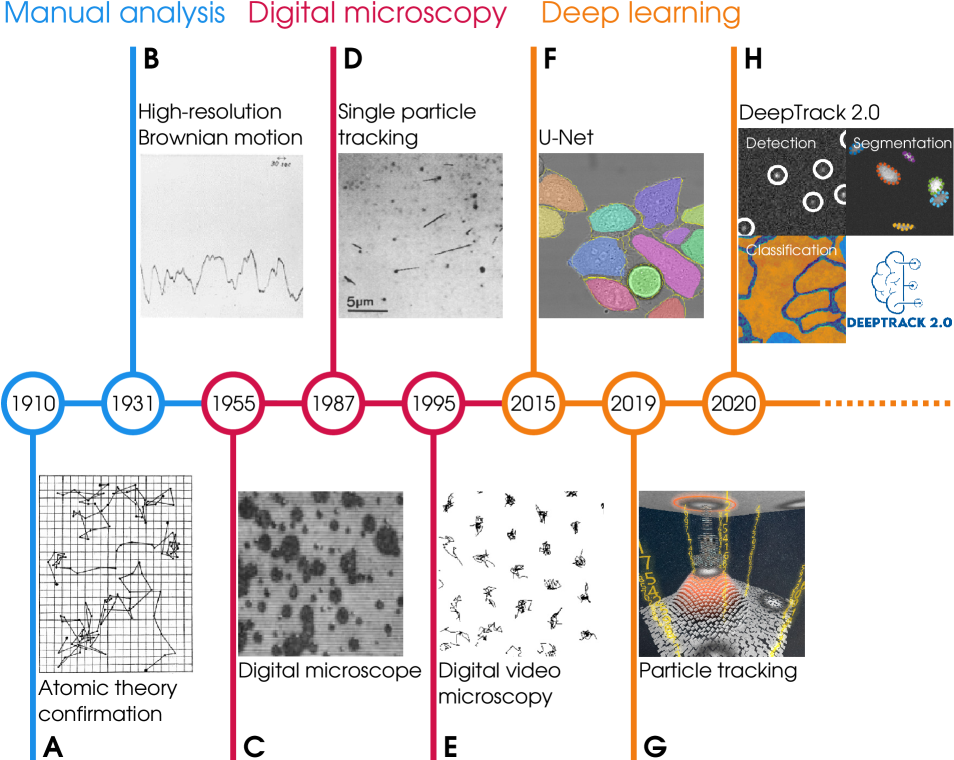
Video microscopy has a long history of providing insights and breakthroughs for a broad range of disciplines, from physics to biology. Image analysis to extract quantitative information from video microscopy data has traditionally relied on algorithmic approaches, which are often difficult to implement, time consuming, and computationally expensive. Recently, alternative data-driven approaches using deep learning have greatly improved quantitative digital microscopy, potentially offering automatized, accurate, and fast image analysis. However, the combination of deep learning and video microscopy remains underutilized primarily due to the steep learning curve involved in developing custom deep-learning solutions. To overcome this issue, we introduce a software, DeepTrack 2.0, to design, train and validate deep-learning solutions for digital microscopy. We use it to exemplify how deep learning can be employed for a broad range of applications, from particle localization, tracking and characterization to cell counting and classification. Thanks to its user-friendly graphical interface, DeepTrack 2.0 can be easily customized for user-specific applications, and, thanks to its open-source object-oriented programming, it can be easily expanded to add features and functionalities, potentially introducing deep-learning-enhanced video microscopy to a far wider audience.
Motivation & Objective
- To address the steep learning curve and implementation challenges in applying deep learning to video microscopy by providing an accessible, integrated software solution.
- To enable accurate, fast, and automated image analysis in quantitative microscopy using deep learning, overcoming limitations of traditional algorithmic approaches.
- To reduce dependency on manually annotated datasets by promoting the use of physically simulated synthetic training data with known ground truth.
- To democratize access to deep learning in microscopy through a graphical user interface and extensible, object-oriented codebase for non-expert users.
- To support real-time analysis and feedback systems by enabling efficient, deployable deep learning models tailored to specific experimental setups.
Proposed method
- DeepTrack 2.0 provides a graphical user interface (GUI) for non-programmers to design, train, and validate deep learning models for microscopy tasks.
- The framework supports end-to-end training using synthetic data generated via physical simulations, ensuring precise ground truth for localization, tracking, and classification.
- It employs a conditional generative adversarial network (cGAN) with a generator loss $ l_{ ext{G}} = u \cdot \text{MAE}\{z_{\text{label}}, z_{\text{output}}\} + (1 - D(z_{\text{output}}))^2 $ and a discriminator loss $ l_{\text{D}} = D(z_{\text{output}})^2 + (1 - D(z_{\text{label}}))^2 $, where $ D $ is the discriminator network.
- The model is trained using the Adam optimizer with a learning rate of 0.0002 and $ \beta_1 = 0.5 $ over 1000 epochs with 16 mini-batches per epoch.
- For data augmentation, the framework performs on-the-fly image transformations to expand training sets when synthetic data generation is infeasible.
- The software is built on an open-source, object-oriented architecture to allow extensibility and community contributions for new models and functionalities.
Experimental results
Research questions
- RQ1Can a deep learning framework be developed that enables non-expert users to build accurate, application-specific models for quantitative microscopy?
- RQ2To what extent can synthetic training data with known ground truth outperform traditional algorithmic methods in particle tracking and cell analysis?
- RQ3How effectively can a GUI-based deep learning platform reduce the barrier to entry for researchers without programming expertise in microscopy image analysis?
- RQ4Can on-the-fly data augmentation in DeepTrack 2.0 compensate for limitations in synthetic data generation for complex or rare sample morphologies?
- RQ5What is the potential of deep learning in enabling real-time feedback systems for microscopy experiments, such as optical force control or adaptive imaging?
Key findings
- DeepTrack 2.0 enables accurate particle localization, tracking, and characterization using purely synthetic training data, achieving performance comparable to or exceeding traditional algorithmic methods.
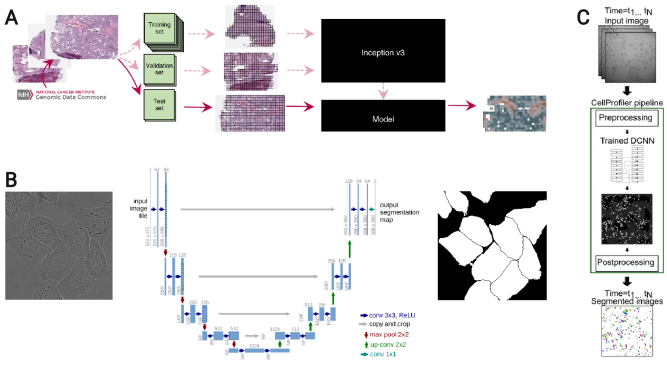
- The framework’s cGAN-based image generation model successfully produces realistic cell-like images from segmentation masks, with qualitative similarity to real experimental data despite lacking fine-textural details.
- The use of synthetic data with exact ground truth allows for training models that generalize across different imaging setups and operators, overcoming the limitations of human-annotated datasets.
- The GUI and open-source, extensible architecture of DeepTrack 2.0 significantly lower the barrier to entry, enabling researchers with minimal programming experience to develop and deploy deep learning models.
- The framework supports real-time inference potential, paving the way for closed-loop experimental systems that use deep learning for dynamic control of imaging parameters or optical forces.
- The authors demonstrate that physical simulations are a viable and powerful solution to the data scarcity problem in deep learning for microscopy, especially for high-accuracy tasks like single-particle tracking.
Better researchstarts right now
From reading papers to final review, dramatically reduce your research time.
No credit card · Free plan available
This review was created by AI and reviewed by human editors.