
[Paper Review] Quantum-enhanced sensing on an optical transition via emergent collective quantum correlations
This paper demonstrates quantum-enhanced sensing in a 1D chain of up to 51 trapped ions using power-law-decaying state-dependent interactions to generate collective quantum correlations. It achieves spin squeezing of −3.9 ± 0.3 dB (Wineland parameter) and reduces measurement uncertainty by −3.2 ± 0.5 dB below the standard quantum limit in a Ramsey interferometer, showing scalable entanglement without full all-to-all connectivity.
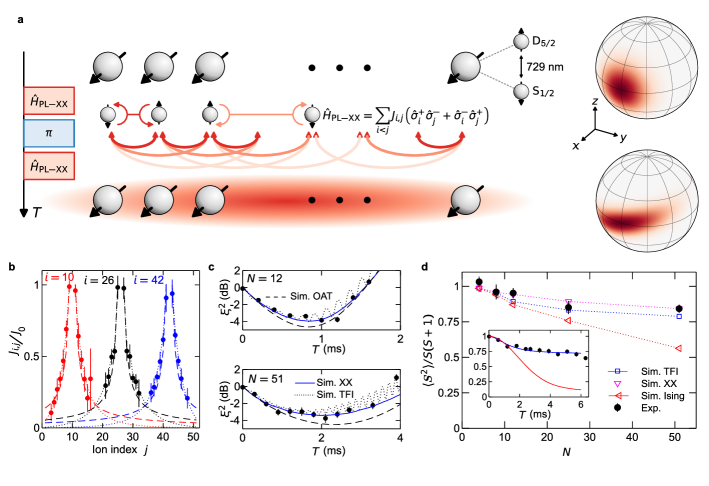
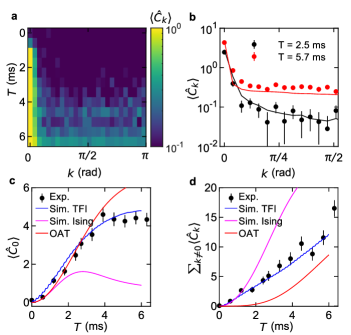
The control over quantum states in atomic systems has led to the most precise optical atomic clocks to date. Their sensitivity is currently bounded by the standard quantum limit, a fundamental floor set by quantum mechanics for uncorrelated particles, which can nevertheless be overcome when operated with entangled particles. Yet demonstrating a quantum advantage in real world sensors is extremely challenging and remains to be achieved aside from two remarkable examples, LIGO and more recently HAYSTAC. Here we illustrate a pathway for harnessing scalable entanglement in an optical transition using 1D chains of up to 51 ions with state-dependent interactions that decay as a power-law function of the ion separation. We show our sensor can be made to behave as a one-axis-twisting (OAT) model, an iconic fully connected model known to generate scalable squeezing. The collective nature of the state manifests itself in the preservation of the total transverse magnetization, the reduced growth of finite momentum spin-wave excitations, the generation of spin squeezing comparable to OAT (a Wineland parameter of $-3.9 \pm 0.3$ dB for only N = 12 ions) and the development of non-Gaussian states in the form of atomic multi-headed cat states in the Q-distribution. The simplicity of our protocol enables scalability to large arrays with minimal overhead, opening the door to advances in timekeeping as well as new methods for preserving coherence in quantum simulation and computation. We demonstrate this in a Ramsey-type interferometer, where we reduce the measurement uncertainty by $-3.2 \pm 0.5$ dB below the standard quantum limit for N = 51 ions.
Motivation & Objective
- To demonstrate quantum-enhanced sensing in a large array of trapped ions using finite-range interactions instead of full all-to-all connectivity.
- To achieve scalable spin squeezing and entanglement in a 1D ion chain with power-law decaying XX interactions.
- To show that collective quantum correlations—such as preserved total transverse magnetization and non-Gaussian multi-headed cat states—emerge naturally in such systems.
- To achieve a measurable quantum advantage in a Ramsey-type interferometer, reducing measurement uncertainty below the standard quantum limit.
- To establish a scalable, low-overhead protocol for quantum sensors that preserves coherence and enables timekeeping and quantum simulation advances.
Proposed method
- Utilizing a 1D chain of up to 51 trapped 40Ca+ ions, with qubits encoded on an optical transition (D5/2 → D3/2) for high coherence.
- Implementing state-dependent interactions via laser-driven spin-exchange (XX-type) interactions that decay as a power-law with ion separation (α ≈ 0.9–1.0).
- Applying a sequence of global laser pulses to implement a one-axis-twisting (OAT)-like evolution, generating spin-squeezed states from a spin coherent state (SCS).
- Measuring spin squeezing via the Wineland parameter and monitoring collective spin dynamics using the total transverse magnetization and spin-wave excitations.
- Using Q-distribution analysis to detect non-Gaussian features such as multi-headed cat states, confirming the emergence of many-body entanglement.
- Performing Ramsey interferometry with the squeezed state to quantify the reduction in measurement uncertainty relative to the standard quantum limit.
Experimental results
Research questions
- RQ1Can scalable spin squeezing be achieved in a 1D trapped ion chain with finite-range, power-law-decaying interactions without full all-to-all connectivity?
- RQ2To what extent do collective quantum correlations—such as preserved total transverse magnetization and non-Gaussian states—emerge in such systems?
- RQ3Can the system achieve a quantum advantage in a Ramsey-type interferometer below the standard quantum limit using only local control and power-law interactions?
- RQ4How does the performance of the system compare to the ideal OAT model in the presence of decoherence and dephasing?
- RQ5What are the scaling limits of spin squeezing and measurement uncertainty reduction as system size increases (N = 12 to N = 51) under realistic decoherence?
Key findings
- Spin squeezing of −3.9 ± 0.3 dB was achieved for N = 12 ions, approaching the performance of the ideal OAT model under similar decoherence.
- Measurement uncertainty in a Ramsey interferometer was reduced by −3.2 ± 0.5 dB below the standard quantum limit for N = 51 ions, demonstrating a measurable quantum advantage.
- The system preserved the total transverse magnetization during evolution, indicating robust collective behavior despite finite-range interactions.
- Finite momentum spin-wave excitations grew more slowly than in non-collective models, confirming the emergence of collective dynamics.
- Non-Gaussian states—evidenced by multi-headed cat states in the Q-distribution—were observed, confirming the generation of complex many-body entanglement.
- Scaling of spin squeezing showed saturation for large N, limited by slow entanglement generation and dephasing, but improvement was observed when J₀ was doubled for N = 12.
Read this paper
Open the full text in the Nubint reader and ask about any passage as you read.
Read this paper on NubintThis review was generated by AI from the original paper. Please check the paper before citing it.