
[Paper Review] Quantum metrology with critical driven-dissipative collective spin system
This paper proposes two quantum metrology schemes using a critical driven-dissipative collective spin system of N spin-1/2 particles with squeezed collective decay. By exploiting a dissipative phase transition, the steady state exhibits enhanced sensitivity, achieving a quantum Fisher information scaling as 𝒪(N⁴/³), enabling sub-shot-noise-limited parameter estimation without requiring initial entanglement or adiabatic control.
We propose a critical dissipaive quantum metrology schemes for single parameter estimation which are based on a quantum probe consisting of coherently driven ensemble of $N$ spin-1/2 particles under the effect of squeezed, collective spin decay. The collective spin system exhibits a dissipative phase transition between thermal and ferromagnetic phases, which is characterized with nonanalytical behavior of the spin observables. We show that thanks to the dissipative phase transition the sensitivity of the parameter estimation can be significantly enhanced. Furthermore, we show that our steady state is an entangled spin squeezed state which allow to perform parameter estimation with sub shot-noise limited measurement uncertainty.
Motivation & Objective
- To develop quantum metrology protocols that leverage dissipative phase transitions in open quantum systems for enhanced parameter estimation.
- To demonstrate that critical driven-dissipative collective spin systems can achieve sub-shot-noise-limited sensitivity without requiring initial entangled states.
- To investigate the role of steady-state entanglement and spin squeezing in enhancing estimation precision.
- To establish scaling laws for quantum Fisher information near the critical point.
- To compare two distinct metrology protocols: one based on dynamical evolution to steady state, and another based on unitary perturbation of a pre-prepared steady state.
Proposed method
- Model a system of N spin-1/2 particles coherently driven with Rabi frequency Ω and subject to squeezed, collective spin decay with decay rates Γ₊ and Γ₋.
- Formulate the master equation using a Liouvillian superoperator, identifying the steady state as the eigenmatrix with zero eigenvalue.
- Identify the dissipative phase transition between a ferromagnetic phase (nonzero magnetization M) and a thermal phase (M = 0) at critical driving strength Ω_c.
- Use the quantum Fisher information (QFI) as the figure of merit for parameter estimation precision, derived from the variance of spin operators along optimal measurement directions.
- Apply finite-size scaling to analyze the behavior of QFI near the critical point, showing 𝒪(N⁴/³) scaling.
- Define spin squeezing via the spin-squeezing parameter ξ² and entanglement via χ² = N / F_Q, with χ² < 1 indicating multiparticle entanglement.
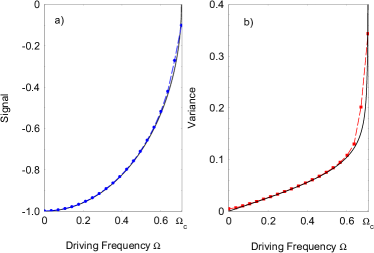
Experimental results
Research questions
- RQ1Can a driven-dissipative collective spin system exhibit enhanced parameter estimation sensitivity near a dissipative phase transition?
- RQ2Does the steady state of such a system display entanglement and spin squeezing, enabling sub-shot-noise-limited metrology?
- RQ3What is the scaling of the quantum Fisher information with system size N near the critical point?
- RQ4Can parameter estimation be enhanced without requiring initial state preparation or adiabatic evolution?
- RQ5How does the QFI scale in two distinct metrology protocols: one based on dynamical evolution and another on unitary perturbation of a steady state?
Key findings
- The quantum Fisher information (QFI) scales as 𝒪(N⁴/³) at the critical point, indicating sensitivity beyond the standard shot-noise limit.
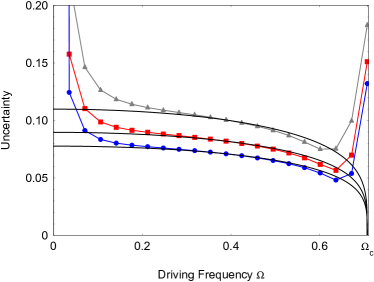
- The steady state is an entangled spin-squeezed state, as confirmed by χ² < 1, with the squeezing parameter decreasing as 𝒪(N⁻¹/³) near criticality.
- The QFI diverges as the magnetization M → 0 at the critical point, signaling the onset of the dissipative phase transition and enhanced sensitivity.
- The first protocol—using arbitrary initial state evolving to steady state—achieves sub-shot-noise-limited estimation without requiring initial entanglement.
- The second protocol—applying a parameter-dependent unitary to the steady state—also yields QFI scaling as 𝒪(N⁴/³), confirming robustness of the enhancement.
- Finite-size scaling confirms that the N⁴/³ scaling is robust and observable even for moderate N, with χ² decreasing as 𝒪(N⁻¹/³) at criticality.
Read this paper
Open the full text in the Nubint reader and ask about any passage as you read.
Read this paper on NubintThis review was generated by AI from the original paper. Please check the paper before citing it.