
[Paper Review] Quantum oscillations in a doped Mott insulator beyond Onsager's relation
This paper investigates quantum oscillations in a doped Mott insulator using the exactly soluble Hatsugai–Kohmoto model with infinite-range interactions, demonstrating that inter-Landau level (inter-LL) interactions—previously neglected—lead to non-monotonous spectral reconstruction and aperiodic quantum oscillations that violate Onsager's relation. The key result is the breakdown of the standard Onsager quantization rule due to strong inter-LL repulsion, accompanied by unconventional temperature dependencies and effective mass renormalizations.
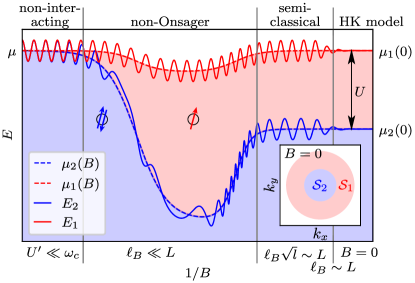
The kinetic energy of electrons in a magnetic field is quenched resulting in a discrete set of highly degenerate Landau levels (LL) which gives rise to fascinating phenomena like the de Haas-van Alphen effect (dHvAe) or the integer and fractional quantum Hall effects. The latter is a result of interactions partially lifting the degeneracy within a given LL while inter-LL interactions are usually assumed to be unimportant. Here, we study the LL spectrum of the Hatsugai-Kohmoto model, a Hubbard-like model which is exactly soluble on account of infinite range interactions. For the doped Mott insulator phase in a magnetic field we find that the degeneracy of LLs is preserved but inter-LL interactions are important leading to a non-monotonous reconstruction of the spectrum. As a result, strong LL repulsion leads to aperiodic quantum oscillations of the dHvAe in contrast to Onsager's famous relation connecting oscillation frequencies with the Fermi surface areas at zero field. In addition, we find unconventional temperature dependencies of quantum oscillations and interaction-induced effective mass renormalizations. We discuss the general importance of inter-LL interactions for understanding doped Mott insulators in magnetic fields.
Motivation & Objective
- To investigate the role of inter-Landau level (inter-LL) interactions in doped Mott insulators under magnetic fields, where standard theories assume only intra-LL interactions matter.
- To understand how strong electron correlations beyond the single-LL approximation affect quantum oscillations (QOs) and the breakdown of Onsager's relation.
- To explore the spectral reconstruction and thermodynamic response in a doped Mott insulator with exact solubility via the Hatsugai–Kohmoto model.
- To analyze the emergence of aperiodic quantum oscillations and unconventional temperature dependencies in the de Haas–van Alphen effect (dHvAe) due to inter-LL interactions.
- To establish the general importance of inter-LL interactions for understanding strongly correlated systems in magnetic fields, especially in doped Mott insulators.
Proposed method
- Use of the Hatsugai–Kohmoto (HK) model, an exactly soluble Hubbard-like model with infinite-range interactions and a center-of-mass constraint, enabling exact treatment of the Landau level (LL) spectrum.
- Projection of the local Hubbard interaction into the Landau level basis to derive the inter-LL interaction vertex $\tilde{V}_{ijkl}$, which is computed exactly using Hermite polynomial series expansions.
- Exact diagonalization of the Hamiltonian in the LL basis to study the spectral reconstruction under finite magnetic fields, preserving LL degeneracy while allowing strong inter-LL interactions.
- Calculation of thermodynamic observables such as the ground state energy and density of states (DOS) to extract quantum oscillation (QO) behavior under fixed chemical potential and fixed particle number.
- Application of the Lifshitz–Kosevich formalism to analyze the temperature dependence of QO amplitudes, revealing deviations from standard Fermi liquid behavior.
- Use of the Landau level wavefunctions $\psi_l(\xi)$ and their orthogonality to compute matrix elements and interaction vertices in the $\ell_B \to \infty$ limit, ensuring semiclassical consistency.
Experimental results
Research questions
- RQ1To what extent do inter-Landau level (inter-LL) interactions invalidate the standard Onsager relation between quantum oscillation frequency and Fermi surface area?
- RQ2How do strong electron correlations in a doped Mott insulator modify the temperature dependence of quantum oscillations compared to the Lifshitz–Kosevich prediction?
- RQ3What is the role of inter-LL interactions in reconstructing the Landau level spectrum, and how does this lead to aperiodic quantum oscillations?
- RQ4How do effective mass renormalizations emerge from inter-LL interactions in the absence of intra-LL splitting?
- RQ5Can exact solubility in the Hatsugai–Kohmoto model provide a controlled framework to study QOs beyond the single-LL approximation in strongly correlated systems?
Key findings
- Inter-Landau level (inter-LL) interactions are strong and non-perturbative in the doped Mott insulator phase of the Hatsugai–Kohmoto model, leading to a non-monotonous reconstruction of the LL spectrum.
- The standard Onsager relation between quantum oscillation frequency and Fermi surface area is violated due to strong inter-LL repulsion, resulting in aperiodic quantum oscillations in the de Haas–van Alphen effect.
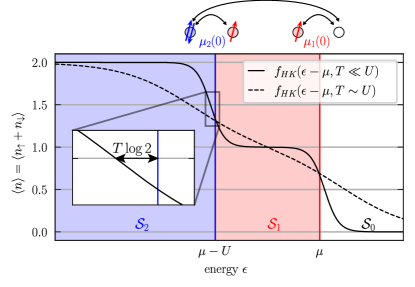
- The temperature dependence of quantum oscillation amplitudes deviates from the standard Lifshitz–Kosevich form, indicating unconventional many-body effects beyond Fermi liquid theory.
- Effective mass renormalizations emerge due to inter-LL interactions, even though intra-LL degeneracy is preserved, suggesting a new mechanism for mass enhancement in correlated systems.
- The model preserves LL degeneracy exactly but allows for strong inter-LL coupling, enabling exact computation of the full spectrum and QO response in the presence of strong correlations.
- The vertex $\tilde{V}_{ijkl}$ for the Hubbard interaction in the LL basis is computed exactly using Hermite polynomial series, revealing selection rules and non-zero matrix elements only for even $i+j+k+l$.
Read this paper
Open the full text in the Nubint reader and ask about any passage as you read.
Read this paper on NubintThis review was generated by AI from the original paper. Please check the paper before citing it.