
[Paper Review] Rateless Coding for MIMO Block Fading Channels
This paper proposes rateless coding schemes for MIMO block fading channels that achieve the diversity-multiplexing tradeoff (DMT) performance limit by transforming unit-length permutation codes into variable-rate codes. It shows that for low multiplexing gains, rateless codes offer a higher effective multiplexing gain than conventional schemes, with performance degrading as the rate increases beyond a threshold.
In this paper the performance limits and design principles of rateless codes over fading channels are studied. The diversity-multiplexing tradeoff (DMT) is used to analyze the system performance for all possible transmission rates. It is revealed from the analysis that the design of such rateless codes follows the design principle of approximately universal codes for parallel multiple-input multiple-output (MIMO) channels, in which each sub-channel is a MIMO channel. More specifically, it is shown that for a single-input single-output (SISO) channel, the previously developed permutation codes of unit length for parallel channels having rate LR can be transformed directly into rateless codes of length L having multiple rate levels (R, 2R, . . ., LR), to achieve the DMT performance limit.
Motivation & Objective
- To analyze the diversity-multiplexing tradeoff (DMT) performance of rateless codes over fading channels with finite block lengths.
- To determine whether rateless codes can outperform conventional fixed-rate coding schemes in terms of multiplexing gain and diversity gain.
- To identify design principles for rateless codes that achieve the DMT performance limit without requiring instantaneous CSI at the transmitter.
- To reveal the relationship between code design parameters (L, rₙ) and the effective system multiplexing gain r.
- To propose a new class of rateless codes combining MIMO space-time codes and parallel channel codes for fading channels.
Proposed method
- Transforms previously developed unit-length permutation codes for parallel channels into L-length rateless codes with multiple rate levels (R, 2R, ..., LR).
- Uses the diversity-multiplexing tradeoff (DMT) as a performance metric, defined via limits of error probability and rate as SNR increases.
- Applies Fano’s inequality to derive lower bounds on error probability and uses asymptotic analysis (dotted equality ≲) to characterize diversity order.
- Analyzes error probability as a sum over decoding failure events across blocks, with each block contributing to the overall outage and error probability.
- Establishes approximate universality by showing that error probability decays exponentially under any fading distribution, enabling robust performance across channel conditions.
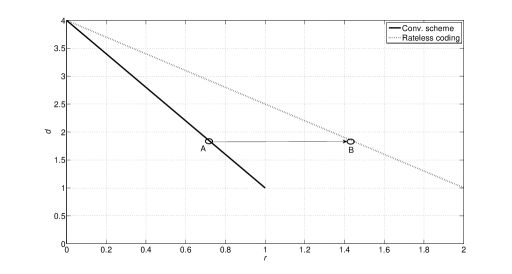
- Derives the effective multiplexing gain r = L·rₙ for low rₙ, and shows it degrades to r = L·rₙ / k for higher rₙ, where k is the number of blocks needed for decoding.
Experimental results
Research questions
- RQ1What is the DMT performance limit of rateless codes over MIMO block fading channels with finite block lengths?
- RQ2How does the effective multiplexing gain of rateless codes compare to that of conventional fixed-rate codes across different rate regimes?
- RQ3Can rateless codes achieve the DMT performance limit without requiring instantaneous CSI at the transmitter?
- RQ4What is the impact of the number of blocks L on the system's multiplexing gain and diversity gain?
- RQ5How do code design parameters (L and rₙ) influence the effective multiplexing gain r and the system's DMT curve?
Key findings
- For low multiplexing gain rₙ < min(M,N)/L, rateless codes achieve an effective multiplexing gain r = L·rₙ with diversity gain f(rₙ), matching the DMT performance limit.
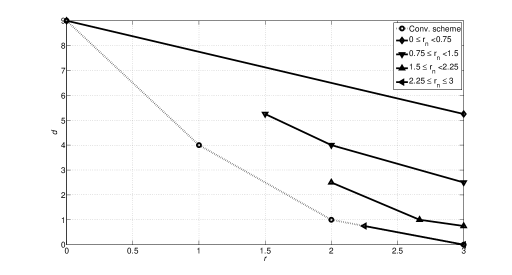
- When rₙ exceeds min(M,N)/L, the effective multiplexing gain degrades to r = L·rₙ / k for k ≥ 2, due to increased decoding delay and error probability.
- The system DMT curve is piecewise, with diversity order f(r·k/L) in the interval r ∈ [(k-1)min(M,N)/k, min(M,N)), for k = 1, 2, ..., L.
- Increasing L improves the overall DMT curve but does not always increase the multiplexing gain for a fixed rₙ, especially at higher rates.
- Rateless codes can be designed as a combination of conventional MIMO space-time codes and approximately universal parallel channel codes, achieving optimal DMT.
- The proposed rateless codes are approximately universal, with error probability decaying as e^(-η^δ), ensuring robustness across fading distributions.
Read this paper
Open the full text in the Nubint reader and ask about any passage as you read.
Read this paper on NubintThis review was generated by AI from the original paper. Please check the paper before citing it.