
[Paper Review] Re-Dock: Towards Flexible and Realistic Molecular Docking with Diffusion Bridge
Re-Dock introduces a diffusion-bridge framework on geometric manifolds to forecast flexible ligand and pocket sidechain poses with explicit interaction priors, improving realistic docking in apo and cross-dock scenarios.
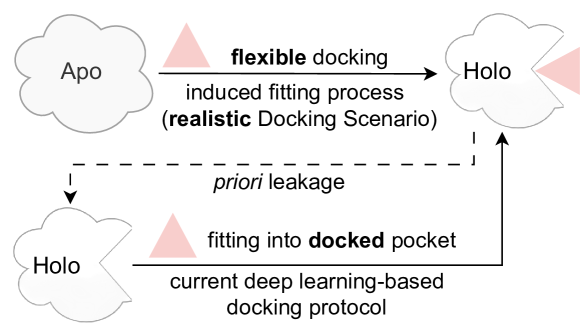
Accurate prediction of protein-ligand binding structures, a task known as molecular docking is crucial for drug design but remains challenging. While deep learning has shown promise, existing methods often depend on holo-protein structures (docked, and not accessible in realistic tasks) or neglect pocket sidechain conformations, leading to limited practical utility and unrealistic conformation predictions. To fill these gaps, we introduce an under-explored task, named flexible docking to predict poses of ligand and pocket sidechains simultaneously and introduce Re-Dock, a novel diffusion bridge generative model extended to geometric manifolds. Specifically, we propose energy-to-geometry mapping inspired by the Newton-Euler equation to co-model the binding energy and conformations for reflecting the energy-constrained docking generative process. Comprehensive experiments on designed benchmark datasets including apo-dock and cross-dock demonstrate our model's superior effectiveness and efficiency over current methods.
Motivation & Objective
- Motivate the under-explored task of flexible docking that jointly models ligand and pocket sidechain poses.
- Develop a diffusion-bridge generative model on geometric manifolds (rotations, translations, torsions) with energy-to-geometry priors.
- Incorporate explicit protein–ligand interaction priors to steer geometry-based generation.
- Benchmark the approach on apo-dock and cross-dock datasets to assess realism and efficiency.
Proposed method
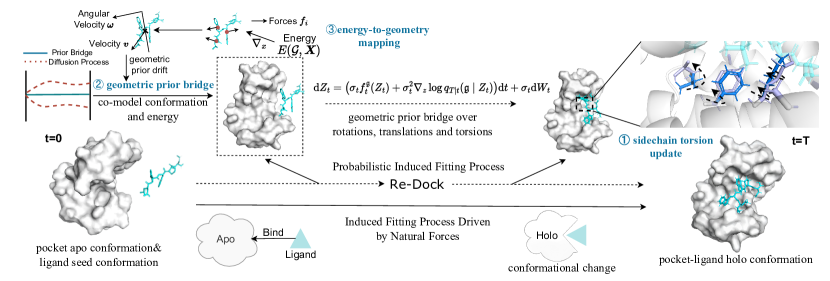
- Extend diffusion bridge concepts to non-Euclidean geometric manifolds (translation, rotation, torsion) for docking.
- Introduce geometric prior bridges with interaction priors via an energy-to-geometry mapping inspired by Newton–Euler rigid-body mechanics.
- Autoregressively model pocket sidechains to respect their sequential torsion dynamics during generation.
- Embed 3D interaction energy priors into the diffusion process through energy-to-geometry coupling.
- Parameterize the learned drift as s_t^θ = β f̂_t + f̂_t^θ, enabling co-modeling of binding energy and poses.
Experimental results
Research questions
- RQ1Can Re-Dock accurately predict flexible docking poses for ligands and pocket sidechains in realistic (apo and cross-dock) settings?
- RQ2How well does Re-Dock generate realistic sidechain conformations compared to baselines?
- RQ3How does Re-Dock generalize to challenging docking tasks such as cross-dock and apo docking without holo-pocket leakage?
- RQ4What is the impact of key design choices (sidechain autoregression, energy priors, sampling steps) on docking quality and efficiency?
Key findings
- Re-Dock demonstrates superior performance on flexible redocking and apo-docking benchmarks compared with baselines, using pocket-aware predictions.
- The model achieves accurate sidechain pose generation, outperforming baselines in Angstrom-scale RMSD-like metrics for sidechains.
- Energy-to-geometry priors and diffusion-bridge mechanisms on geometry enable interaction-aware, induced-fit docking with improved realism.
- Ablation studies show the importance of sidechain generation and prior energy terms for maintaining physical plausibility and reducing clashes.
- The approach extends to cross-dock tasks, indicating practical applicability in drug discovery pipelines.
Read this paper
Open the full text in the Nubint reader and ask about any passage as you read.
Read this paper on NubintThis review was generated by AI from the original paper. Please check the paper before citing it.