
[Paper Review] Reliability of lattice gauge theories in the thermodynamic limit
This paper demonstrates that energy-penalty protection in lattice gauge theories preserves gauge invariance in the thermodynamic limit, even with large spin-S representations. It analytically identifies two emergent effective theories—adjusted and renormalized gauge theories—whose dynamics accurately describe the system up to timescales proportional to $\sqrt{V/V_0^3}$ and $\exp(V/V_0)/V_0$, respectively, with protection strength $V$ scaling as $S^2$ and being volume-independent.
Although gauge invariance is a postulate in fundamental theories of nature such as quantum electrodynamics, in quantum-simulation implementations of gauge theories it is compromised by experimental imperfections. In a recent work [Halimeh and Hauke, \href{https://journals.aps.org/prl/abstract/10.1103/PhysRevLett.125.030503}{Phys. Rev. Lett. extbf{125}, 030503 (2020)}], it has been shown in finite-size spin-$1/2$ quantum link lattice gauge theories that upon introducing an energy-penalty term of sufficiently large strength $V$, unitary gauge-breaking errors at strength $λ$ are suppressed $\proptoλ^2/V^2$ up to all accessible evolution times. Here, we show numerically that this result extends to quantum link models in the thermodynamic limit and with larger spin-$S$. As we show analytically, the dynamics at short times is described by an extit{adjusted} gauge theory up to a timescale that is at earliest $τ_ ext{adj}\propto\sqrt{V/V_0^3}$, with $V_0$ an energy factor. Moreover, our analytics predicts that a renormalized gauge theory dominates at intermediate times up to a timescale $τ_ ext{ren}\propto\exp(V/V_0)/V_0$. In both emergent gauge theories, $V$ is volume-independent and scales at worst $\sim S^2$. Furthermore, we numerically demonstrate that robust gauge invariance is also retained through a single-body gauge-protection term, which is experimentally straightforward to implement in ultracold-atom setups and NISQ devices.
Motivation & Objective
- To establish the reliability of lattice gauge theories in the thermodynamic limit under experimental imperfections that break gauge invariance.
- To investigate whether energy-penalty protection, previously shown in finite-size systems, remains effective in the thermodynamic limit and for larger spin-S representations.
- To analytically derive the effective dynamics emerging from gauge-breaking errors under protection, identifying distinct timescales governed by adjusted and renormalized gauge theories.
- To validate that the protection strength $V$ remains volume-independent and scales at worst as $S^2$, enabling scalability in quantum simulators.
- To demonstrate the robustness of single-body gauge-protection terms in ultracold-atom and NISQ device implementations.
Proposed method
- Numerical simulations using infinite matrix product states (iMPS) to study quench dynamics in spin-S quantum link models in the thermodynamic limit.
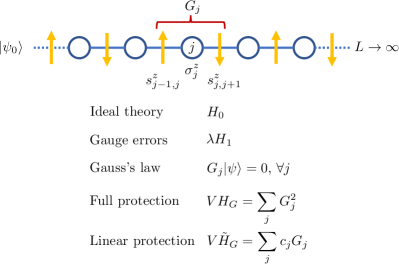
- Application of a full energy penalty $V H_G = V \sum_j G_j^2$ and a linear protection term $V \tilde{H}_G = V \sum_j c_j G_j$, with $c_j$ chosen to induce the quantum Zeno effect.
- Adaptation of the Abanin-De Roeck-Ho-Huveneers (ARHH) method to derive a universal bound on constrained quantum dynamics under local, frustration-free, and gapped protection Hamiltonians.
- Analytical derivation of the adjusted gauge theory Hamiltonian $H_{\text{adj}} = H_0 + \lambda \mathcal{P}_0 H_1 \mathcal{P}_0$, valid up to a timescale $\tau_{\text{adj}} \propto \sqrt{V/V_0^3}$, where $\mathcal{P}_0$ is the projection onto the physical subspace.
- Identification of a renormalized gauge theory as the dominant effective dynamics up to $\tau_{\text{ren}} \propto \exp(V/V_0)/V_0$, arising from non-perturbative effects in the protection strength.
- Use of the quantum Zeno effect to justify the validity of linear protection, with error bounds scaling as $\sim t V_0^2 L^2 / V$ and timescales $\propto V/(V_0 L)^2$.
Experimental results
Research questions
- RQ1Can energy-penalty protection maintain gauge invariance in the thermodynamic limit of lattice gauge theories with larger spin-S representations?
- RQ2What effective dynamics emerge from gauge-breaking errors under strong protection, and how do they depend on the protection strength $V$?
- RQ3Are the timescales over which the effective dynamics remain valid volume-independent and scalable with $S$?
- RQ4How does the quantum Zeno effect contribute to gauge protection in the linear protection scheme, and what are the resulting error bounds?
- RQ5Can single-body gauge-protection terms provide robust protection in experimentally feasible setups like ultracold-atom systems and NISQ devices?
Key findings
- The dynamics of the system are accurately described by an adjusted gauge theory $H_{\text{adj}} = H_0 + \lambda \mathcal{P}_0 H_1 \mathcal{P}_0$ up to a timescale $\tau_{\text{adj}} \propto \sqrt{V/V_0^3}$, with error bounded by $\sim t^2 V_0^3 / V$.
- For the physical error term $\lambda H_1$, the adjusted Hamiltonian reduces to $H_0$ because $\mathcal{P}_0 H_1 \mathcal{P}_0 = 0$, implying no effective correction at this order.
- A renormalized gauge theory dominates at intermediate times, with a timescale $\tau_{\text{ren}} \propto \exp(V/V_0)/V_0$, indicating non-perturbative stabilization of gauge invariance.
- The protection strength $V$ is volume-independent and scales at worst as $S^2$ in the large-$S$ limit, ensuring scalability in quantum simulations.
- Single-body gauge-protection terms—specifically linear protection with a non-compliant sequence $c_j = (-1)^{j+1}$—achieve robust gauge invariance via the quantum Zeno effect, with error bounds $\sim t V_0^2 L^2 / V$.
- Numerical results confirm that both full and linear protection schemes maintain robust gauge invariance, with convergence verified across bond dimensions in iMPS simulations.

Read this paper
Open the full text in the Nubint reader and ask about any passage as you read.
Read this paper on NubintThis review was generated by AI from the original paper. Please check the paper before citing it.