
[Paper Review] Representation theory for categorical symmetries
The paper develops higher tube categories and algebras to describe how higher fusion category symmetries act on extended operators in D≥2 quantum field theories, linking tube representations to the Drinfeld center via the sandwich construction, with explicit 3D examples.
This paper addresses the question of how categorical symmetries act on extended operators in quantum field theory. Building on recent results in two dimensions, we introduce higher tube categories and algebras associated to higher fusion category symmetries. We show that twisted sector extended operators transform in higher representations of higher tube algebras and interpret this result from the perspective of the sandwich construction of finite symmetries via the Drinfeld center. Focusing on three dimensions, we discuss a variety of examples to illustrate the general constructions. In the case of invertible symmetries, we show that higher tube algebras are higher analogues of twisted Drinfeld doubles of finite groups, generalising known constructions in two dimensions. Building on this foundation, we discuss non-invertible Ising-like symmetry categories obtained by gauging finite subgroups. We also consider non-invertible topological symmetry lines described by braided fusion categories and discuss connections to the Müger center and braided module categories.
Motivation & Objective
- Motivate and formalize how spherical fusion (D-1)-category symmetries act on twisted sector and extended operators in QFT in D≥2.
- Introduce higher tube categories and higher tube algebras that encode the action of these symmetries on n-twisted sector operators.
- Establish the correspondence between tube representations and categorical centers through the sandwich construction.
- Provide concrete 3D examples including invertible and non-invertible symmetry cases, and relate to braided categories and Müger center.
Proposed method
- Define higher tube categories T_{S^d}(C) as n-categories encoding actions of topological symmetry defects on n-twisted sector operators.
- Introduce higher tube algebras A_{S^d}(C) generated by tube category morphisms and show [T_{S^d}(C), nVec] ≅ Rep(A_{S^d}(C)).
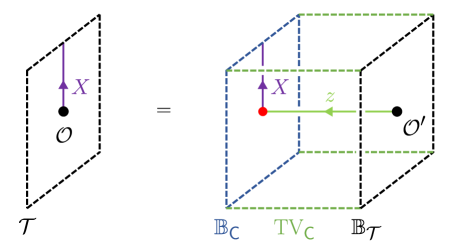
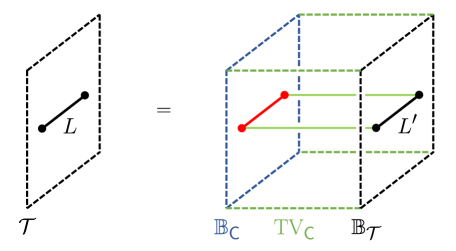
- Relate tube representations to the sandwich construction, linking [T_{S^d}(C), nVec] with TV_C(S^d) and Z(C) via Drinfeld centers and looping.
- Specialize to D=3 to present explicit constructions for actions on 1- and 2-twisted sector operators.
- Discuss examples with anomalous finite 2-group symmetries, Ising-like non-invertible cases, and braided fusion categories via Müger center and braided modules.
- Explain higher analogues of twisted Drinfeld doubles in the invertible case and outline extensions to non-invertible higher symmetries.
Experimental results
Research questions
- RQ1How do higher fusion category (categorical) symmetries act on twisted sector and extended operators in D≥2 quantum field theories?
- RQ2What are the appropriate higher tube categories and higher tube algebras that capture these actions, and how do their representations relate to known centers or doubles?
- RQ3How does the sandwich construction generalize to higher dimensions and non-invertible symmetries, and what is the role of the Drinfeld center in this context?
- RQ4What concrete 3D examples illustrate the structure of tube representations for invertible and non-invertible symmetries, including Ising-like and braided cases?
- RQ5How do higher tube representations connect to braided module categories and Müger centers in the presence of braided fusion categories?
Key findings
- Tube representations of a fusion category C in D=2 are equivalent to representations of the tube algebra A(C), and reproduce the Drinfeld center Z(C).
- In D=3, the action on 1-twisted sector operators is captured by the tube category T_{S^2}(C) whose representations correspond to the looping of the Drinfeld center, Omega Z(C).
- Higher tube categories T_{S^d}(C) and higher tube algebras A_{S^d}(C) provide a unified framework for representing non-invertible and inverted symmetries in D≥2, with [T_{S^d}(C), nVec] ≅ Rep(A_{S^d}(C)).
- The sandwich construction extends to higher categorical symmetries, linking tube representations with bulk topological defects in TV_C and their S^d-linked defects.
- Invertible cases generalize twisted Drinfeld doubles to higher settings, while non-invertible examples (e.g., Ising-like) arise from gauging finite subgroups and relate to braided structures and Müger centers.
- The framework encompasses braided fusion categories and braided module categories, connecting to the Müger center and generalized centers in higher dimensions.
Read this paper
Open the full text in the Nubint reader and ask about any passage as you read.
Read this paper on NubintThis review was generated by AI from the original paper. Please check the paper before citing it.