
[Paper Review] REVEAL: Retrieval-Augmented Visual-Language Pre-Training with Multi-Source Multimodal Knowledge Memory
ReVeaL proposes an end-to-end retrieval-augmented visual-language model that pre-trains a unified multimodal memory from diverse sources—such as image-text pairs, knowledge graphs, and Wikipedia passages—enabling efficient retrieval and generation. By jointly training the retriever and generator with an attentive fusion mechanism, ReVeaL achieves state-of-the-art performance on OKVQA (59.1% accuracy) with significantly fewer parameters than prior methods.
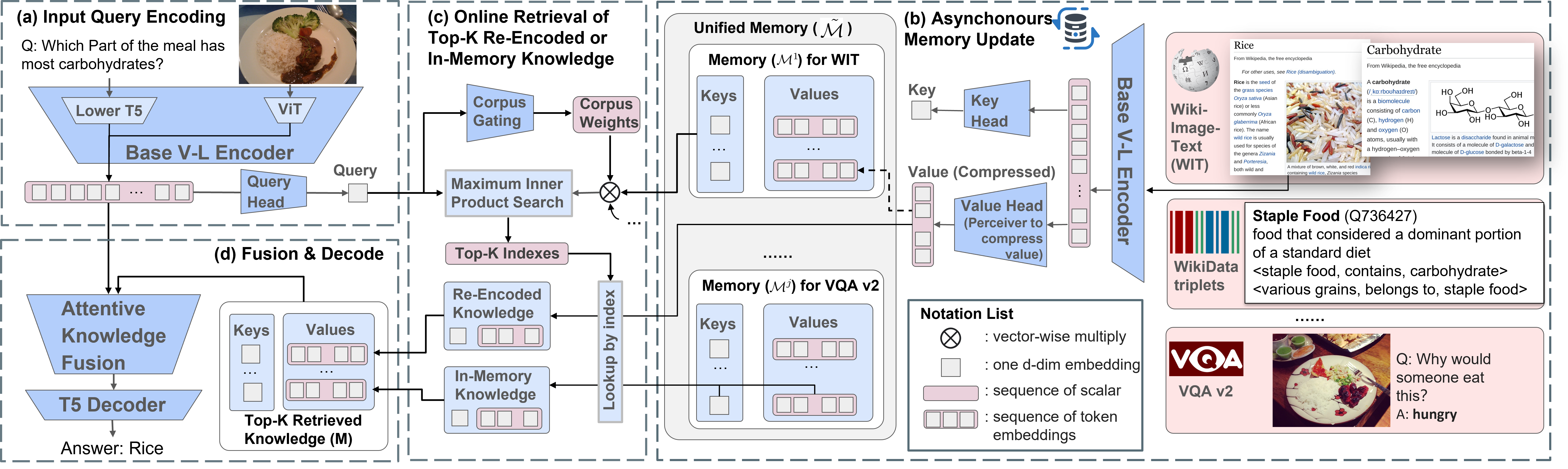
In this paper, we propose an end-to-end Retrieval-Augmented Visual Language Model (REVEAL) that learns to encode world knowledge into a large-scale memory, and to retrieve from it to answer knowledge-intensive queries. REVEAL consists of four key components: the memory, the encoder, the retriever and the generator. The large-scale memory encodes various sources of multimodal world knowledge (e.g. image-text pairs, question answering pairs, knowledge graph triplets, etc) via a unified encoder. The retriever finds the most relevant knowledge entries in the memory, and the generator fuses the retrieved knowledge with the input query to produce the output. A key novelty in our approach is that the memory, encoder, retriever and generator are all pre-trained end-to-end on a massive amount of data. Furthermore, our approach can use a diverse set of multimodal knowledge sources, which is shown to result in significant gains. We show that REVEAL achieves state-of-the-art results on visual question answering and image captioning.
Motivation & Objective
- To address the limitations of large-scale visual-language models that require massive retraining when world knowledge is updated.
- To enable efficient, scalable, and dynamic knowledge retrieval by decoupling knowledge storage from model parameters.
- To improve performance on knowledge-intensive visual-language tasks by leveraging diverse multimodal knowledge sources.
- To develop a differentiable, end-to-end training paradigm for retrieval-augmented visual-language models with joint optimization of retriever and generator.
- To enable rapid knowledge updates without retraining model parameters by modifying only the external memory.
Proposed method
- The model uses a unified encoder to embed diverse multimodal knowledge sources—image-text pairs, Wikipedia passages, knowledge graph triplets—into a shared memory space.
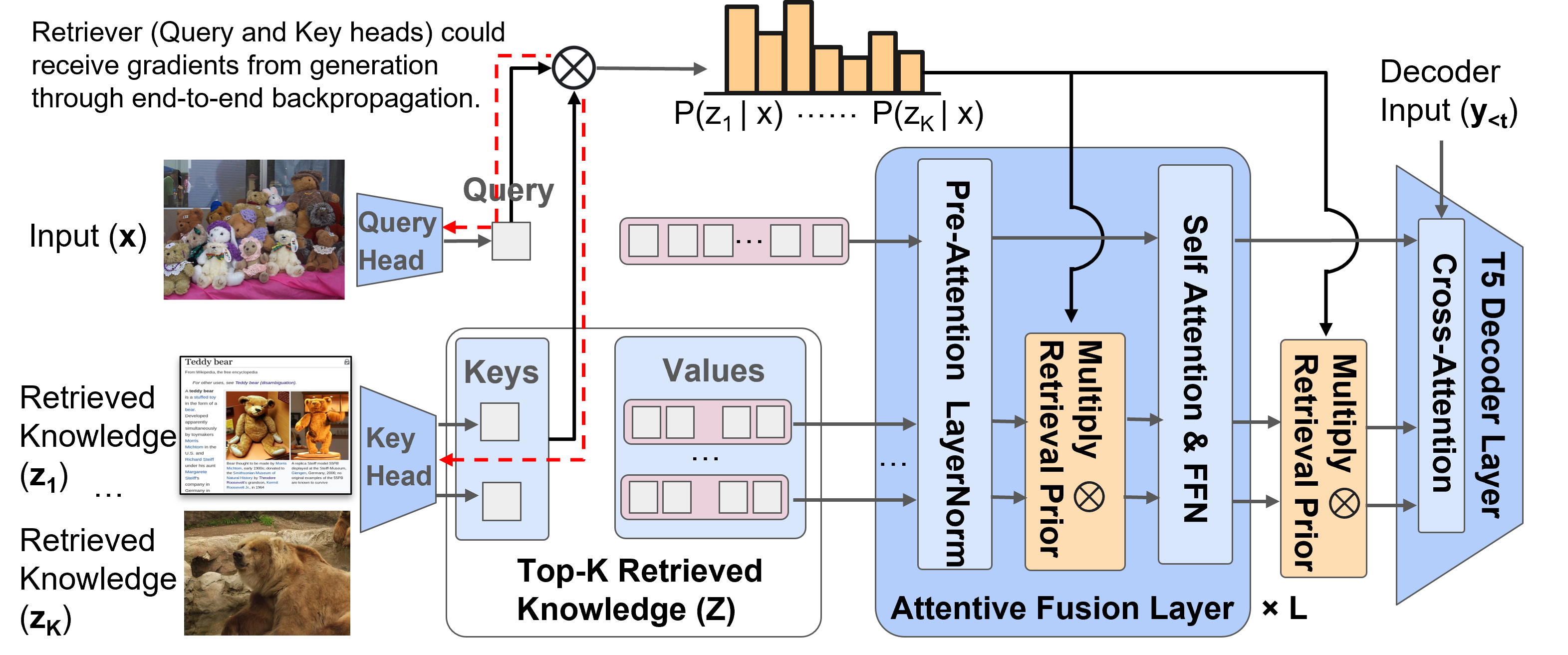
- A retriever module uses multimodal query embeddings to retrieve the most relevant knowledge entries from the memory using a differentiable attention-based fusion mechanism.
- An attentive fusion layer integrates retrieval scores directly into the self-attention mechanism, enabling end-to-end backpropagation through the retriever.
- The generator fuses the retrieved knowledge with the input query to produce answers or captions, trained via a language modeling objective.
- The entire system—memory, encoder, retriever, and generator—is pre-trained jointly on a massive-scale image-text corpus with multiple knowledge sources.
- Knowledge updates are supported by modifying the memory without retraining the model parameters, enabling dynamic adaptation.
Experimental results
Research questions
- RQ1Can a retrieval-augmented visual-language model achieve state-of-the-art performance on knowledge-intensive visual question answering and image captioning tasks?
- RQ2Does end-to-end pre-training of the retriever with the generator lead to better retrieval and generation performance than frozen or distillation-based methods?
- RQ3Can a unified multimodal memory effectively integrate diverse knowledge sources (e.g., text, images, knowledge graphs) for improved reasoning?
- RQ4How efficiently can the model adapt to new or updated knowledge without retraining its parameters?
- RQ5Does the attentive fusion mechanism improve retrieval quality and downstream task accuracy compared to independent retrieval scoring?
Key findings
- ReVeaL achieves a new state-of-the-art accuracy of 59.1% on the OKVQA benchmark, significantly outperforming prior methods.
- The model achieves this result with an order of magnitude fewer parameters than previous SOTA approaches, demonstrating high parameter efficiency.
- The attentive fusion method achieves 72.6% retrieval accuracy at top-10 and 89.4% at top-100 on the WIT dataset, outperforming baseline methods like Attention Distill and Perplexity Distill.
- When knowledge is removed from the memory, model accuracy drops to 45.1%; upon reintroduction, accuracy recovers to 51.8%, proving the model’s ability to adapt to knowledge updates without retraining.
- The proposed method has a computational cost (120 GFLOPs) comparable to Attention Distill but significantly lower than EMDR2 and Perplexity Distill, indicating high efficiency.
- The model demonstrates strong generalization and robustness, with performance gains from using diverse multimodal knowledge sources in the memory.
Better researchstarts right now
From reading papers to final review, dramatically reduce your research time.
No credit card · Free plan available
This review was created by AI and reviewed by human editors.