
[Paper Review] Reviewer2: Optimizing Review Generation Through Prompt Generation
Reviewer2 proposes a two-stage LLM framework that first generates aspect prompts to guide detailed, controlled review generation, significantly improving specificity and coverage over baseline methods. Trained on a new 27k-paper, 99k-review dataset with aspect prompts, it outperforms existing methods in review quality and controllability using LongLoRA and FlashAttention-2 for 32k context length.
Recent developments in LLMs offer new opportunities for assisting authors in improving their work. In this paper, we envision a use case where authors can receive LLM-generated reviews that uncover weak points in the current draft. While initial methods for automated review generation already exist, these methods tend to produce reviews that lack detail, and they do not cover the range of opinions that human reviewers produce. To address this shortcoming, we propose an efficient two-stage review generation framework called Reviewer2. Unlike prior work, this approach explicitly models the distribution of possible aspects that the review may address. We show that this leads to more detailed reviews that better cover the range of aspects that human reviewers identify in the draft. As part of the research, we generate a large-scale review dataset of 27k papers and 99k reviews that we annotate with aspect prompts, which we make available as a resource for future research.
Motivation & Objective
- Address the lack of detail and limited coverage in existing LLM-based automated review generation methods.
- Enable authors to receive targeted feedback on specific aspects of their paper by controlling the review focus.
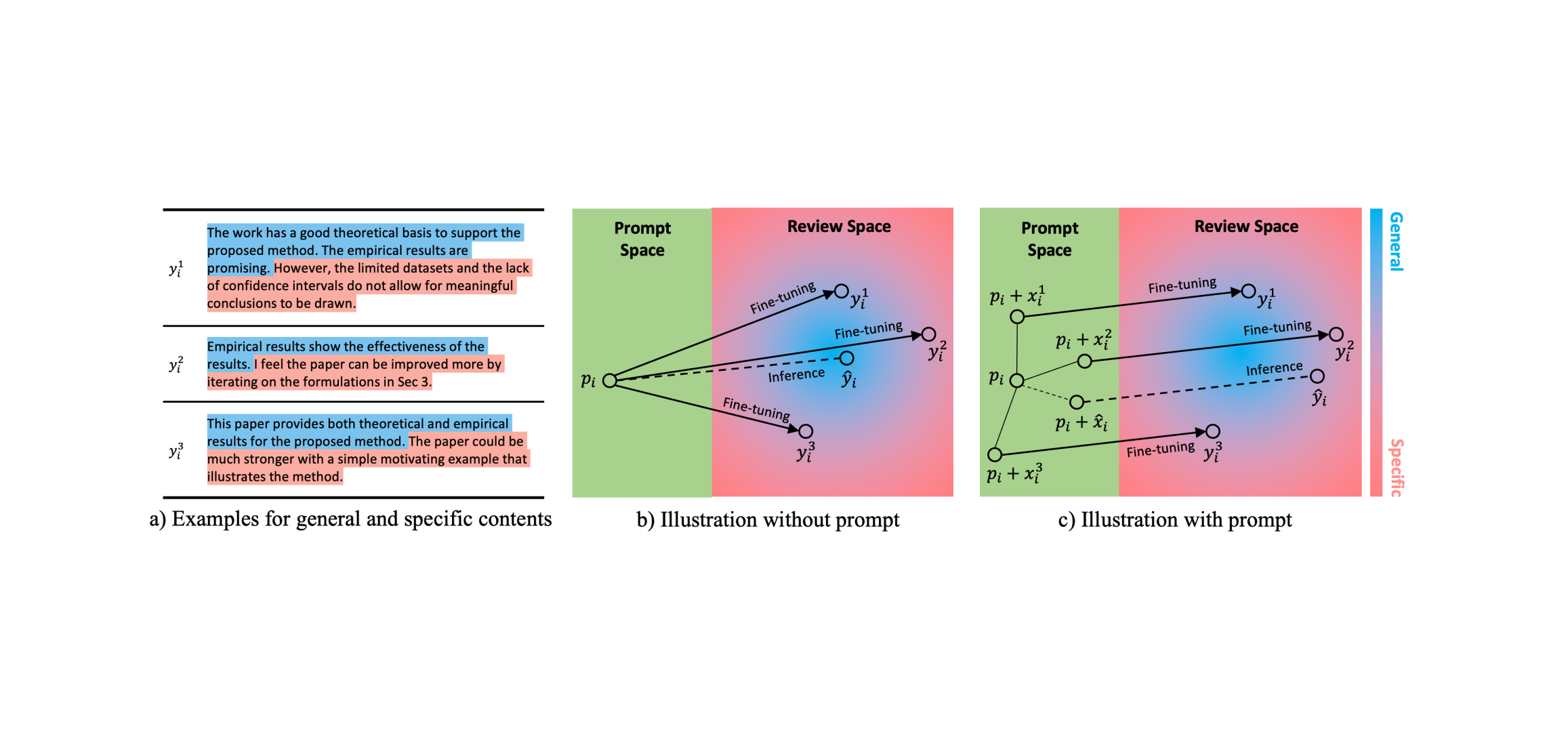
- Overcome the limitations of standard fine-tuning, which leads to generic, low-specificity reviews and regression-to-the-mean in aspect coverage.
- Develop a scalable, efficient pipeline to generate high-quality aspect prompts for training and inference.
- Create a large-scale, annotated dataset of paper-review pairs with aspect prompts to support future research in automated review generation.
Proposed method
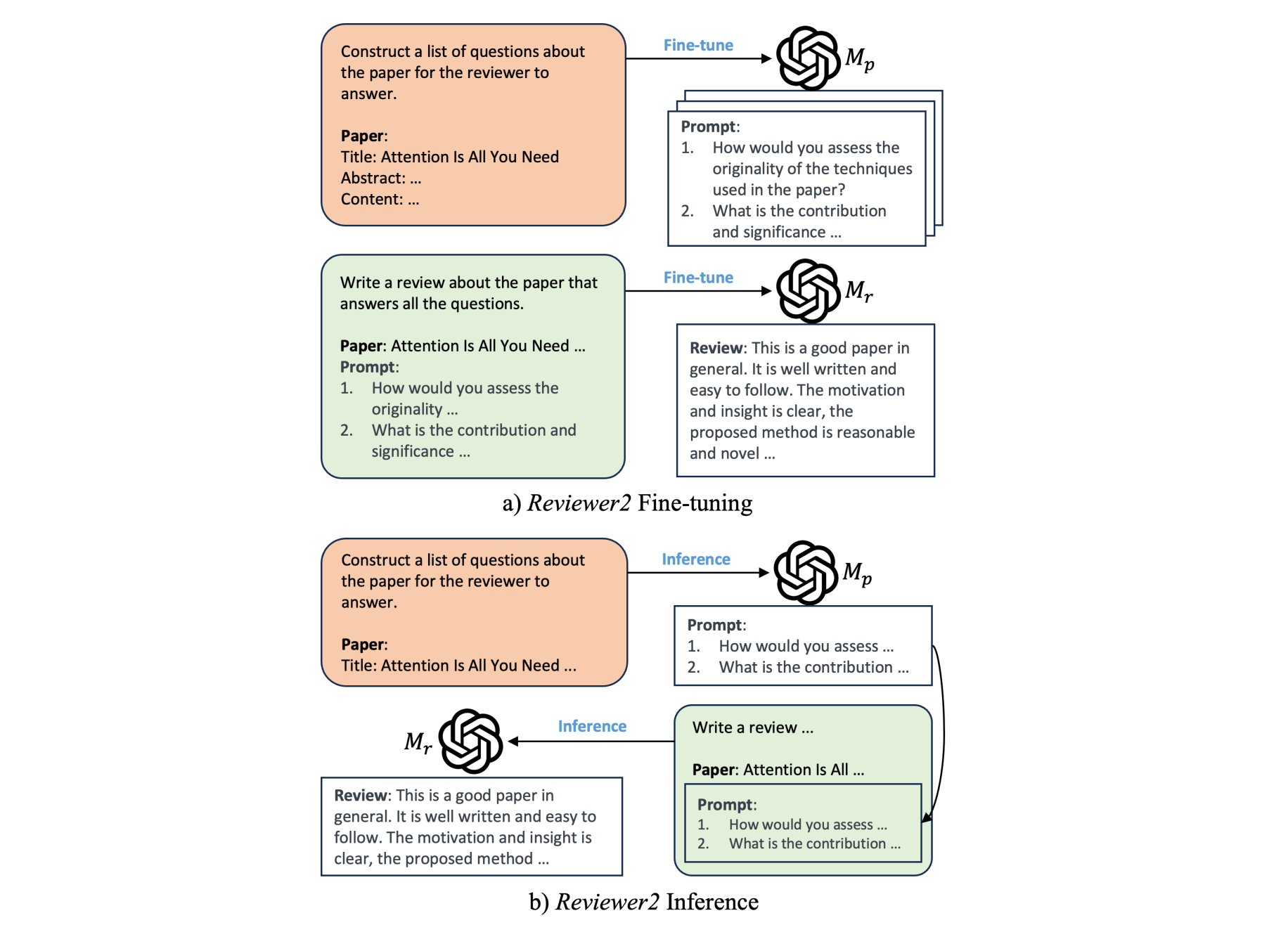
- Use a two-stage framework: first, a language model generates aspect prompts (e.g., 'Evaluate the theoretical foundation in Section 3') based on the paper; second, a second model generates a review using the paper and the aspect prompt.
- Implement the framework using LongLoRA and FlashAttention-2 to enable 32k context length, avoiding extractive summarization of long papers.
- Design a prompt generation with evaluation (PGE) pipeline that generates aspect prompts from human reviews and uses self-evaluation to ensure prompt quality.
- Introduce two new evaluation metrics: specificity (measuring justification depth) and coverability (measuring diversity of generated reviews across prompts).
- Fine-tune the second-stage model on a new dataset of 27,000 papers and 99,000 reviews with corresponding aspect prompts, sourced from six venues.
- Use BertScore to compute pairwise similarity between reference and generated reviews to assess coverability and consistency.
Experimental results
Research questions
- RQ1Can aspect prompt guidance improve the specificity and depth of LLM-generated reviews compared to generic prompts?
- RQ2Does the two-stage framework with aspect prompts lead to better coverage of diverse review aspects than standard fine-tuning?
- RQ3To what extent can the model generate reviews that are both detailed and responsive to specific aspect prompts?
- RQ4How does the use of full-context 32k-length inputs affect review quality and aspect coverage compared to truncated inputs?
- RQ5Can a self-evaluation-based prompt generation pipeline produce high-quality, diverse aspect prompts suitable for training robust review generation models?
Key findings
- Reviewer2 reduces coverability (a measure of review diversity across prompts) to 4.22 on ICLR, 3.99 on NeurIPS, and 3.23 on ACL, significantly outperforming the baseline R2-E with values of 13.55, 12.66, and 16.62 respectively.
- The framework generates reviews with higher specificity than standard fine-tuning, as shown by a decline in generic phrasing over training steps, with more detailed justifications emerging at later stages.
- The PGE pipeline successfully generates high-quality aspect prompts, enabling the model to produce reviews that are both specific and responsive to the input prompts.
- The use of 32k context length via LongLoRA and FlashAttention-2 allows full paper context without summarization, improving review quality and aspect coverage.
- The new dataset of 27,000 papers and 99,000 reviews with aspect prompts is publicly released, providing a valuable resource for future research in automated review generation and instruction tuning.
- Reviewer2 demonstrates strong controllability: when prompted with different aspects, it generates distinct, relevant reviews that align with the intended focus, as confirmed by low similarity between outputs from different prompts.
Read this paper
Open the full text in the Nubint reader and ask about any passage as you read.
Read this paper on NubintThis review was generated by AI from the original paper. Please check the paper before citing it.