
[Paper Review] RiNALMo: General-Purpose RNA Language Models Can Generalize Well on Structure Prediction Tasks
RiNALMo is a 650M-parameter RNA language model pre-trained on 36M ncRNA sequences that demonstrates strong generalization to RNA structure and function tasks, outperforming existing models across multiple datasets, including unseen RNA families.
While RNA has recently been recognized as an interesting small-molecule drug target, many challenges remain to be addressed before we take full advantage of it. This emphasizes the necessity to improve our understanding of its structures and functions. Over the years, sequencing technologies have produced an enormous amount of unlabeled RNA data, which hides a huge potential. Motivated by the successes of protein language models, we introduce RiboNucleic Acid Language Model (RiNALMo) to unveil the hidden code of RNA. RiNALMo is the largest RNA language model to date, with 650M parameters pre-trained on 36M non-coding RNA sequences from several databases. It can extract hidden knowledge and capture the underlying structure information implicitly embedded within the RNA sequences. RiNALMo achieves state-of-the-art results on several downstream tasks. Notably, we show that its generalization capabilities overcome the inability of other deep learning methods for secondary structure prediction to generalize on unseen RNA families.
Motivation & Objective
- Leverage large-scale unlabeled RNA data to learn a general-purpose RNA representation.
- Pre-train an RNA-focused Transformer encoder with modern architectural improvements.
- Evaluate RiNALMo on diverse downstream tasks to assess structure and function generalization.
- Demonstrate inter-family generalization where unseen RNA families are evaluated.
- Provide public release of code to enable broader adoption and reproducibility.
Proposed method
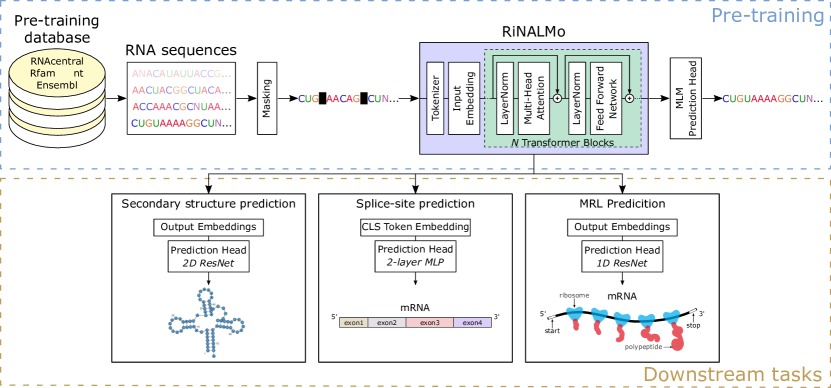
- Pre-train RiNALMo (650M parameters) as a BERT-style encoder using masked language modeling on 36M ncRNA sequences from RNAcentral, Rfam, nt, and Ensembl.
- Use 33 Transformer blocks with RoPE positional encoding, SwiGLU activation, FlashAttention-2, and 20 attention heads per block.
- Limit input length to 1024 tokens and train with 15% corruption (80% masked, 10% random token, 10% unchanged) using cross-entropy loss.
- Represent sequences with a 1280-d embedding dimension; prepend CLS and append EOS tokens; fine-tune end-to-end on downstream tasks with simple prediction heads.
- Evaluate the learned embeddings by attaching a simple ResNet-based predictor for structure tasks and MLP heads for splice-site and ribosome loading tasks.
Experimental results
Research questions
- RQ1Can RiNALMo generalize to RNA families not seen during training for secondary structure prediction?
- RQ2How does RiNALMo perform on multi-species splice-site prediction compared to existing RNA LMs and traditional methods?
- RQ3Is RiNALMo capable of accurate mean ribosome loading prediction and generalize from random-origin training to human sequences?
Key findings
- RiNALMo significantly outperforms other methods on inter-family secondary structure prediction, achieving higher F1 scores across most tested families.
- On inter-family generalization, RiNALMo beats thermodynamics-based and deep learning baselines in eight of nine families (telomerase RNAs are a noted exception).
- For multi-species splice-site prediction, RiNALMo achieves state-of-the-art F1 scores across fish, fly, plant, and worm datasets.
- In mean ribosome loading prediction, RiNALMo attains higher R^2 scores than Uni-RNA, RNA-FM, and Optimus 5-Prime on both Random7600 and Human7600 datasets.
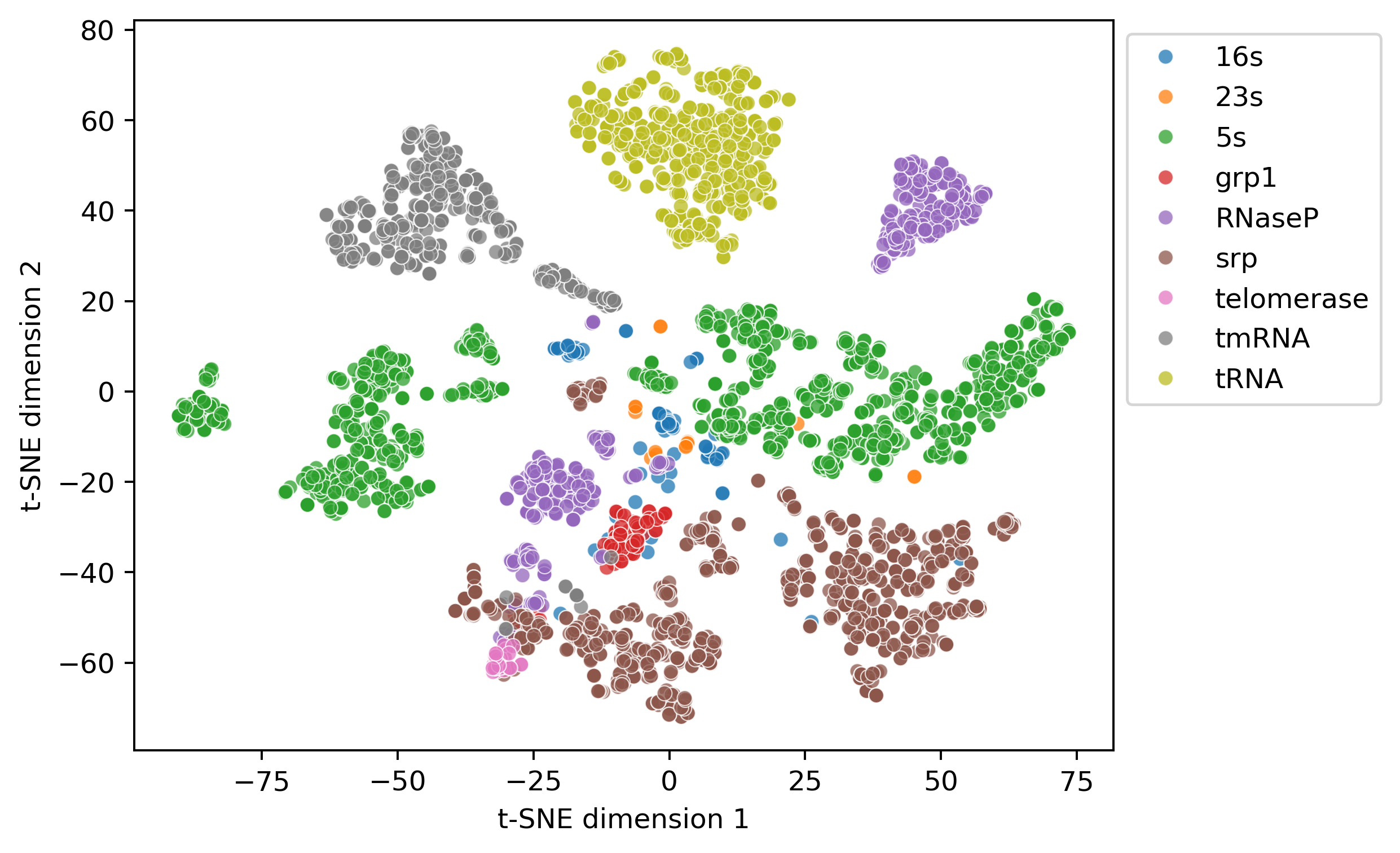
- RiNALMo’s inter-family structure embeddings show clear clustering by RNA family in t-SNE visualizations, indicating rich structural information in the embeddings.
- RiNALMo’s average inter-family secondary structure F1 score is 0.72, higher than RNAstructure (0.59) and CONTRAfold (0.61) and other baselines (Table 2).
- In donor/acceptor splice-site prediction, RiNALMo achieves average F1 scores of 97.70 (Fish), 96.11 (Fly), 96.25 (Plant), and 95.63 (Worm).
- RiNALMo’s splice-site results surpass SpliceBERT, Uni-RNA, RNA-FM, Spliceator on the reported species splits (Table 3).
- RiNALMo shows robust generalization by producing near-state performance on human UTR MRL data even when trained on random-origin sequences (Random7600 vs Human7600 in Table 4).
Read this paper
Open the full text in the Nubint reader and ask about any passage as you read.
Read this paper on NubintThis review was generated by AI from the original paper. Please check the paper before citing it.