
[Paper Review] RoboScript: Code Generation for Free-Form Manipulation Tasks across Real and Simulation
RoboScript introduces a unified code generation pipeline that bridges high-level language instructions to executable robot control code for both simulation and real-world deployment. By integrating with ROS, Gazebo, and MoveIt, it enables end-to-end execution from natural language to motion planning, with ablation studies showing perception noise causes up to 15.0% performance drop, highlighting the critical role of accurate perception in real-world robot autonomy.
Rapid progress in high-level task planning and code generation for open-world robot manipulation has been witnessed in Embodied AI. However, previous studies put much effort into general common sense reasoning and task planning capabilities of large-scale language or multi-modal models, relatively little effort on ensuring the deployability of generated code on real robots, and other fundamental components of autonomous robot systems including robot perception, motion planning, and control. To bridge this ``ideal-to-real'' gap, this paper presents extbf{RobotScript}, a platform for 1) a deployable robot manipulation pipeline powered by code generation; and 2) a code generation benchmark for robot manipulation tasks in free-form natural language. The RobotScript platform addresses this gap by emphasizing the unified interface with both simulation and real robots, based on abstraction from the Robot Operating System (ROS), ensuring syntax compliance and simulation validation with Gazebo. We demonstrate the adaptability of our code generation framework across multiple robot embodiments, including the Franka and UR5 robot arms, and multiple grippers. Additionally, our benchmark assesses reasoning abilities for physical space and constraints, highlighting the differences between GPT-3.5, GPT-4, and Gemini in handling complex physical interactions. Finally, we present a thorough evaluation on the whole system, exploring how each module in the pipeline: code generation, perception, motion planning, and even object geometric properties, impact the overall performance of the system.
Motivation & Objective
- To close the 'ideal-to-real' gap in robot manipulation by enabling deployable code generation from natural language instructions.
- To develop a unified pipeline that supports both simulation (Gazebo) and real robots (Franka, UR5) via ROS abstraction.
- To create a benchmark that evaluates reasoning in physical space, constraints, and object properties beyond semantic understanding.
- To assess the impact of perception accuracy, motion planning robustness, and geometric properties on system performance.
- To enable seamless deployment across diverse robot embodiments and gripper types using conda-compatible ROS (Robostack).
Proposed method
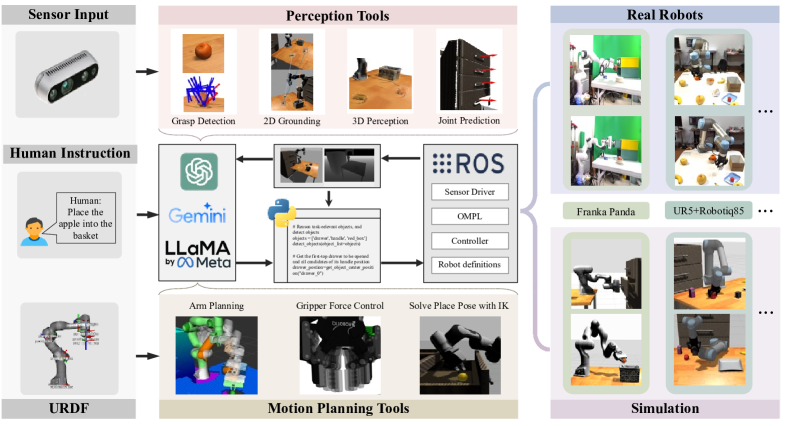
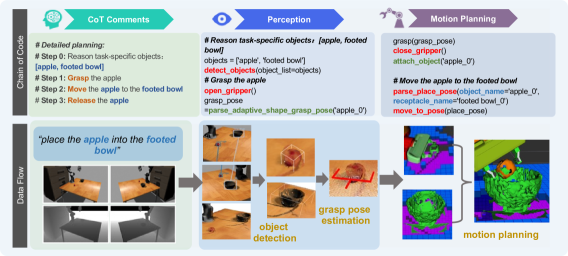
- The framework uses a modular pipeline: input from RGBD sensors and natural language instructions, processed through perception tools (e.g., AnyGrasp for grasp pose prediction) and 3D scene reconstruction via multi-view fusion.
- Perception outputs are fed into motion planning via MoveIt, using inverse kinematics and collision avoidance for trajectory generation.
- All code is generated using large language models (GPT-3.5, GPT-4, Gemini), with syntax validation and simulation testing in Gazebo to ensure deployability.
- A ROS-based code generation testing interface ensures syntactic correctness and enables direct deployment on real robots using conda-compatible Robostack.
- The perception-in-the-loop pipeline uses predicted grasp poses and bounding boxes as inputs to planning, simulating real-world perception errors.
- A comprehensive benchmark evaluates reasoning on physical constraints, workspace limits, and object geometry, with ground truth data provided to mitigate noise.
Experimental results
Research questions
- RQ1How does perception noise affect the success rate of motion planning in real robot deployment?
- RQ2To what extent do LLMs like GPT-4 and Gemini outperform GPT-3.5 in reasoning about physical constraints and object properties?
- RQ3How does the integration of perception, planning, and control impact end-to-end task success in real-world robot manipulation?
- RQ4What is the impact of robot morphology (e.g., Franka vs. UR5) and gripper type on code generation and task execution?
- RQ5Can a unified code generation pipeline ensure reliable sim-to-real transfer across diverse robotic platforms?
Key findings
- Perception noise reduced task success rates by 14.0% and 15.0% on pick-and-place and open-drawer tasks, respectively, indicating perception is a major bottleneck.
- Incorrect 2D grounding led to erroneous 3D bounding boxes that included the robot arm, causing unsolvable self-collision in MoveIt and motion planning failure.
- GPT-4 demonstrated superior reasoning on physical constraints and object geometry compared to GPT-3.5 and Gemini, particularly in complex spatial reasoning tasks.
- The system achieved successful real-world deployment on both Franka Panda and UR5 with Robotiq 85 gripper, validating the unified pipeline across hardware platforms.
- MoveIt motion planning was highly sensitive to detection errors, especially when object bounding boxes were enlarged and included the robot’s own mesh.
- The ablation study confirmed that perception inaccuracies have a larger impact on performance than motion planning or control errors, underscoring the need for robust perception in real-world systems.
Read this paper
Open the full text in the Nubint reader and ask about any passage as you read.
Read this paper on NubintThis review was generated by AI from the original paper. Please check the paper before citing it.