
[Paper Review] Sampling with censored data: a practical guide
This paper presents a practical, reproducible guide for generating pseudo-random censored data using R, focusing on type I, II, and random censoring within the Weibull distribution framework. It introduces algorithms for simulating censored samples with a cure fraction, validated through simulation studies and MLE inference, offering researchers a ready-to-use toolkit for survival analysis simulations.
In this review, we present a simple guide for researchers to obtain pseudo-random samples with censored data. We focus our attention on the most common types of censored data, such as type I, type II, and random censoring. We discussed the necessary steps to sample pseudo-random values from long-term survival models where an additional cure fraction is informed. For illustrative purposes, these techniques are applied in the Weibull distribution. The algorithms and codes in R are presented, enabling the reproducibility of our study. Finally, we developed an R package that encapsulates these methodologies, providing researchers with practical tools for implementation.
Motivation & Objective
- To address the lack of comprehensive, practical guides for simulating pseudo-random censored data in survival analysis.
- To provide step-by-step algorithms for generating censored samples under type I, type II, and random censoring mechanisms.
- To extend simulation techniques to include long-term survival (cure fraction) in Weibull-based models.
- To ensure reproducibility by providing full R code for all simulation and inference procedures.
- To validate the proposed methods through simulation studies assessing bias and mean squared error of parameter estimators.
Proposed method
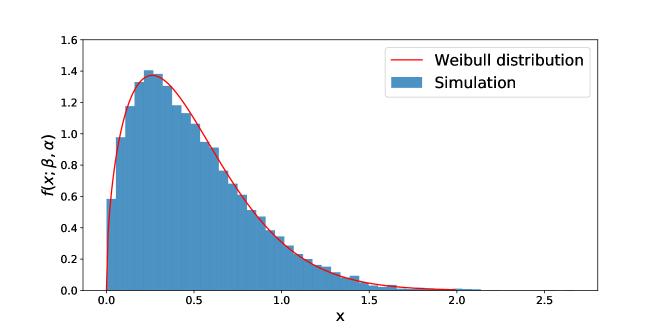
- Uses the inverse transformation method to generate baseline Weibull-distributed random variables.
- Applies type I censoring by setting a fixed study end time, truncating all survival times beyond this point.
- Applies type II censoring by terminating the experiment after a pre-specified number of failures, with remaining units censored.
- Implements random censoring by assigning independent, uniformly distributed censoring times to each subject.
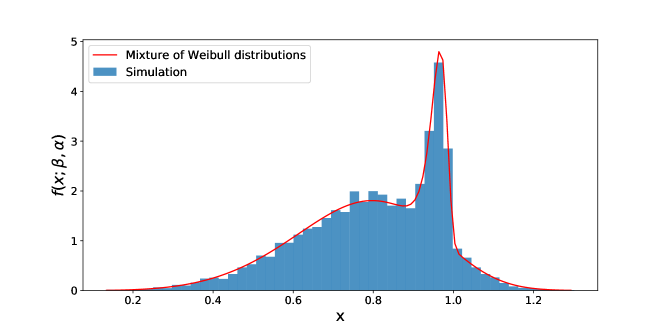
- Integrates a cure fraction model by simulating a mixture of cured (non-event) and susceptible (event) individuals using a Bernoulli component.
- Employs maximum likelihood estimation (MLE) with numerical optimization (via maxLik in R) to estimate parameters, using the Hessian matrix for standard errors and confidence intervals.
Experimental results
Research questions
- RQ1How can researchers reliably simulate type I censored data using the Weibull distribution in R?
- RQ2What is the correct procedure to generate type II censored samples with known failure thresholds?
- RQ3How can random censoring be implemented when censoring times vary across subjects?
- RQ4What is the impact of a cure fraction on the simulation of censored survival data?
- RQ5How do different censoring mechanisms affect the bias and mean squared error of MLE parameter estimates?
Key findings
- The MLE for the shape parameter α was estimated as 1.655 with a standard error of 0.428, yielding a 95% confidence interval of (0.817, 2.492).
- The scale parameter β was estimated at 0.281 with a standard error of 0.140, resulting in a 95% confidence interval of (0.007, 0.555).
- The simulation framework successfully generated censored data under all three censoring schemes (I, II, and random) with full reproducibility via R code.
- The inclusion of a cure fraction in the Weibull model was effectively simulated using a mixture model with a Bernoulli component for cured individuals.
- The simulation study demonstrated that censoring mechanisms significantly influence estimator bias and mean squared error, with results consistent across multiple sample sizes.
- The Fisher information matrix was computed numerically using the Hessian from the maxLik function, enabling accurate standard error and confidence interval estimation despite complex special functions (Meijer-G).
Read this paper
Open the full text in the Nubint reader and ask about any passage as you read.
Read this paper on NubintThis review was generated by AI from the original paper. Please check the paper before citing it.