
[Paper Review] Satellite-based Quantum Network: Security and Challenges over Atmospheric Channel
This paper investigates satellite-based quantum key distribution (QKD) over atmospheric channels, focusing on quantum state transfer (QST) and wavepacket shaping to enhance security, fidelity, and transmissivity. It proposes physical-layer techniques to mitigate atmospheric loss, turbulence, and quantum hacking threats, emphasizing channel estimation and entanglement preservation for next-generation quantum networks.
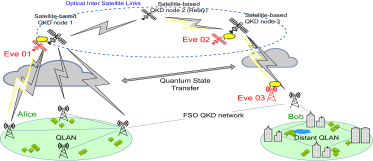
The ultra-secure quantum network leverages quantum cryptography to deliver unsurpassed data transfer security. In principle, the well-known quantum key distribution (QKD) achieves unconditional security, which raises concerns about the trustworthiness of 6G wireless systems in order to mitigate the gap between practice and theory. The long-distance satellite-to-ground evolving quantum network distributes keys that are ubiquitous to the node on the ground through low-orbit satellites. As the secret key sequence is encoded into quantum states, it is sent through the atmosphere via a quantum channel. It still requires more effort in the physical layer design of deployment ranges, transmission, and security to achieve high-quality quantum communication. In this paper, we first review the quantum states and channel properties for satellite-based quantum networks and long-range quantum state transfer (QST). Moreover, we highlight some challenges, such as transmissivity statistics, estimation of channel parameters and attack resilience, quantum state transfer for satellite-based quantum networks, and wavepacket shaping techniques over atmospheric channels. We underline two research directions that consider the QST and wavepacket shaping techniques for atmospheric transmission in order to encourage further research toward the next generation of satellite-based quantum networks.
Motivation & Objective
- To address the gap between theoretical quantum security and practical deployment in 6G and satellite-based quantum networks.
- To analyze atmospheric channel effects—such as turbulence, attenuation, and diffraction—on quantum state transmission and key distribution.
- To identify critical physical-layer challenges in satellite-based QKD, including transmissivity estimation, channel parameter dynamics, and attack resilience.
- To propose QST and wavepacket shaping as key techniques to improve fidelity, secret key rate, and security in long-distance quantum communication.
- To encourage research on secure, high-fidelity quantum communication by identifying open challenges in atmospheric quantum transmission.
Proposed method
- Reviews quantum states and channel properties in satellite-based QKD, focusing on free-space optical (FSO) transmission through the atmosphere.
- Analyzes atmospheric channel impairments such as turbulence, absorption, and diffraction, which affect transmissivity and quantum state fidelity.
- Examines quantum state transfer (QST) mechanisms in uplink/downlink scenarios, emphasizing fidelity degradation due to channel loss.
- Proposes wavepacket shaping modulation to enhance photon purity and preserve entanglement in single-photon and biphoton QKD systems.
- Introduces the use of entanglement purification and density matrix reconstruction to restore quantum correlations under atmospheric noise.
- Highlights the need for robust channel estimation and self-compensating receiver designs to maintain high secret key rates.
Experimental results
Research questions
- RQ1How do atmospheric channel impairments such as turbulence and absorption affect the fidelity and transmissivity of quantum state transfer in satellite-based QKD?
- RQ2To what extent can wavepacket shaping techniques preserve entanglement and photon purity in single-photon and biphoton states over long atmospheric paths?
- RQ3What are the key challenges in estimating dynamic channel parameters—such as transmissivity and loss—under real-time atmospheric conditions in satellite-to-ground quantum links?
- RQ4How can quantum state transfer be optimized to maintain high fidelity in the presence of atmospheric noise and loss?
- RQ5What physical-layer techniques can enhance resilience against quantum hacking attacks, particularly time-shift attacks, in practical satellite-based QKD systems?
Key findings
- Atmospheric turbulence and channel loss significantly degrade the fidelity of quantum state transfer, especially in long-distance satellite-to-ground links.
- Wavepacket shaping modulation has been experimentally shown to preserve high photon purity and entanglement even at high excitation powers, reducing biexciton emission in quantum dots.
- Entanglement concurrence can be conserved through turbulent atmospheric channels, indicating potential for robust long-range quantum communication.
- Quantum state transfer fidelity can be improved by generating symmetric states in intermediate stations, aligning with the Braunstein-Kimble teleportation protocol.
- Transmissivity estimation and dynamic channel compensation are critical for maintaining high secret key rates and resisting side-channel attacks.
- Current commercial QKD systems remain vulnerable to technically feasible quantum hacking, underscoring the need for verifiable security proofs and resilient physical-layer designs.
Read this paper
Open the full text in the Nubint reader and ask about any passage as you read.
Read this paper on NubintThis review was generated by AI from the original paper. Please check the paper before citing it.