
[Paper Review] Search-based Motion Planning for Quadrotors using Linear Quadratic Minimum Time Control
This paper proposes a search-based motion planning framework for quadrotors that generates dynamically feasible, minimum-time trajectories in cluttered environments by using motion primitives derived from Linear Quadratic Minimum Time (LQMT) control. The method discretizes the state space via optimal control solutions, enabling efficient graph search with a tight heuristic, and achieves real-time online re-planning with smoother, globally optimal trajectories compared to path-based methods.
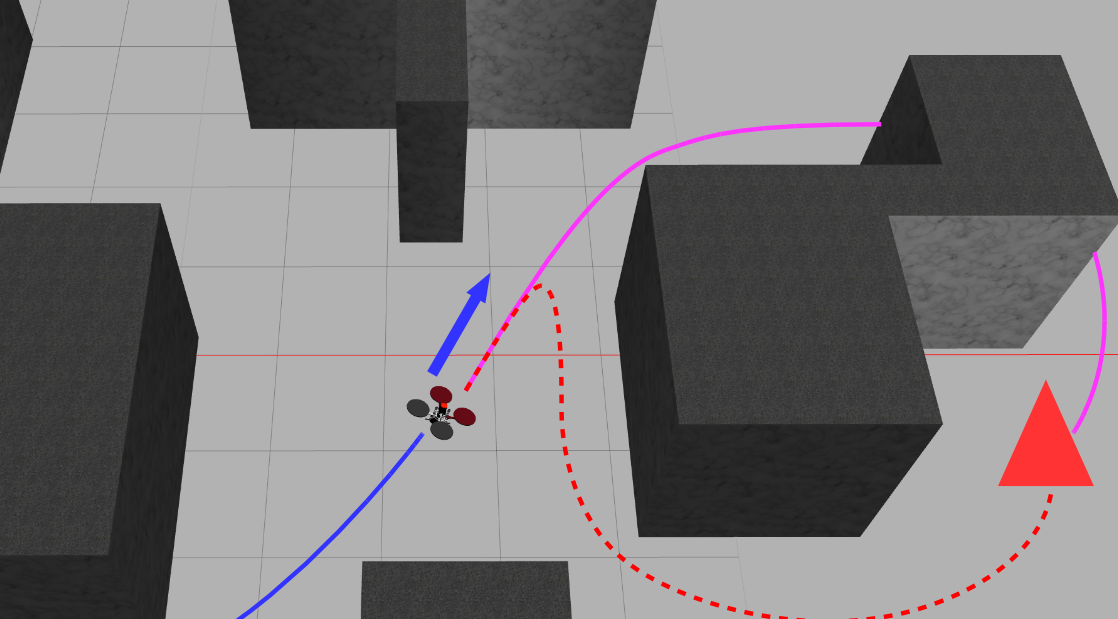
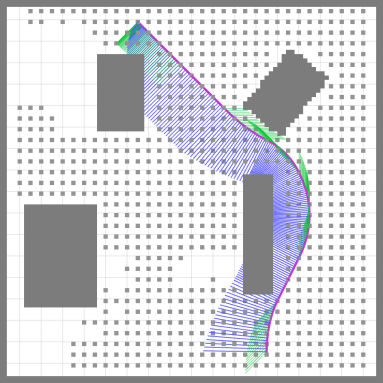
In this work, we propose a search-based planning method to compute dynamically feasible trajectories for a quadrotor flying in an obstacle-cluttered environment. Our approach searches for smooth, minimum-time trajectories by exploring the map using a set of short-duration motion primitives. The primitives are generated by solving an optimal control problem and induce a finite lattice discretization on the state space which can be explored using a graph-search algorithm. The proposed approach is able to generate resolution-complete (i.e., optimal in the discretized space), safe, dynamically feasibility trajectories efficiently by exploiting the explicit solution of a Linear Quadratic Minimum Time problem. It does not assume a hovering initial condition and, hence, is suitable for fast online re-planning while the robot is moving. Quadrotor navigation with online re-planning is demonstrated using the proposed approach in simulation and physical experiments and comparisons with trajectory generation based on state-of-art quadratic programming are presented.
Motivation & Objective
- To address the limitations of path-based trajectory generation, which restricts trajectories to a homology class and may produce suboptimal or infeasible paths when dynamics are ignored.
- To enable globally optimal, dynamically feasible, and time-minimizing trajectories for quadrotors in obstacle-rich environments without relying on precomputed geometric paths.
- To develop a computationally efficient method for online re-planning during fast flight by leveraging explicit solutions to the LQMT problem.
- To achieve resolution-complete planning by discretizing the state space through motion primitives derived from optimal control, enabling graph search with strong heuristic guidance.
Proposed method
- Motion primitives are generated by solving a Linear Quadratic Minimum Time (LQMT) optimal control problem for short time intervals, ensuring minimum-time transitions between states.
- The LQMT solution provides an explicit, closed-form control input that maps state transitions to control inputs, enabling finite lattice discretization of the state space.
- A graph is constructed where nodes represent discretized states and edges represent motion primitives, allowing search-based trajectory planning over the state space.
- A tight heuristic based on the LQMT solution is used to guide A* search, significantly accelerating convergence in high-dimensional state spaces.
- The final trajectory is refined via unconstrained quadratic programming to ensure exact feasibility for the quadrotor dynamics, even after lower-dimensional planning.
- The method avoids precomputed lookup tables and does not assume hovering initial conditions, enabling fast online re-planning during motion.
Experimental results
Research questions
- RQ1Can motion primitives derived from optimal control be used to discretize the state space in a way that enables efficient graph search for trajectory planning?
- RQ2Can the explicit solution of the LQMT problem provide a tight, computable heuristic that accelerates A* search in high-dimensional state spaces?
- RQ3Does the proposed method generate smoother, more dynamically feasible, and time-optimal trajectories than path-based approaches that rely on geometric shortest paths?
- RQ4Can the method support real-time online re-planning for fast quadrotors without assuming a hovering initial condition?
Key findings
- The proposed method generates resolution-complete, dynamically feasible, minimum-time trajectories by discretizing the state space using LQMT-derived motion primitives.
- The use of an LQMT-based heuristic significantly accelerates A* search, making real-time planning in high-dimensional state spaces feasible.
- The method produces smoother trajectories than traditional path-based approaches, avoiding sharp turns near obstacles even during online re-planning.
- Physical experiments and simulations demonstrate successful online re-planning in cluttered environments, with trajectories that are both safe and time-optimal.
- The approach outperforms state-of-the-art quadratic programming-based methods in terms of trajectory smoothness and time optimality, especially in dynamic scenarios.
- The open-source implementation is available on GitHub, enabling reproducibility and integration into broader robotic systems.
Read this paper
Open the full text in the Nubint reader and ask about any passage as you read.
Read this paper on NubintThis review was generated by AI from the original paper. Please check the paper before citing it.