
[Paper Review] Security of discrete-modulated continuous-variable quantum key distribution
This paper presents a finite-size security proof for a discrete-modulated continuous-variable quantum key distribution (CVQKD) protocol using four coherent states and heterodyne detection, leveraging the entropy accumulation theorem to establish security against coherent attacks. It achieves asymptotic key rates of 0.1–10⁻⁴ bits per round over 100 km and generates approximately 10 Gbits of secret key after 10¹² rounds at tens of kilometers, under realistic parameters.
Continuous variable quantum key distribution with discrete modulation has the potential to provide information-theoretic security using widely available optical elements and existing telecom infrastructure. While their implementation is significantly simpler than that for protocols based on Gaussian modulation, proving their finite-size security against coherent attacks poses a challenge. In this work we prove finite-size security against coherent attacks for a discrete-modulated quantum key distribution protocol involving four coherent states and heterodyne detection. To do so, and contrary to most of the existing schemes, we first discretize all the continuous variables generated during the protocol. This allows us to use the entropy accumulation theorem, a tool that has previously been used in the setting of discrete variables, to construct the finite-size security proof. We then compute the corresponding finite-key rates through semi-definite programming and under a photon-number cutoff. Our analysis provides asymptotic rates in the range of $0.1-10^{-4}$ bits per round for distances up to hundred kilometres, while in the finite case and for realistic parameters, we get of the order of $10$ Gbits of secret key after $n\sim10^{11}$ rounds and distances of few tens of kilometres.
Motivation & Objective
- To establish finite-size security for discrete-modulated CVQKD protocols against coherent attacks, where Gaussian extremality does not apply.
- To overcome the challenge of proving security without relying on Gaussian state optimality, which is invalid for discrete modulation.
- To enable practical implementation of CVQKD using standard telecom components by proving security for a protocol with only four coherent states.
- To derive realistic key rates for long-distance quantum key distribution under finite-resource conditions.
Proposed method
- The authors apply the entropy accumulation theorem (EAT) to upgrade an asymptotic security bound into a finite-size security proof.
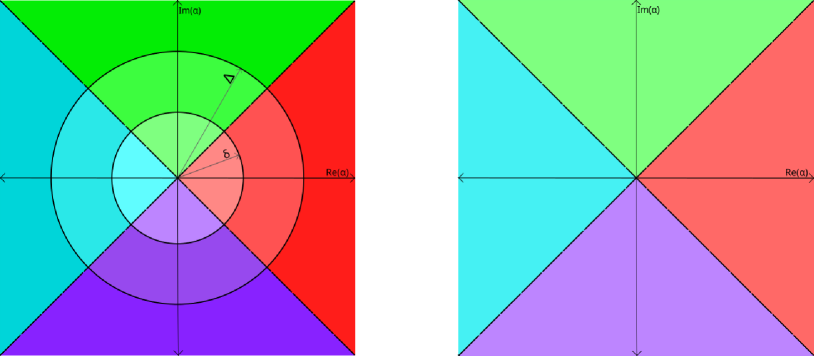
- They model the protocol with discrete modulation using four coherent states and heterodyne detection, fully discretizing the information to avoid reliance on continuous-variable assumptions.
- A photon number cutoff is imposed to model realistic experimental constraints, and the asymptotic key rate is bounded under this assumption.
- The proof uses purified distance and max-entropy bounds to control the deviation between the actual and idealized states, ensuring security within an epsilon-ball.
- Hoeffding’s inequality is used to bound the probability of high photon number outcomes, enabling control over the error in the entropy estimation.
- Conditional max-entropy bounds are derived to handle the case where the protocol outcome is restricted to a subset of outcomes, ensuring robustness under statistical fluctuations.
Experimental results
Research questions
- RQ1Can finite-size security be rigorously proven for discrete-modulated CVQKD protocols without relying on Gaussian state optimality?
- RQ2What is the achievable asymptotic key rate for a four-state discrete-modulated CVQKD protocol under realistic photon number constraints?
- RQ3How does the key rate scale with the number of rounds in finite-size scenarios, and what is the total secret key length achievable for practical parameters?
- RQ4Can the entropy accumulation theorem be effectively applied to continuous-variable protocols with discrete modulation, despite the lack of Gaussian structure?
- RQ5What is the impact of experimental imperfections such as photon number cutoff and finite statistics on the final key rate and security?
Key findings
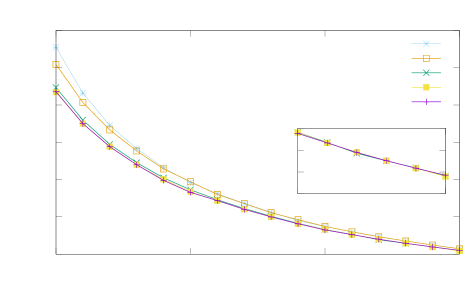
- The asymptotic key rate for the discrete-modulated CVQKD protocol ranges from 0.1 to 10⁻⁴ bits per round over a 100 km transmission distance.
- For realistic parameters and n = 10¹² rounds, the protocol generates approximately 10 Gbits of secret key over tens of kilometers.
- The security proof is valid against coherent attacks, using the entropy accumulation theorem to handle finite-size effects without relying on de Finetti or postselection techniques.
- The key rate is bounded under a realistic photon number cutoff, ensuring the analysis reflects experimental constraints.
- The method achieves security by controlling the purified distance between the actual and idealized states, with error bounds derived via Hoeffding’s inequality.
- Conditional max-entropy bounds are derived that scale with the square root of n, enabling tight finite-size estimates even under statistical fluctuations.
Read this paper
Open the full text in the Nubint reader and ask about any passage as you read.
Read this paper on NubintThis review was generated by AI from the original paper. Please check the paper before citing it.