
[Paper Review] Self-supervised Dynamic CT Perfusion Image Denoising with Deep Neural Networks
This paper proposes a self-supervised deep learning method for dynamic CT perfusion image denoising that trains without high-dose reference images by leveraging temporal correlations between adjacent frames. The approach uses Noise2Noise-style learning, where each frame is predicted from its neighboring frames, effectively removing independent noise and achieving superior image quality and contrast-to-noise ratio compared to supervised and conventional denoising methods on real clinical data.
Dynamic computed tomography perfusion (CTP) imaging is a promising approach for acute ischemic stroke diagnosis and evaluation. Hemodynamic parametric maps of cerebral parenchyma are calculated from repeated CT scans of the first pass of iodinated contrast through the brain. It is necessary to reduce the dose of CTP for routine applications due to the high radiation exposure from the repeated scans, where image denoising is necessary to achieve a reliable diagnosis. In this paper, we proposed a self-supervised deep learning method for CTP denoising, which did not require any high-dose reference images for training. The network was trained by mapping each frame of CTP to an estimation from its adjacent frames. Because the noise in the source and target was independent, this approach could effectively remove the noise. Being free from high-dose training images granted the proposed method easier adaptation to different scanning protocols. The method was validated on both simulation and a public real dataset. The proposed method achieved improved image quality compared to conventional denoising methods. On the real data, the proposed method also had improved spatial resolution and contrast-to-noise ratio compared to supervised learning which was trained on the simulation data
Motivation & Objective
- To address the challenge of high radiation dose in dynamic CT perfusion (CTP) imaging by enabling low-dose CTP with effective image denoising.
- To eliminate the need for paired high-dose reference images in training deep learning models for CTP denoising.
- To develop a self-supervised method that leverages temporal correlations between adjacent CTP frames to improve image quality and diagnostic reliability.
- To validate the method on both simulated and real-world CTP datasets, demonstrating performance gains over supervised and conventional denoising techniques.
Proposed method
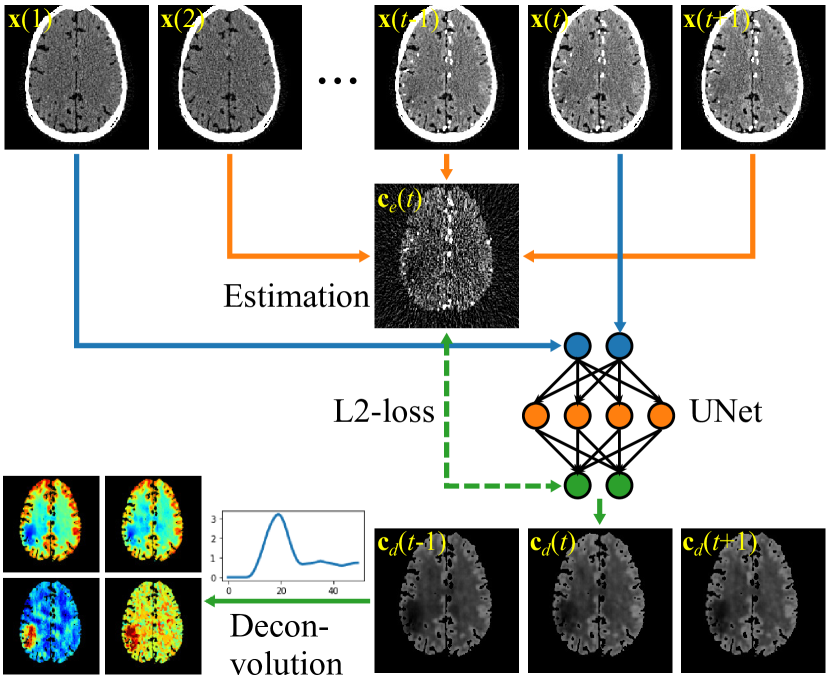
- The method employs a self-supervised learning framework based on Noise2Noise, where each low-dose CTP frame is predicted from its temporally adjacent frames.
- The network is trained to map a noisy input frame to a denoised estimation using only the temporal context from neighboring frames, assuming independent noise across frames.
- The training objective minimizes the mean squared error between the network output and the target frame, which is assumed to be a noisy version of the same underlying structure.
- The approach relies on the assumption that noise in the source and target frames is independent and zero-mean, enabling effective noise removal without ground truth.
- A U-Net-based architecture is used for the deep neural network, enabling effective feature learning and spatial-temporal denoising.
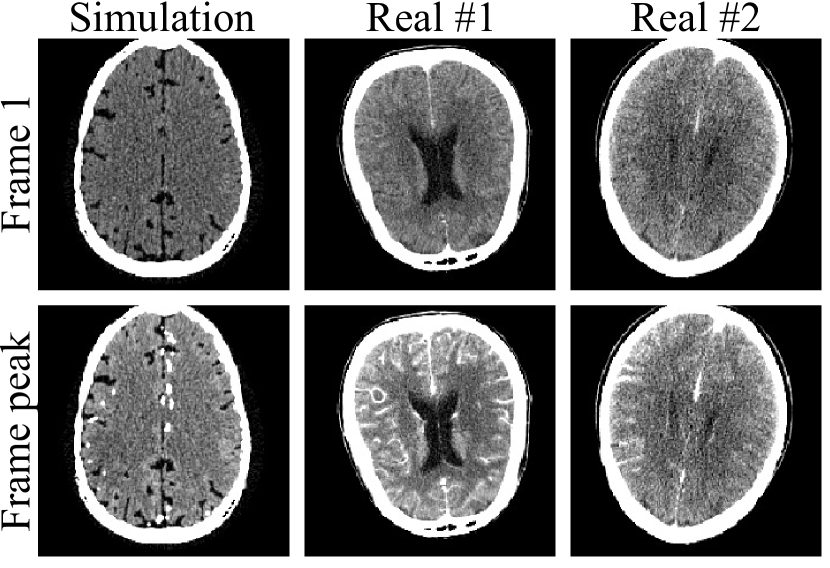
- The method is validated on both simulated low-dose CTP data and a public real CTP dataset, comparing performance against supervised and conventional denoising baselines.
Experimental results
Research questions
- RQ1Can self-supervised deep learning effectively denoise dynamic CT perfusion images without requiring high-dose reference scans?
- RQ2How does the performance of self-supervised denoising compare to supervised learning methods when trained on simulated data and tested on real data?
- RQ3To what extent can temporal correlations between adjacent CTP frames improve image denoising quality and preserve diagnostic features like contrast-to-noise ratio and spatial resolution?
- RQ4What is the impact of noise independence and zero-mean assumptions on the convergence and effectiveness of the Noise2Noise-based training objective in CTP denoising?
- RQ5Can the proposed method generalize across different scanning protocols without requiring retraining on high-dose data?
Key findings
- The proposed self-supervised method achieved improved image quality over conventional denoising methods on both simulated and real CTP data.
- On real CTP data, the method outperformed supervised learning models trained on simulated data in terms of spatial resolution and contrast-to-noise ratio.
- The method demonstrated effective noise removal by leveraging temporal correlations between adjacent frames, even without access to high-dose reference images.
- Theoretical analysis confirmed that under independent and zero-mean noise assumptions, the Noise2Noise objective converges to the true underlying image, validating the method's learning principle.
- The approach showed robustness to varying scanning protocols due to the absence of high-dose data requirements, enabling easier clinical adaptation.
- The method achieved superior performance in preserving hemodynamic parametric map accuracy, which is critical for ischemic stroke diagnosis.
Better researchstarts right now
From reading papers to final review, dramatically reduce your research time.
No credit card · Free plan available
This review was created by AI and reviewed by human editors.