
[Paper Review] Self-testing composite measurements and bound entangled state in a single quantum network
This paper introduces a unified quantum network framework for self-testing three types of composite projective measurements in a three-qubit system: one from genuinely entangled GHZ-like states, one from nonlocality-without-entanglement (NLWE) product states, and a hybrid measurement from an unextendible product basis (UPB). The scheme enables the first self-testing of a bound entangled state via indirect certification through the UPB-based measurement, demonstrating a novel network-based certification of mixed entangled states beyond the standard Bell scenario.
Within the quantum networks scenario we introduce a single scheme allowing to certify three different types of composite projective measurements acting on a three-qubit Hilbert space: one constructed from genuinely entangled GHZ-like states, one constructed from fully product vectors that exhibit the phenomenon of nonlocality without entanglement (NLWE), and a hybrid measurement obtained from an unextendible product basis (UPB). Noticeably, we certify a basis exhibiting NLWE in the smallest dimension capable of supporting this phenomenon. On the other hand, the possibility of certification of a measurement obtained from a UPB has an interesting implication that one can also self-test a bound entangled state in the considered quantum network. Such a possibility does not seem to exist in the standard Bell scenario. Furthermore, we also analyse the robustness of our scheme towards experimental errors.
Motivation & Objective
- To address the lack of general schemes for self-testing composite quantum measurements in multi-qubit systems.
- To certify three distinct types of projective measurements—entangled, NLWE, and hybrid UPB-based—within a single experimental setup.
- To demonstrate the first network-based self-testing of a bound entangled state, which is not possible in the standard Bell scenario.
- To achieve certification in the minimal dimension (three qubits) supporting NLWE, improving efficiency over prior work.
Proposed method
- Construct a quantum network with shared entangled states and measurement settings tailored to test three distinct measurement types.
- Use a UPB in a three-qubit Hilbert space to define a hybrid measurement combining product states and a projector onto the orthogonal entangled subspace.
- Apply self-testing protocols based on Bell-type inequalities and measurement statistics to certify the structure of the measurement operators.
- Leverage the symmetry and orthogonality of the states to derive constraints on the measurement operators via semidefinite programming and state reconstruction.
- Utilize unitary transformations and trace operations to relate observed correlations to the target quantum states and measurements.
- Prove that the observed statistics uniquely determine the measurement operators and the post-measurement state, including the bound entangled state from the UPB.
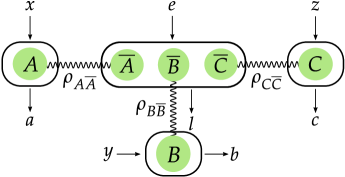
Experimental results
Research questions
- RQ1Can a single quantum network protocol self-test three distinct types of composite projective measurements in a three-qubit system?
- RQ2Is it possible to self-test a bound entangled state via a measurement derived from an unextendible product basis (UPB) in a network scenario?
- RQ3Can nonlocality without entanglement (NLWE) be certified in the smallest possible dimension (three qubits) using a unified framework?
- RQ4How does the network-based self-testing scheme differ from standard Bell scenario self-testing in terms of state and measurement certification?
Key findings
- The paper achieves self-testing of a measurement constructed from a UPB in a three-qubit system, which is the first such certification in a network setting.
- It demonstrates the first indirect self-testing of a bound entangled state via a UPB-based measurement, a possibility not realizable in the standard Bell scenario.
- The scheme certifies a nonlocality-without-entanglement (NLWE) basis in the minimal dimension (three qubits), confirming the phenomenon in the smallest possible Hilbert space.
- The protocol requires fewer measurements than prior work, enhancing experimental feasibility and efficiency.
- The post-measurement state after a specific outcome is shown to be a tensor product of a bound entangled state (from the UPB) and a maximally entangled state, confirming the structure of the certified state.
Read this paper
Open the full text in the Nubint reader and ask about any passage as you read.
Read this paper on NubintThis review was generated by AI from the original paper. Please check the paper before citing it.