
[Paper Review] Sensitivity Analysis in Unconditional Quantile Effects
This paper introduces a sensitivity analysis framework for unconditional quantile effects under partial identification when counterfactual policies change the proportion of treated individuals. It proposes the quantile breakdown frontier to assess whether a sensitivity analysis is feasible and to quantify the maximum selection bias consistent with a given conclusion across quantiles, enabling bounds on global and marginal effects under policy selection bias.
This paper proposes a framework to analyze the effects of counterfactual policies on the unconditional quantiles of an outcome variable. For a given counterfactual policy, we obtain identified sets for the effect of both marginal and global changes in the proportion of treated individuals. To conduct a sensitivity analysis, we introduce the quantile breakdown frontier, a curve that (i) indicates whether a sensitivity analysis is possible or not, and (ii) when a sensitivity analysis is possible, quantifies the amount of selection bias consistent with a given conclusion of interest across different quantiles. To illustrate our method, we perform a sensitivity analysis on the effect of unionizing low income workers on the quantiles of the distribution of (log) wages.
Motivation & Objective
- To address the challenge of identifying counterfactual quantile effects when treatment status is not randomly assigned and the distribution of newly treated individuals is unknown.
- To develop a sensitivity analysis framework that quantifies the impact of policy selection bias—defined as the difference between the distributions of newly treated and already treated individuals—on unconditional quantile effects.
- To provide identified sets for both global and marginal effects of policy changes on outcome quantiles, even when point identification is not possible.
- To introduce the quantile breakdown frontier as a tool to determine whether a given conclusion about quantile effects holds under plausible levels of selection bias.
- To enable empirical estimation of bounds on quantile effects using empirical distribution functions, with root-n asymptotic validity.
Proposed method
- Proposes a framework for analyzing global and marginal effects of counterfactual policies on unconditional quantiles, allowing for partial identification when the distribution of newly treated individuals is not observed.
- Introduces the policy selection bias as the key source of identification failure, defined as the difference between the distribution of wages for newly treated individuals and those already treated.
- Defines the quantile breakdown frontier as a curve that maps the maximum allowable policy selection bias to the validity of a given conclusion about quantile effects across different quantiles.
- Derives identified sets for global and marginal effects by combining the quantile breakdown frontier with empirical distribution functions and empirical quantiles.
- Employs Hadamard directional differentiability and weak convergence arguments to establish root-n asymptotic normality of estimators for the breakdown frontier and effect bounds.
- Uses empirical process theory and functional central limit theorems to derive asymptotic distributions of the estimated bounds and frontier.
Experimental results
Research questions
- RQ1Under what conditions can a sensitivity analysis be conducted for unconditional quantile effects when the counterfactual distribution of newly treated individuals is not observed?
- RQ2How much policy selection bias—defined as the difference between the distributions of newly and already treated individuals—is consistent with a given conclusion about the effect of a policy on outcome quantiles?
- RQ3What are the identified sets for global and marginal effects on unconditional quantiles when treatment assignment is subject to selection bias?
- RQ4How can the quantile breakdown frontier be estimated from data, and what are its asymptotic properties?
- RQ5To what extent do the proposed bounds on quantile effects remain valid under plausible deviations from point identification due to policy selection bias?
Key findings
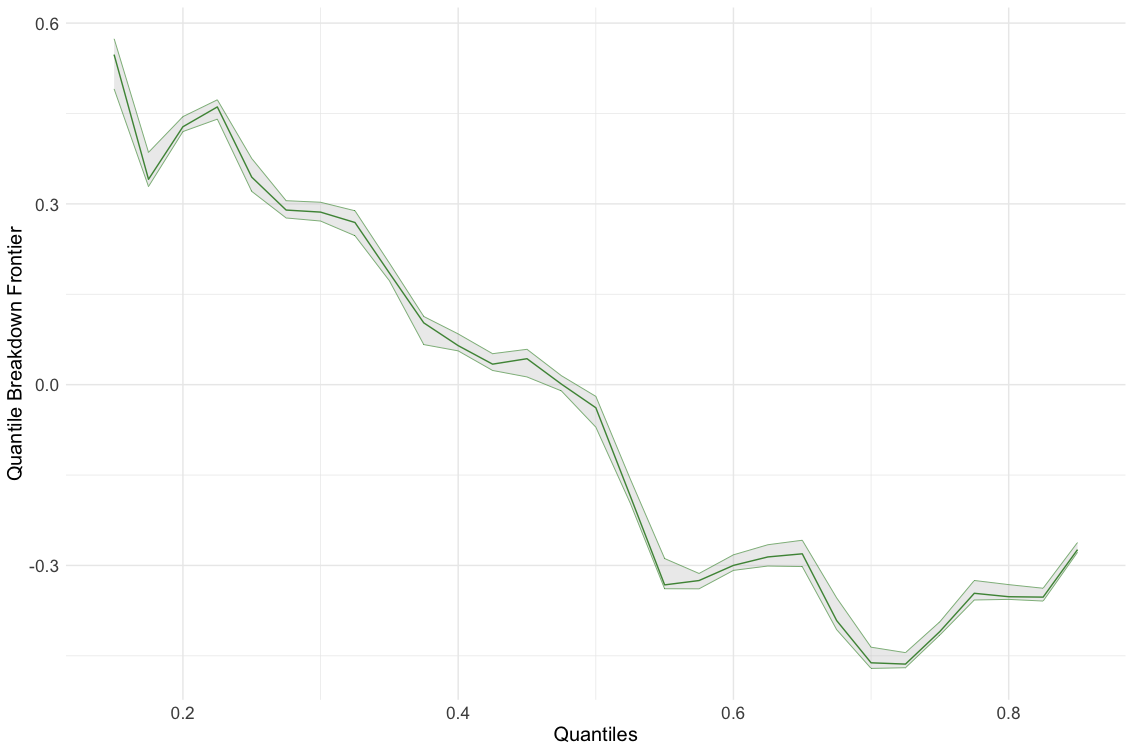
- The quantile breakdown frontier provides a visual and quantitative tool to assess the feasibility of a sensitivity analysis and to bound the maximum policy selection bias consistent with a given conclusion about quantile effects.
- The identified sets for global and marginal effects are derived using the quantile breakdown frontier and are valid under partial identification due to unobserved counterfactual distributions of newly treated individuals.
- Estimators for the quantile breakdown frontier and effect bounds are root-n consistent and asymptotically normal, enabling inference via weak convergence and functional central limit theorems.
- The policy selection bias can be non-negligible even when original treatment assignment is random, highlighting that identification depends on the counterfactual policy design, not just initial selection.
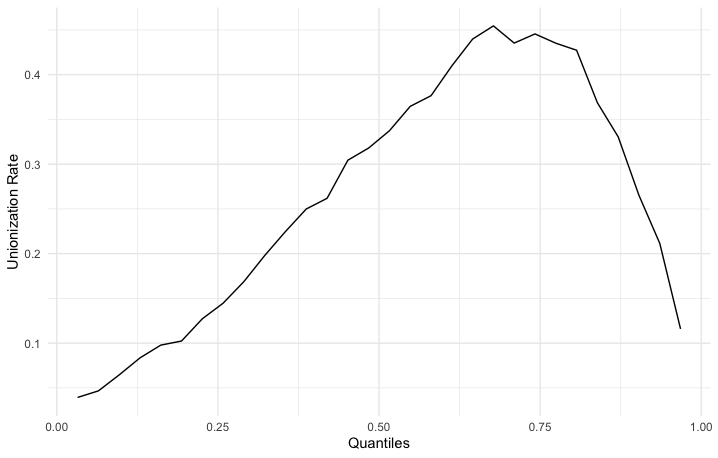
- In the unionization example, the method reveals that increasing unionization among low-skilled workers may reduce inequality, but only under plausible assumptions about the wage distribution of newly unionized workers.
- The framework allows for robust inference on quantile effects even when the counterfactual distribution of outcomes for newly treated individuals is not point-identified, by quantifying the sensitivity to distributional assumptions.
Read this paper
Open the full text in the Nubint reader and ask about any passage as you read.
Read this paper on NubintThis review was generated by AI from the original paper. Please check the paper before citing it.