
[Paper Review] Single-Component Superconductivity in UTe$_2$ at Ambient Pressure
This study uses pulse-echo ultrasound to measure elastic moduli in UTe₂, demonstrating no thermodynamic discontinuities in shear moduli across Tc in both single- and double-transition samples. The absence of shear modulus anomalies provides direct experimental evidence for a single-component superconducting order parameter, favoring the B₂u odd-parity state over multi-component models.
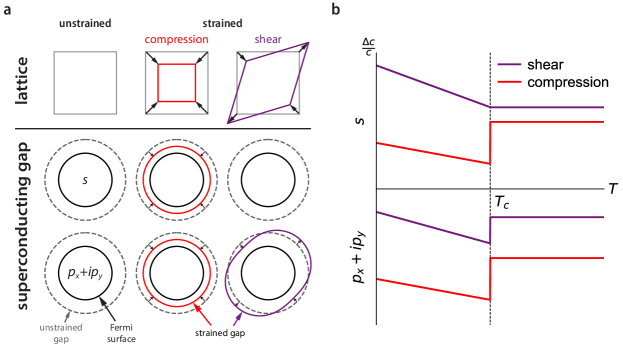
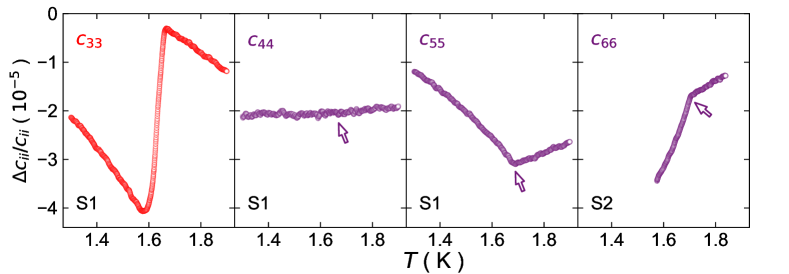
The microscopic mechanism of Cooper pairing in a superconductor leaves its fingerprint on the symmetry of the order parameter. UTe$_2$ has been inferred to have a multi-component order parameter that entails exotic effects like time reversal symmetry breaking. However, recent experimental observations in newer-generation samples have raised questions about this interpretation, pointing to the need for a direct experimental probe of the order parameter symmetry. Here, we use pulse-echo ultrasound to measure the elastic moduli of UTe$_2$ in samples that exhibit both one and two superconducting transitions. We demonstrate the absence of thermodynamic discontinuities in the shear elastic moduli of both single- and double-transition samples, providing direct evidence that UTe$_2$ has a single-component superconducting order parameter. We further show that superconductivity is highly sensitive to compression strain along the $a$ and $c$ axes, but insensitive to strain along the $b$ axis. This leads us to suggest a single-component, odd-parity order parameter -- specifically the B$_{2u}$ order parameter -- as most compatible with our data.
Motivation & Objective
- To resolve the long-standing debate over the pairing symmetry in UTe₂, particularly whether it hosts a multi-component or single-component superconducting order parameter.
- To provide direct experimental evidence for the nature of the superconducting order parameter using strain-dependent elastic measurements.
- To investigate the sensitivity of superconductivity to uniaxial strain along different crystallographic axes (a, b, c) in UTe₂.
- To determine whether the observed two superconducting transitions in some samples are intrinsic or due to inhomogeneity or strain effects.
Proposed method
- Employed pulse-echo ultrasound to measure the elastic moduli of UTe₂ single crystals under varying temperature and strain conditions.
- Measured changes in shear and compressional elastic moduli across the superconducting transition temperature Tc to detect thermodynamic discontinuities indicative of multi-component pairing.
- Applied uniaxial strain along the a, b, and c crystallographic axes to probe the anisotropic response of superconductivity to lattice distortions.
- Used symmetry analysis and group theory to classify possible odd-parity order parameters (Aᵤ, B₁ᵤ, B₂ᵤ, B₃ᵤ) based on nodal structure and momentum dependence.
- Compared experimental strain and elastic modulus responses to theoretical predictions for single- vs. two-component superconductors.
- Correlated results with quantum oscillation data and density functional theory (DFT) calculations to validate Fermi surface topology and gap symmetry.
Experimental results
Research questions
- RQ1Does the superconducting order parameter in UTe₂ exhibit a single-component or multi-component nature, as indicated by elastic response to strain?
- RQ2Are thermodynamic discontinuities in shear elastic moduli—expected for two-component superconductors—observed in UTe₂ across Tc?
- RQ3How does superconductivity in UTe₂ respond to uniaxial strain along the a, b, and c crystallographic axes?
- RQ4Which odd-parity irreducible representation (e.g., B₂ᵤ) best describes the superconducting gap symmetry in UTe₂ based on elastic and strain response?
- RQ5Can the presence of two superconducting transitions in some samples be attributed to intrinsic multi-component pairing or extrinsic inhomogeneity?
Key findings
- No thermodynamic discontinuities were observed in the shear elastic moduli across Tc in either single- or double-transition UTe₂ samples, ruling out a two-component order parameter.
- The superconducting transition in UTe₂ is highly sensitive to compressive strain along the a and c axes, but insensitive to strain along the b axis.
- The observed strain and elastic response are consistent with a single-component, odd-parity superconducting order parameter, specifically the B₂ᵤ channel.
- The B₂ᵤ order parameter is fully gapped on the Fermi surface and exhibits point nodes only along the k_y direction, consistent with the observed nodal structure.
- The absence of shear modulus anomalies contradicts predictions for multi-component superconductors such as p_x + ip_y, supporting a simpler pairing state.
- The results resolve conflicting interpretations of earlier data by showing that the two-transition behavior in some samples is not evidence of intrinsic multi-component pairing but may arise from inhomogeneity or strain effects.
Read this paper
Open the full text in the Nubint reader and ask about any passage as you read.
Read this paper on NubintThis review was generated by AI from the original paper. Please check the paper before citing it.