
[Paper Review] Skill dependencies uncover nested human capital
This study constructs a hierarchical skill dependency tree from U.S. labor data (2005–2019), revealing that specialized skills are built upon foundational, widely required abilities. It finds that career advancement and wage premiums are strongly tied to progression along these nested skill paths, with growing inequality in access to foundational skills across demographics and regions.
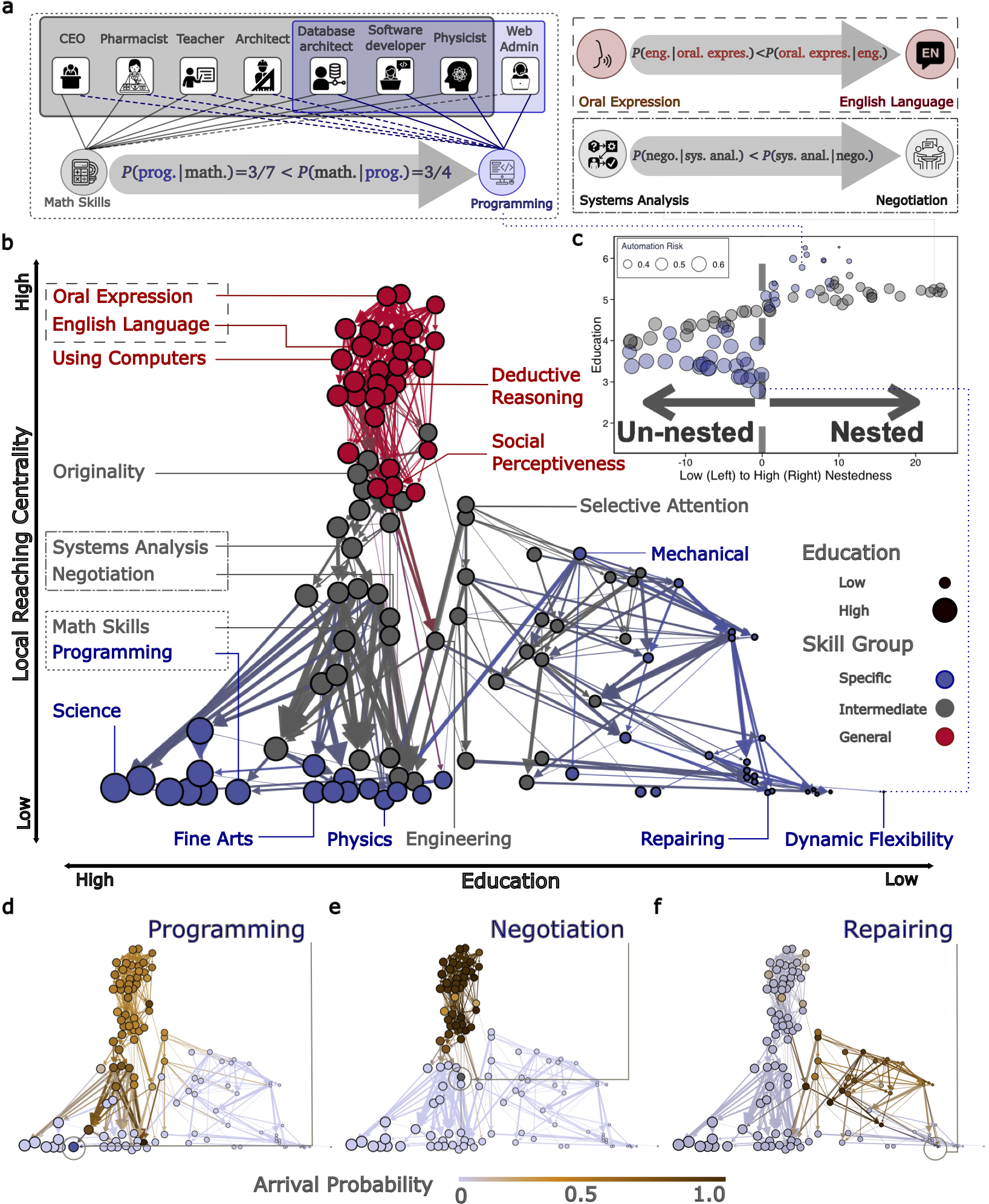
Modern economies require increasingly diverse and specialized skills, many of which depend on the acquisition of other skills first. Here we analyse US survey data to reveal a nested structure within skill portfolios, where the direction of dependency is inferred from asymmetrical conditional probabilities-occupations require one skill conditional on another. This directional nature suggests that advanced, specific skills and knowledge are often built upon broader, fundamental ones. We examine 70 million job transitions to show that human capital development and career progression follow this structured pathway in which skills more aligned with the nested structure command higher wage premiums, require longer education and are less likely to be automated. These disparities are evident across genders and racial-ethnic groups, explaining long-term wage penalties. Finally, we find that this nested structure has become even more pronounced over the past two decades, indicating increased barriers to upward job mobility.
Motivation & Objective
- To empirically map the hierarchical structure of skill dependencies in the U.S. labor market using large-scale survey and resume data.
- To differentiate between nested skills (requiring prerequisites) and non-nested skills (no prerequisites) and analyze disparities in their acquisition across gender, race/ethnicity, and geography.
- To examine how skill progression along nested pathways correlates with career advancement and wage premiums over time.
- To assess temporal changes in skill structure and absorptive capacity gaps from 2005 to 2019, revealing increasing polarization in skill development opportunities.
Proposed method
- Constructed a skill dependency network using asymmetrical conditional probabilities of skill co-occurrence from 70 million job transitions in national surveys and resumes.
- Built a hierarchical, tree-like structure where foundational skills form the root and specialized skills form the branches, based on dependency directionality.
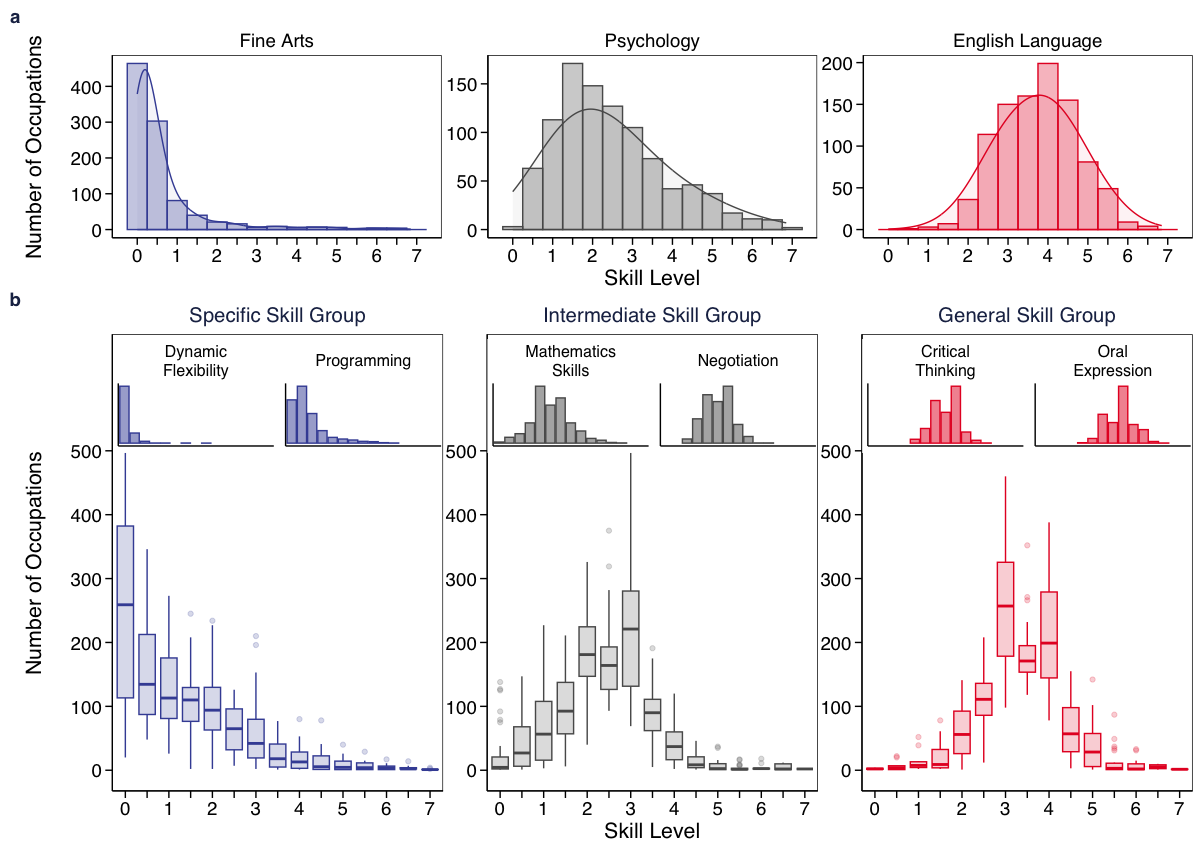
- Classified skills into 'nested' (requiring prerequisites) and 'non-nested' (no prerequisites) using demand distribution and dependency density.
- Trained and evaluated skill, education, and wage estimators using 10,000 bootstrap iterations with 95% confidence intervals to ensure robustness.
- Mapped geographic skill distributions across U.S. counties and metropolitan areas using BLS occupational data and location quotients for manufacturing intensity.
- Tracked temporal evolution of skill structure by aligning 2005 and 2019 occupational classifications via a multi-year crosswalk, enabling comparison of skill network changes.
Experimental results
Research questions
- RQ1What is the hierarchical structure of skill dependencies in the U.S. labor market, and how is it shaped by asymmetrical conditional probabilities of skill co-occurrence?
- RQ2How do nested skills—those requiring foundational prerequisites—differ in their career and wage outcomes from non-nested skills?
- RQ3To what extent do disparities in absorptive capacity for foundational skills contribute to wage inequality across gender, racial/ethnic, and geographic groups?
- RQ4How has the structure of skill dependencies evolved between 2005 and 2019, and what does this imply for labor market polarization?
Key findings
- The skill network forms a partially nested, unbalanced tree structure, with foundational skills at the root and specialized skills at the periphery, reflecting hierarchical learning dependencies.
- Individuals who progress along nested skill paths experience significantly higher wage premiums, especially when they reinforce foundational skills early in their careers.
- Without strong foundational skills, the expected wage premiums from specialization are substantially diminished, underscoring the critical role of prerequisites.
- The gap in absorptive capacity between nested and non-nested skills has grown over the past two decades, indicating increasing polarization in skill development access.
- Geographic disparities in skill composition are pronounced: cities with higher manufacturing intensity and larger populations show stronger skill concentration and higher nested skill levels.
- Racial and gender disparities in skill acquisition persist, with Asian, Black, and Hispanic workers showing lower absorptive capacity for nested skills compared to White and Asian male workers, contributing to unequal wage outcomes.
Read this paper
Open the full text in the Nubint reader and ask about any passage as you read.
Read this paper on NubintThis review was generated by AI from the original paper. Please check the paper before citing it.