
[Paper Review] Solving Multi-Agent Target Assignment and Path Finding with a Single Constraint Tree
This paper proposes Incremental Target Assignment CBS (ITA-CBS), a novel algorithm that solves the Multi-Agent Target Assignment and Path Finding (TAPF) problem optimally using a single constraint tree and incremental target assignment. By eliminating redundant collision resolution across multiple trees and avoiding expensive K-best assignment computation, ITA-CBS achieves 96.1% faster performance than CBS-TA across 6,334 test cases, with speedups of up to 100× in some cases.
Combined Target-Assignment and Path-Finding problem (TAPF) requires simultaneously assigning targets to agents and planning collision-free paths for agents from their start locations to their assigned targets. As a leading approach to address TAPF, Conflict-Based Search with Target Assignment (CBS-TA) leverages both K-best target assignments to create multiple search trees and Conflict-Based Search (CBS) to resolve collisions in each search tree. While being able to find an optimal solution, CBS-TA suffers from scalability due to the duplicated collision resolution in multiple trees and the expensive computation of K-best assignments. We therefore develop Incremental Target Assignment CBS (ITA-CBS) to bypass these two computational bottlenecks. ITA-CBS generates only a single search tree and avoids computing K-best assignments by incrementally computing new 1-best assignments during the search. We show that, in theory, ITA-CBS is guaranteed to find an optimal solution and, in practice, is computationally efficient.
Motivation & Objective
- To address the scalability limitations of CBS-TA, a leading optimal TAPF solver, which suffers from redundant collision resolution across multiple search trees and high computational cost of K-best target assignment.
- To develop a new framework that integrates target assignment and conflict-based search more efficiently by maintaining a single constraint tree throughout the search process.
- To eliminate the need for pre-computing K-best target assignments by incrementally updating assignments during the search.
- To prove that the proposed method guarantees optimal solutions while significantly improving runtime performance.
Proposed method
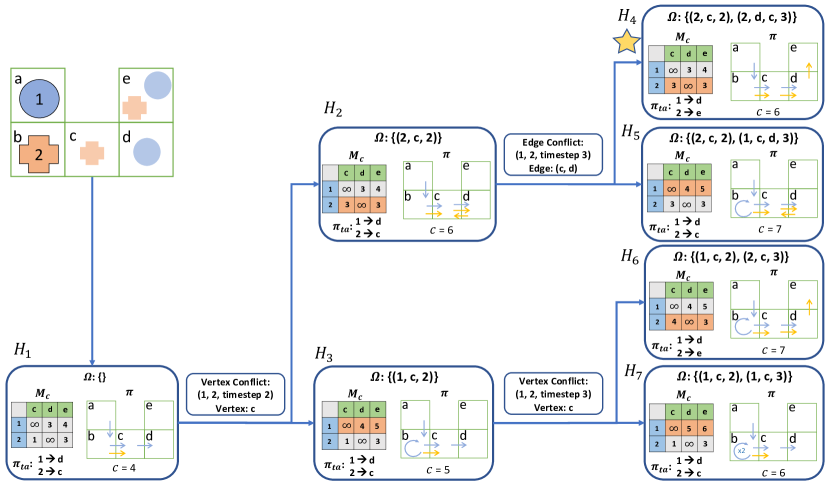
- The algorithm constructs a single constraint tree (CT) for the entire search, avoiding the creation of multiple CTs as in CBS-TA, thereby reducing redundant collision resolution.
- Instead of computing K-best target assignments upfront, ITA-CBS incrementally recomputes 1-best assignments at each CT node using a dynamic Hungarian algorithm.
- The search maintains a priority queue of CT nodes, where each node represents a partial assignment and a set of constraints to prevent collisions.
- At each node, the algorithm performs a low-level search to find collision-free paths for the current assignment, using a conflict detection mechanism that checks both vertex and edge conflicts.
- When conflicts are detected, the algorithm generates child nodes by adding constraints to resolve them, while updating the target assignment incrementally to explore new assignments.
- The algorithm uses a bounded-suboptimal search strategy with a cost function that minimizes the total flowtime, ensuring optimality is preserved.
Experimental results
Research questions
- RQ1Can a single constraint tree be used to solve TAPF optimally while avoiding the computational overhead of maintaining multiple search trees?
- RQ2Does incremental target assignment during the search process eliminate the need for expensive K-best assignment computation without sacrificing solution quality?
- RQ3How does the performance of ITA-CBS compare to CBS-TA in terms of runtime and scalability across diverse TAPF problem instances?
- RQ4What is the impact of reduced node expansions and fewer target assignment calls on overall algorithm efficiency?
Key findings
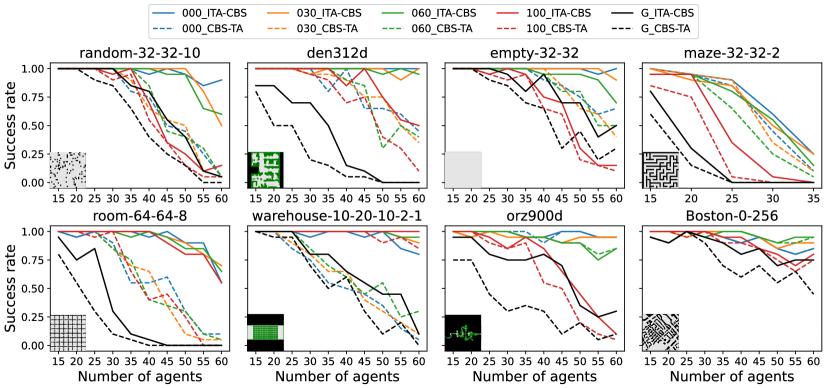
- ITA-CBS outperforms CBS-TA in 96.1% of the 6,334 test cases evaluated, demonstrating superior runtime efficiency.
- In 38.7% of test cases, ITA-CBS is 5 times faster than CBS-TA, and in 5.6% of cases, it is 100 times faster.
- The target assignment (TA) runtime in ITA-CBS is 200 times smaller than in CBS-TA, despite calling the TA algorithm at every CT node.
- ITA-CBS requires significantly fewer node expansions than CBS-TA, which is the primary reason for its performance gain.
- The dynamic Hungarian algorithm used in ITA-CBS is much faster per call than the K-best assignment used in CBS-TA.
- In the Common Target Test, ITA-CBS maintains higher success rates than CBS-TA even as the ratio of shared targets increases, indicating better robustness.
Read this paper
Open the full text in the Nubint reader and ask about any passage as you read.
Read this paper on NubintThis review was generated by AI from the original paper. Please check the paper before citing it.