
[Paper Review] Solving the domain wall problem with first-order phase transition
This paper proposes that first-order phase transitions (FOPTs) can resolve the domain wall problem by diluting domain wall networks through collisions with expanding vacuum bubbles. Using numerical simulations, the authors demonstrate that FOPTs suppress domain wall scaling behavior and generate gravitational waves (GWs) with amplitudes several orders of magnitude higher than those from isolated domain walls, making the FOPT scale detectable via GW observations.
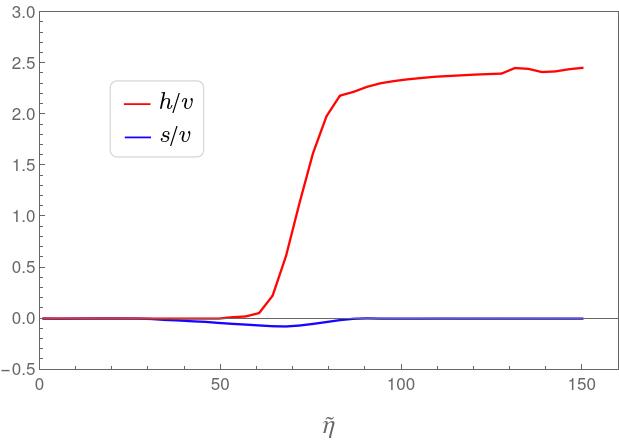
Domain wall networks are two-dimensional topological defects generally predicted in many beyond standard model physics. In this Letter, we propose to solve the domain wall problem with the first-order phase transition. We numerically study the phase transition dynamics, and for the first time show that the domain walls reached scaling regime can be diluted through the interaction with vacuum bubbles during the first-order phase transition. We find that the amplitude of the gravitational waves produced by the second-stage first-order phase transition is several orders higher than that from the domain walls evolution in the scaling regime. The scale of the first-order phase transition that dilute the domain walls can be probed through gravitational waves detection.
Motivation & Objective
- To address the cosmological domain wall problem, where stable domain walls overclose the universe and conflict with observations.
- To investigate whether a first-order phase transition (FOPT) following domain wall formation can dilute the domain wall network and prevent overclosure.
- To quantify the gravitational wave (GW) signal from the FOPT and compare its amplitude to that from domain wall evolution in the scaling regime.
- To characterize the dynamics of domain wall decay via interactions with vacuum bubbles during the FOPT.
Proposed method
- Numerical simulation of a two-step phase transition: first a second-order transition generates domain walls, followed by a first-order transition with vacuum bubble nucleation.
- Use of a Z2-symmetric scalar model with thermal potential terms up to T², including field couplings λSh, λS, and λh.
- Implementation of the second-order leap-frog algorithm on a comoving lattice to evolve the equations of motion for scalar fields s and h.
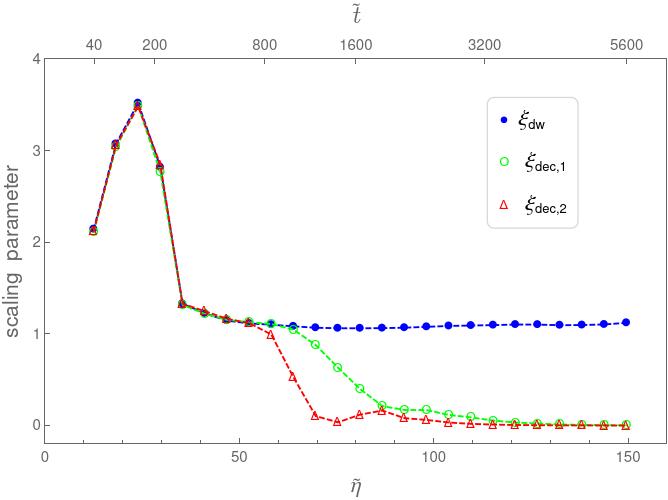
- Tracking the evolution of domain wall scaling parameters ξ_dw and measuring GW power spectra via energy density fluctuations.
- Calculation of GW efficiency parameters ε_gw and differential amplitude ˜ε_gw at the peak of the GW spectrum.
- Rescaling of physical quantities using conformal time η̃ and Hubble rate Hi to ensure dimensionless consistency in simulations.
Experimental results
Research questions
- RQ1Can a first-order phase transition effectively dilute a domain wall network formed in a prior second-order phase transition?
- RQ2How does the interaction between vacuum bubbles and domain walls affect the scaling behavior of the domain wall network?
- RQ3What is the amplitude and spectral shape of gravitational waves produced by the first-order phase transition compared to those from domain wall evolution in the scaling regime?
- RQ4Can the scale of the first-order phase transition that dilutes domain walls be probed through gravitational wave detection?
Key findings
- The domain wall network enters a stable scaling regime at ṫ ≈ 50, with a scaling parameter ξ_dw ≈ 1.09, indicating self-similar evolution.
- Vacuum bubbles from the first-order phase transition collide with domain walls, disrupting the scaling regime and leading to domain wall decay.
- The gravitational wave amplitude from the first-order phase transition is several orders of magnitude higher than that from domain wall evolution in the scaling regime.
- The average GW efficiency parameter ε_gw is 0.73 and the peak differential amplitude ˜ε_gw is 0.49, indicating strong GW emission.
- The physical thickness of domain walls is δ_dw ≈ 1.37 times the lattice spacing at the final simulation time.
- The GW power spectrum peaks at a dimensionless comoving wavenumber k_dw,f corresponding to the wall thickness, confirming the expected scaling behavior.
Read this paper
Open the full text in the Nubint reader and ask about any passage as you read.
Read this paper on NubintThis review was generated by AI from the original paper. Please check the paper before citing it.