
[Paper Review] Space Group Constrained Crystal Generation
DiffCSP++ extends diffusion-based crystal generation by integrating space group constraints, enabling lattice, Wyckoff-position, and atom-type generation under symmetry. Experiments show improved structure prediction and ab initio generation with space-group-aware control.
Crystals are the foundation of numerous scientific and industrial applications. While various learning-based approaches have been proposed for crystal generation, existing methods seldom consider the space group constraint which is crucial in describing the geometry of crystals and closely relevant to many desirable properties. However, considering space group constraint is challenging owing to its diverse and nontrivial forms. In this paper, we reduce the space group constraint into an equivalent formulation that is more tractable to be handcrafted into the generation process. In particular, we translate the space group constraint into two parts: the basis constraint of the invariant logarithmic space of the lattice matrix and the Wyckoff position constraint of the fractional coordinates. Upon the derived constraints, we then propose DiffCSP++, a novel diffusion model that has enhanced a previous work DiffCSP by further taking space group constraint into account. Experiments on several popular datasets verify the benefit of the involvement of the space group constraint, and show that our DiffCSP++ achieves promising performance on crystal structure prediction, ab initio crystal generation and controllable generation with customized space groups.
Motivation & Objective
- Motivate incorporating space group symmetry into diffusion-based crystal generation to improve accuracy and controllability.
- Translate space group constraints into tractable forms for lattice (basis) and Wyckoff (fractional coordinates) constraints.
- Develop a diffusion model that jointly generates lattice matrices, fractional coordinates, and atom types under these constraints.
- Demonstrate improved performance on crystal structure prediction and ab initio crystal generation across multiple datasets.
Proposed method
- Interpret space group constraints as two parts: lattice basis constraints in an invariant log-space and Wyckoff-position constraints for fractional coordinates.
- Represent the lattice L via polar decomposition L = Q exp(S) so that the invariant part S (a symmetric matrix) determines the lattice shape independent of O(3) rotations.
- Classify space groups into 6 crystal families to map lattice constraints onto symmetric basis coefficients k_i (i=1..6).
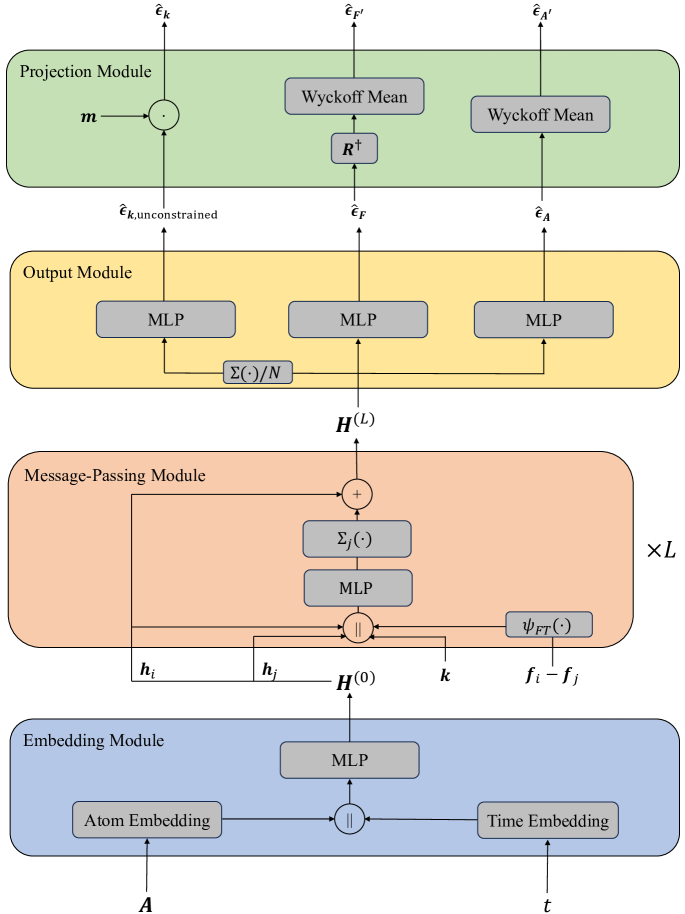
- Model Wyckoff positions by constraining fractional coordinates via site symmetry and Wyckoff multiplicities, projecting denoised coordinates onto Wyckoff-constrained subspaces using pseudo-inverses as needed.
- Apply a diffusion process on an invariant k-vector for L, on Wyckoff-constrained fractional coordinates F′, and on basic atom types A′, with a joint training objective L_M = λ_k L_k + λ_F′ L_F′ + λ_A′ L_A′.
- Encode space-group symmetry into the denoising model via invariant graph neural network features, time embeddings, and Fourier-based relative position encoding, ensuring E(3)-invariance where appropriate.

Experimental results
Research questions
- RQ1Can space group symmetry be effectively integrated into diffusion-based crystal generation by separating lattice and Wyckoff constraints?
- RQ2Does DiffCSP++ improve crystal structure prediction and ab initio generation performance when space group constraints are enforced during generation?
- RQ3What is the impact of using ground-truth versus template-based space group inputs on generation quality?
- RQ4How does the invariant lattice representation influence model performance compared to previous DiffCSP approaches?
Key findings
- DiffCSP++ with space group constraints achieves strong performance on crystal structure prediction across Perov-5, MP-20, and MPTS-52 datasets.
- Under GT space-group conditions, DiffCSP++ surpasses baseline methods in match rate and RMSE.
- Using CSPML templates with DiffCSP++ improves prediction when GT space groups are unavailable, though gaps remain versus GT conditions (70.58% vs 80.27% MR on MP-20).
- In ab initio generation, DiffCSP++ matches or exceeds baselines on validity and coverage, and shows improved property statistics (e.g., density, formation energy) indicating more realistic crystals.
- Ablation shows the invariant lattice representation and pre/post-average strategies influence MR and RMSE, with DiffCSP++ (Post) achieving higher MR (80.27%) and lower RMSE than variants.
- The method demonstrates that incorporating space group symmetry benefits diffusion-based crystal generation for complex structures.
Read this paper
Open the full text in the Nubint reader and ask about any passage as you read.
Read this paper on NubintThis review was generated by AI from the original paper. Please check the paper before citing it.