
[Paper Review] Space-time wave packets localized in all dimensions
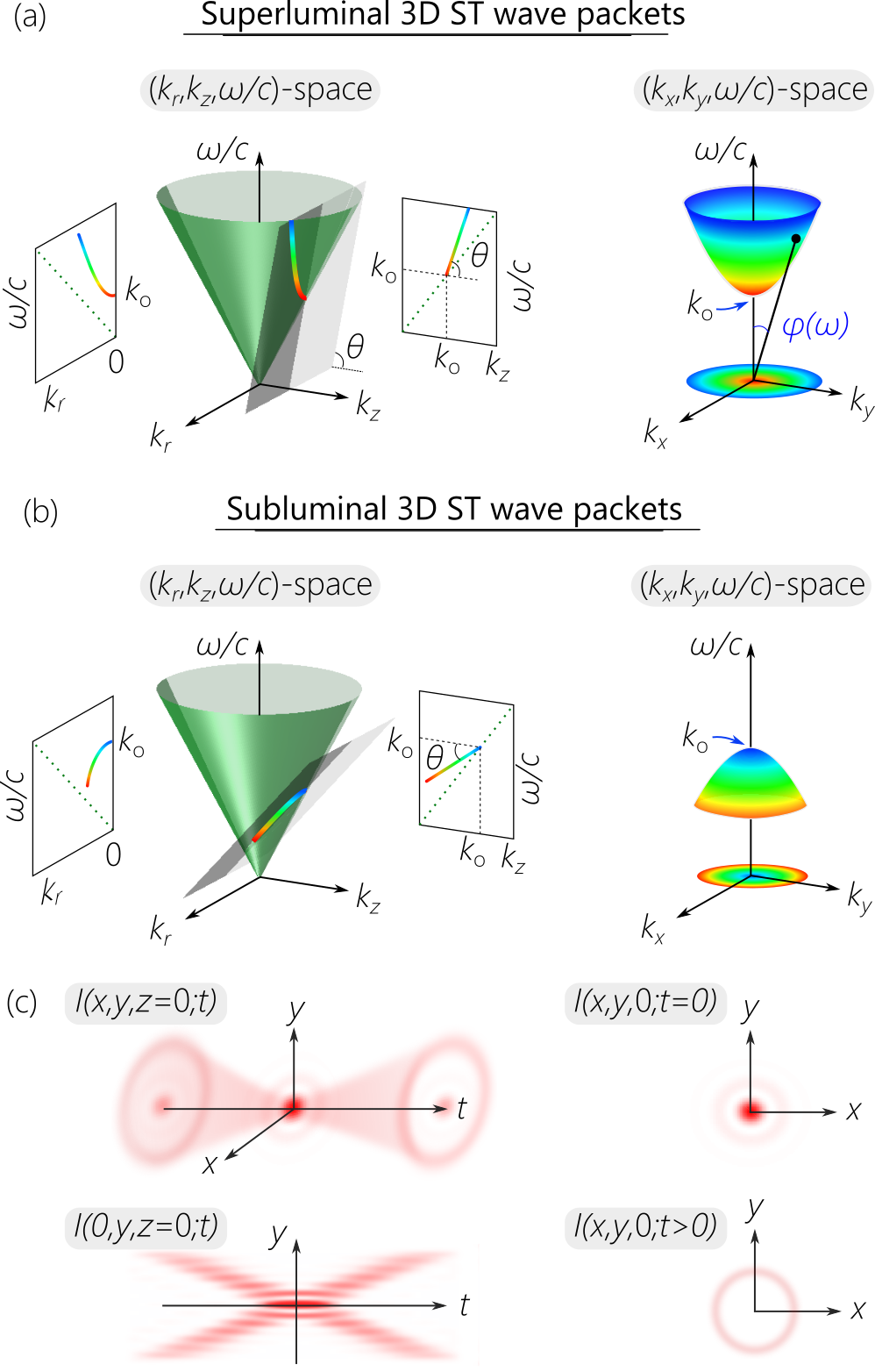
This paper presents a method to generate space-time wave packets localized in all three dimensions (3D) by applying two-dimensional conformal coordinate transformations to sculpt the spatio-temporal spectrum of a pulsed beam. Using a combination of volume chirped Bragg gratings, spectral reshuffling, and log-polar-to-Cartesian transformations, the authors demonstrate propagation-invariant wave packets with tunable group velocities from 0.7c to 1.8c, achieving sub-micron transverse localization and few-picosecond pulse duration over 50 mm of propagation.
Optical wave packets that are localized in space and time, but nevertheless overcome diffraction and travel rigidly in free space, are a long sought-after field structure with applications ranging from microscopy and remote sensing, to nonlinear and quantum optics. However, synthesizing such wave packets requires introducing non-differentiable angular dispersion with high spectral precision in two transverse dimensions, a capability that has eluded optics to date. Here, we describe an experimental strategy capable of sculpting the spatio-temporal spectrum of a generic pulsed beam by introducing arbitrary radial chirp via two-dimensional conformal coordinate transformations of the spectrally resolved field. This procedure yields propagation-invariant `space-time' wave packets localized in all dimensions, with tunable group velocity in the range from $0.7c$ to $1.8c$ in free space, and endowed with prescribed orbital angular momentum. By providing unprecedented flexibility in sculpting the three-dimensional structure of pulsed optical fields, our experimental strategy promises to be a versatile platform for the emerging enterprise of space-time optics.
Motivation & Objective
- To overcome the longstanding challenge of creating optical wave packets that are localized in all three dimensions (spatial and temporal) while propagating rigidly in free space.
- To address the fundamental limitation of existing methods that can only impose angular dispersion in one transverse dimension, preventing full 3D localization.
- To enable non-differentiable angular dispersion in two transverse dimensions—a requirement for propagation-invariant 3D space-time wave packets—using a scalable experimental platform.
- To demonstrate tunable group velocities across both subluminal and superluminal regimes (0.7c to 1.8c) in free space, preserving spatial and temporal localization.
- To provide a flexible, universal platform for shaping the three-dimensional spatio-temporal structure of pulsed optical fields for applications in nonlinear, quantum, and remote sensing optics.
Proposed method
- A pulsed beam is first spatially resolved in one transverse dimension using a double-pass volume chirped Bragg grating, separating wavelengths into distinct spatial positions.
- A spectral reshuffling stage reorders the wavelengths into a prescribed sequence to tailor the angular dispersion profile across the beam.
- A two-dimensional conformal coordinate transformation—specifically, a log-polar-to-Cartesian mapping—is applied to convert the linear spectral distribution into a circular pattern, enabling angular dispersion in both transverse dimensions.
- The transformed spectral wavefront is then collimated and focused using a lens to form a 3D space-time wave packet with localized intensity in space and time.
- The transformation is implemented using either refractive phase plates (PMMA, diamond-machined) or diffractive phase plates (fused silica, electron-beam lithography), both designed to achieve high spectral precision and efficiency.
- The system is tuned to a specific wavelength by adjusting the distance between the two phase elements, compensating for material dispersion and maintaining the paraxial approximation.
Experimental results
Research questions
- RQ1Can space-time wave packets localized in all three dimensions be experimentally realized in free space using linear optics?
- RQ2Is it possible to achieve non-differentiable angular dispersion in two transverse dimensions to enable propagation-invariant wave packets?
- RQ3Can group velocity be tuned across both subluminal and superluminal regimes (0.7c to 1.8c) while maintaining 3D localization?
- RQ4Can a universal platform be developed to sculpt the three-dimensional spatio-temporal spectrum of a generic pulsed beam with high spectral and spatial precision?
- RQ5What are the limits of transverse and temporal localization achievable in such 3D space-time wave packets under free-space propagation?
Key findings
- The authors successfully generated 3D space-time wave packets with a transverse beam width of approximately 30 µm and a pulse duration of about 6 ps.
- These wave packets propagated over more than 50 mm without significant diffraction or spreading, confirming their propagation-invariant nature.
- The group velocity was experimentally tuned from 0.7c to 1.8c, spanning both subluminal and superluminal regimes in free space.
- The method achieved high spectral precision and spatial control, enabling the creation of wave packets with prescribed orbital angular momentum and complex spatio-temporal textures.
- The use of refractive and diffractive phase plates yielded transmission efficiencies of ~85% and ~92%, respectively, demonstrating practical feasibility.
- The conformal coordinate transformation enabled the conversion of one-dimensional spectral modulation into two-dimensional angular dispersion, solving a key bottleneck in 3D space-time optics.
Better researchstarts right now
From reading papers to final review, dramatically reduce your research time.
No credit card · Free plan available
This review was created by AI and reviewed by human editors.