
[Paper Review] Spanning the full range of neutron star properties within a microscopic description
This study employs a Bayesian inference framework within a relativistic mean-field model including nonlinear vector meson interactions to systematically explore the full range of neutron star properties. It identifies three distinct classes of equations of state based on nonlinear vector coupling strength, with key results showing that weak nonlinear coupling allows for a 2.75 M⊙ maximum mass, consistent with the secondary object in GW190814, and that pQCD constraints favor models with strong nonlinear vector terms or hyperons.
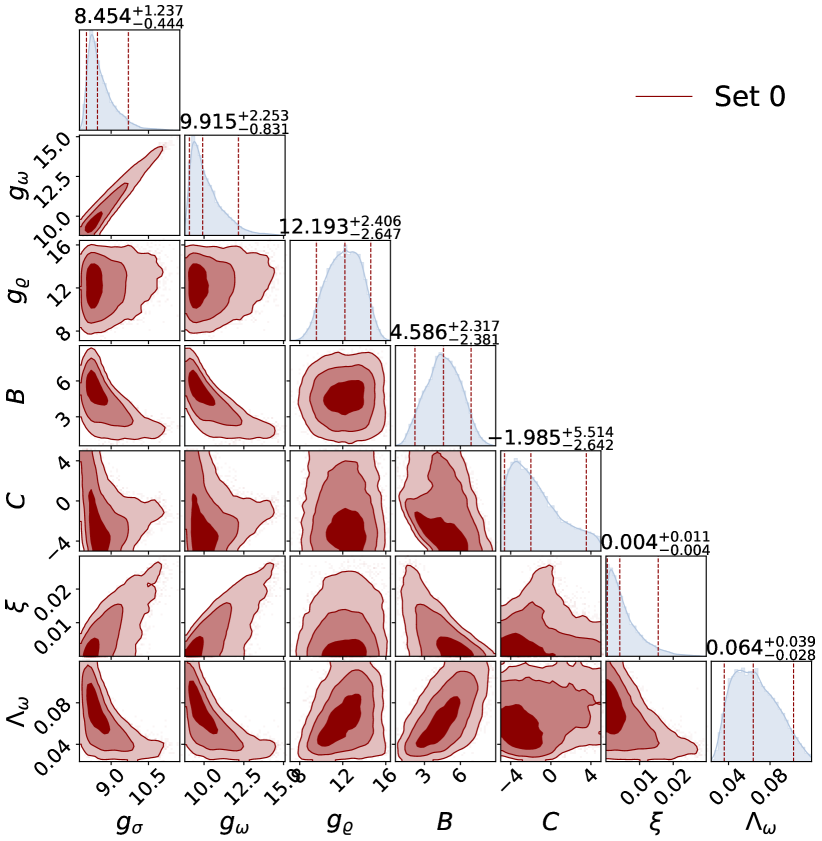
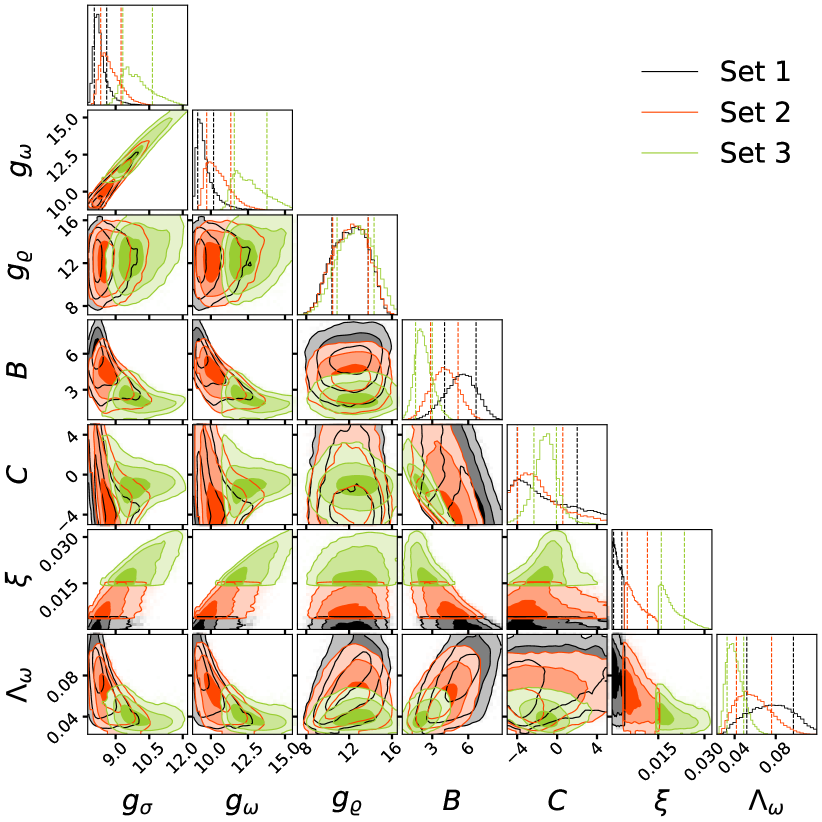
The high-density behavior of nuclear matter is analyzed within a relativistic mean-field description with non-linear meson interactions. To assess the model parameters and their output, a Bayesian inference technique is used. The Bayesian setup is limited only by a few nuclear saturation properties, the neutron star maximum mass larger than 2 M$_\odot$, and the low-density pure neutron matter equation of state (EOS) produced by an accurate N$^3$LO calculation in chiral effective field theory. Depending on the strength of the non-linear scalar vector field contribution, we have found three distinct classes of EOSs, each one correlated to different star properties distributions. If the non-linear vector field contribution is absent, the gravitational maximum mass and the sound velocity at high densities are the greatest. However, it also gives the smallest speed of sound at densities below three times saturation density. On the other hand, models with the strongest non-linear vector field contribution predict the largest radii and tidal deformabilities for 1.4 M$_\odot$ stars, together with the smallest mass for the onset of the nucleonic direct Urca processes and the smallest central baryonic densities for the maximum mass configuration. These models have the largest speed of sound below three times saturation density, but the smallest at high densities, in particular, above four times saturation density the speed of sound decreases approaching approximately $\sqrt{0.4}c$ at the center of the maximum mass star. On the contrary, a weak non-linear vector contribution gives a monotonically increasing speed of sound. A 2.75 M$_\odot$ NS maximum mass was obtained in the tail of the posterior with a weak non-linear vector field interaction. We found that pQCD favors models with a large non-linear vector field contribution or hyperons.
Motivation & Objective
- To systematically explore the full range of neutron star properties using a microscopic nuclear many-body model.
- To assess how nonlinear vector meson interactions influence neutron star equations of state and observable properties.
- To constrain model parameters using Bayesian inference with astrophysical and nuclear physics data, including GW170817, NICER, and chiral EFT constraints.
- To evaluate the compatibility of the resulting equations of state with perturbative QCD bounds at high densities.
- To investigate the role of hyperons and nonlinear terms in shaping the speed of sound and maximum mass configurations.
Proposed method
- A relativistic mean-field Lagrangian with nonlinear self- and cross-interactions of scalar and vector mesons is used to describe dense nuclear matter.
- Bayesian inference is applied to constrain model parameters using nuclear saturation properties, a 2 M⊙ maximum neutron star mass, and low-density pure neutron matter from N3LO chiral effective field theory.
- Three distinct classes of equations of state are identified based on the strength of the nonlinear vector (ω⁴) interaction term.
- The speed of sound, mass-radius relations, tidal deformability, and onset of direct Urca processes are computed for 1.4 M⊙ and maximum mass neutron stars.
- The compatibility of the equations of state with perturbative QCD constraints is evaluated across different QCD scale parameters X ∈ [1,4].
- Hyperon contributions are included to assess their impact on equation of state softening and consistency with observational and theoretical bounds.
Experimental results
Research questions
- RQ1How does the strength of the nonlinear vector meson interaction (ω⁴ term) affect the equation of state and neutron star properties such as mass, radius, and tidal deformability?
- RQ2Can the model reproduce a 2.75 M⊙ maximum neutron star mass while satisfying astrophysical and nuclear constraints?
- RQ3What is the impact of the nonlinear vector term on the speed of sound across different densities, particularly near and above four times saturation density?
- RQ4How do hyperons and the inclusion of perturbative QCD constraints influence the viability of different equations of state?
- RQ5Which model configurations best satisfy the combined constraints from GW170817, NICER, chiral EFT, and pQCD?
Key findings
- Models with zero nonlinear vector interaction (ξ=0) produce the highest maximum neutron star masses and the highest speed of sound at high densities, reaching approximately √0.4 c at the center of the maximum mass star.
- A 2.75 M⊙ maximum mass is achieved in the tail of the posterior distribution with weak nonlinear vector coupling, suggesting the secondary object in GW190814 could be a neutron star.
- Models with strong nonlinear vector coupling predict the largest radii and tidal deformabilities for 1.4 M⊙ neutron stars, along with the smallest central baryonic densities for the maximum mass configuration.
- The speed of sound decreases above four times saturation density in models with strong nonlinear vector terms, approaching √0.4 c at the center of massive stars.
- pQCD constraints are most stringently violated in models with weak nonlinear coupling (ξ < 0.004), where up to 40% of models fail the X=4 condition.
- The inclusion of hyperons or strong nonlinear vector terms increases the likelihood of satisfying pQCD bounds, especially for X=1 and X=4, with hyperon-inclusive models showing near-complete compliance.
Read this paper
Open the full text in the Nubint reader and ask about any passage as you read.
Read this paper on NubintThis review was generated by AI from the original paper. Please check the paper before citing it.