
[Paper Review] Spherical Wavefronts Improve MU-MIMO Spectral Efficiency When Using Electrically Large Arrays
This paper demonstrates that using spherical wavefront models instead of the traditional far-field plane wave approximation significantly improves multi-user MIMO (MU-MIMO) spectral efficiency in high-frequency bands (30 GHz and above), especially with electrically large arrays. By employing exact near-field channel models with minimum mean-square-error (MMSE) combining, the system achieves superior interference suppression, enabling support for up to 1500 UEs/km² while maintaining fairness, even at ranges beyond the Fraunhofer distance.
Modern MIMO communication systems are almost exclusively designed under the assumption of locally plane wavefronts over antenna arrays. This is known as the far-field approximation and is soundly justified at sub-6-GHz frequencies at most relevant transmission ranges. However, when higher frequencies and shorter transmission ranges are used, the wave curvature over the array is no longer negligible, and arrays operate in the so-called radiative near-field region. This letter aims to show that the classical far-field approximation may significantly underestimate the achievable spectral efficiency of multi-user MIMO communications operating in the 30-GHz bands and above, even at ranges beyond the Fraunhofer distance. For planar arrays with typical sizes, we show that computing combining schemes based on the far-field model significantly reduces the channel gain and spatial multiplexing capability. When the radiative near-field model is used, interference rejection schemes, such as the optimal minimum mean-square-error combiner, appear to be very promising, when combined with electrically large arrays, to meet the stringent requirements of next-generation networks.
Motivation & Objective
- To investigate the performance degradation caused by the far-field approximation in high-frequency MU-MIMO systems using electrically large planar arrays.
- To analyze the impact of wavefront curvature (spherical wavefronts) on channel gain and spatial multiplexing in the radiative near-field region.
- To evaluate whether interference-aware combining schemes like MMSE can exploit near-field characteristics to improve spectral efficiency and fairness.
- To quantify the gains in spectral efficiency and user capacity when using exact spherical wavefront models versus the classical plane wave approximation.
Proposed method
- Modeling the wireless channel using spherical wavefronts instead of plane waves to capture phase variations across electrically large arrays.
- Deriving the exact channel response for a planar array with N antennas, accounting for distance-dependent path loss and spherical phase shifts.
- Implementing MMSE combining based on the exact near-field channel model to suppress multi-user interference more effectively than maximum ratio combining.
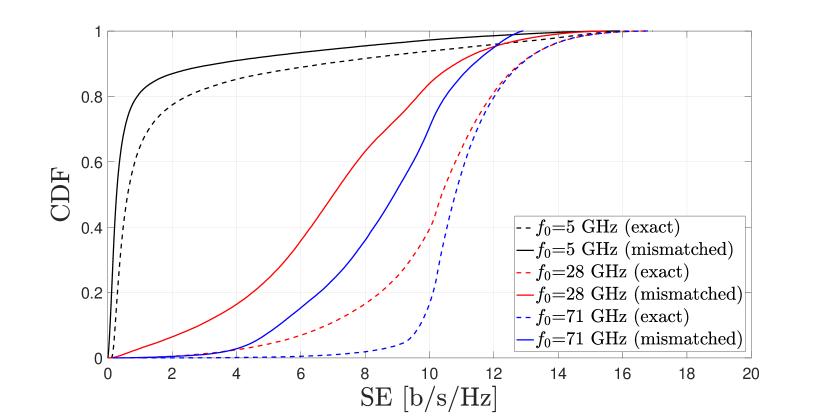
- Comparing spectral efficiency (SE) performance using both the exact spherical wavefront model and the mismatched far-field (plane wave) model.
- Simulating a single-cell MU-MIMO system with randomly distributed UEs in a sector, varying carrier frequency (5–71 GHz), cell radius (up to 230 m), and number of UEs (50–150).
- Evaluating performance via cumulative distribution functions (CDFs) of SE and average SE per UE to assess fairness and scalability.

Experimental results
Research questions
- RQ1How does the far-field approximation affect spectral efficiency in high-frequency MU-MIMO systems with electrically large arrays?
- RQ2To what extent do spherical wavefronts improve interference suppression and spatial multiplexing capability compared to plane wave models?
- RQ3Can MMSE combining based on the exact near-field model achieve higher spectral efficiency and fairness than MR combining in the radiative near-field?
- RQ4What is the maximum number of UEs per km² that can be supported with near-field-aware MMSE combining while maintaining high spectral efficiency and fairness?
- RQ5How does the performance gap between exact and mismatched models scale with frequency, array size, and user density?
Key findings
- Using the exact spherical wavefront model with MMSE combining increases spectral efficiency by a significant margin compared to the mismatched far-field model, especially at 28 GHz and 71 GHz.
- The CDF of SE with MMSE combining based on the exact model shows steeper decay, indicating better fairness across user equipment positions, even at high user densities.
- MMSE combining with the exact model maintains nearly constant average SE per UE up to K=100 UEs, supporting a user density of approximately 1500 UEs/km² per channel use, meeting 5G requirements.
- The performance gap between exact and mismatched models is most pronounced at higher frequencies (e.g., 71 GHz) and in smaller cells (R ≤ 50 m), where wavefront curvature is significant.
- MR combining shows minimal difference between exact and mismatched models, confirming its suboptimality in the near-field regime due to poor interference suppression.
- The results demonstrate that near-field-aware MMSE combining enables scalable, high-capacity MU-MIMO systems in mmWave and sub-THz bands, making it a strong candidate for 6G and beyond.
Read this paper
Open the full text in the Nubint reader and ask about any passage as you read.
Read this paper on NubintThis review was generated by AI from the original paper. Please check the paper before citing it.